
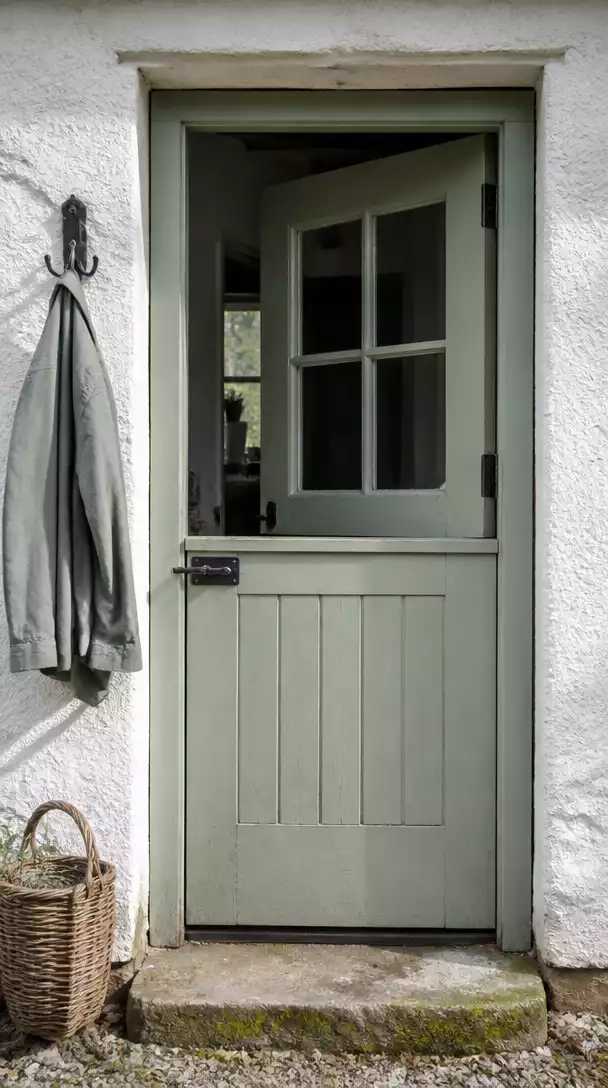
Cottage front doors often tip into theme-park territory with too much fuss and staged perfection. The best cottage doors borrow from farmhouses, English row houses, and old garden gates — not Pinterest mood boards. Here are 10 door ideas defined by classic shapes, soft heritage colors, and simple traditional construction.
Dutch Door
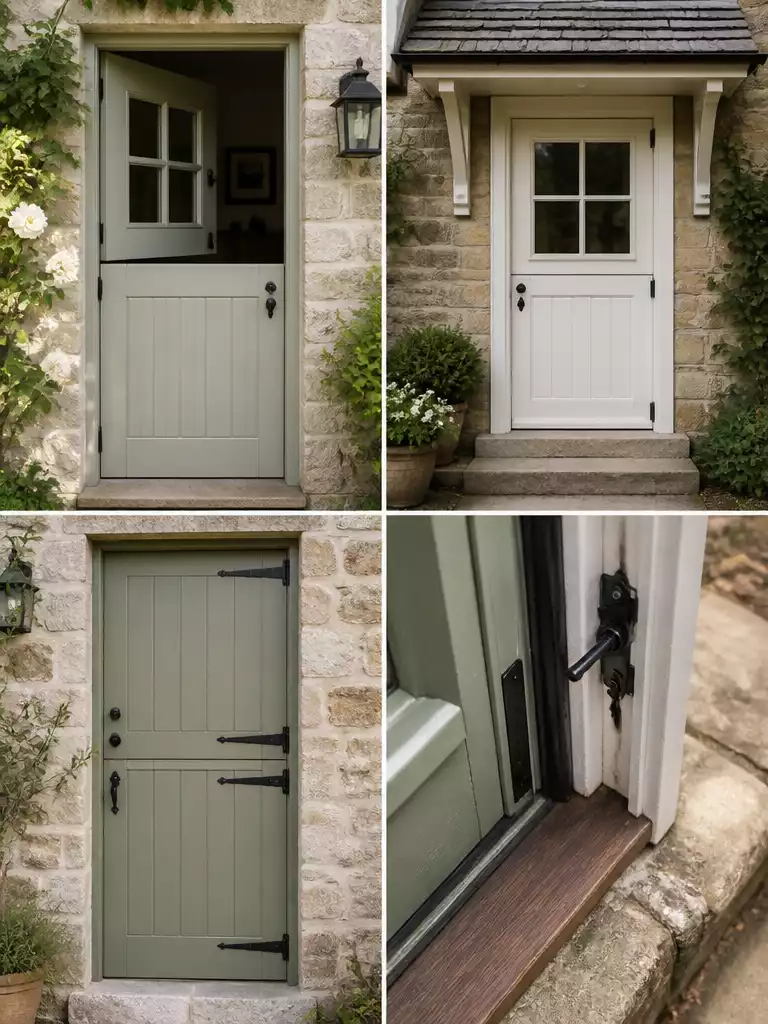
A Dutch door opens your entry to the world without surrendering it completely.
As an Amazon Associate I earn from qualifying purchases. Affiliate links may earn me a commission at no extra cost to you.
The Only Door on This List That Changes How You Use Your Entry: A Dutch door’s top half swings open independently — you can talk to a neighbor, let in a cross-breeze, or watch a child in the front yard without unlocking the whole entry. That function is what separates it from every other door here. The 60/40 panel proportion is what separates it from a barn conversion: the top panel is taller than the bottom, sitting at roughly 40 inches from the floor, so it reads as a proper front door rather than a livestock gate.
The one structural vulnerability worth naming honestly: on a fully exposed entry with no overhead cover, the lower panel catches driving rain at the horizontal seam between the two halves. Dutch doors work hardest on cottages with a shallow covered stoop or a small porch overhang, where the open top half still stays protected. If your entry is fully exposed and faces prevailing weather, this door will ask more maintenance from you than a standard door will.
The meeting-rail seam — where the two panels meet at mid-door — is where most Dutch door drafts originate. It’s not a design flaw; it’s a maintenance point. A top-to-bottom barrel bolt that locks both panels together in winter, combined with a compression gasket at the meeting rail, eliminates most of it. If you’re retrofitting a Dutch door into an older frame, the seam and the floor threshold are the two gaps most likely to let in drafts — and they need different solutions.
If the seam is your concern, the Huge Gap Door Draft Stopper is the right starting point — it’s specifically engineered for large, irregular gaps, which is exactly what a Dutch door meeting rail produces. Most draft stoppers are built for the standard floor threshold; this one handles the wider mid-door seam that a Dutch door creates. For the floor threshold on the lower panel, the Aluminum Door Sweep with Vinyl Seal covers that second gap — together they address both draft entry points.
If your concern is the top panel catching wind and banging back against the house when left open, Self Closing Hinges for Doors with adjustable spring tension solve that — the top half returns to closed position without manual latching every time. Different problem, different moment in the project.
This door is right for anyone who has wanted more connection between inside and outside without installing a screen door — particularly on a cottage with a shallow covered stoop. Skip it if your entry is fully exposed with no overhead cover and you’re not prepared for the threshold seam to need attention after heavy rain. And keep the top panel simple: plain painted wood or a two-over-two divided light window. No decorative glass needed here. The split does all the work.
—
Top Products for Dutch Doors

⭐ Editor’s Pick
★★★★½ 4.5 / 5
Specifically engineered for large, irregular gaps — exactly what a Dutch door meeting-rail seam produces. Most draft stoppers are built for the standard floor threshold; this one handles the wider mid-door gap that a Dutch door creates.
Key features: Fix huge gap | Durable premium material | Multifunctional

★★★★☆ 4.0 / 5
For entries that catch prevailing wind, the top half of a Dutch door can bang or drift when left open. Adjustable spring tension keeps the top panel returning to closed reliably — no manual latching every time.
Key features: Adjustable spring hinges | Quiet auto close action | Heavy duty

Aluminum Door Sweep with Vinyl Seal
★★★★☆ 4.0 / 5
Handles the floor threshold on the lower panel — the second draft entry point specific to Dutch doors, separate from the meeting-rail seam. Common in older cottage homes where floors have settled unevenly and the door bottom no longer sits flush.
Key features: Superior draft protection | Energy-saving design | Easy installation
⭐ Top Products for Dutch Doors
Huge Gap Door Draft Stopper
Self Closing Hinges for Doors
Aluminum Door Sweep with Vinyl Seal
📋 What to Check First Before Installing a Dutch Door:
- Overhead Protection: Confirm your entry has a shallow porch or stoop to shield the lower panel when the top half is open.
- Panel Proportions: Measure that the horizontal split sits about 40 inches from the floor with a taller top panel for cottage scale.
- Draft Points: Inspect the meeting rail and floor threshold gaps to plan for sealing products and winter bolting mechanisms.
Arched Top Door
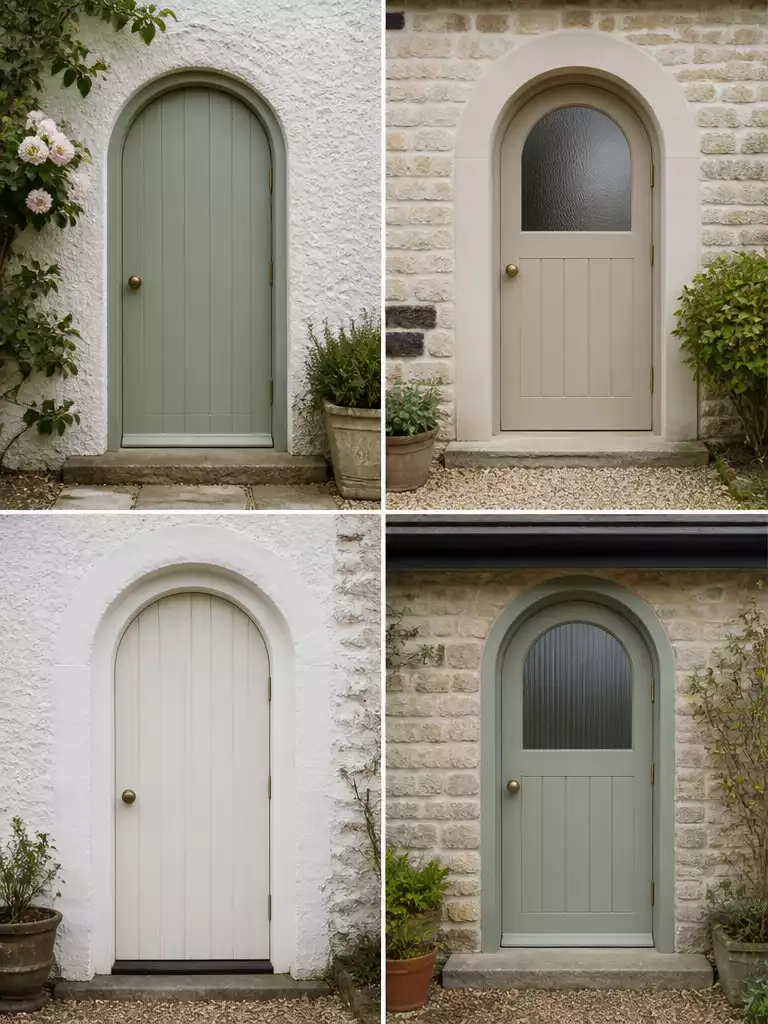
A gently curved top gives a cottage entry its whole character without a single added detail.
Skip This Door If You Already Have Heavy Pediments or Pilasters: A true cottage arched top door earns its character from one thing: the segmental arch — a wide, shallow curve that begins at roughly the top third of the door, not a pointed Gothic peak and not a full semicircle. The radius is wide enough that the door looks gently rounded rather than dramatically vaulted. That single geometry is what separates a cottage entry from a Mediterranean villa or a Tudor revival. If the arch comes to any kind of point, it’s reading a completely different aesthetic.
The most common mistake around an arched door isn’t the door itself — it’s the surround. Adding pilasters, a heavy broken pediment, or ornate casing around a segmental arch competes directly with the shape that’s doing all the work. The arch provides everything the entry needs visually. Flat casing, painted the same color as the door frame, is the correct treatment — nothing more. A homeowner who has been looking at arched doors and finding some feel right and others feel overwrought will recognize this problem immediately once they know to look for it.
There’s also a practical problem specific to this door that almost no one thinks about at the specification stage: the curved top glass panel. Standard rectangular window films, curtains, and privacy solutions don’t fit it. That uncovered triangle of glass at the arch’s peak becomes a clear view into the entry hall at night with interior lights on — and it’s where afternoon sun drives heat gain most aggressively on a south- or west-facing entry. Two products address this directly. The Front Door & Window Curtains are the stronger solution for UV and heat control across the full glass panel — thermally insulated, wrinkle-free fabric that hangs without fuss and handles the larger glass area that an arched door typically carries.
Recommended for Arched Top Doors
Thermal insulated lining blocks UV and reduces heat gain through the arched glass panel — the standout practical feature for a door style where the glass area is larger than standard. Wrinkle-free fabric holds its shape through repeated door use, and installation requires no drilling into the arch frame.
Key Features: Effortless installation | Thermal insulated | Wrinkle-free fabric
Perfect For: Arched top doors with a large glass panel in a south- or west-facing entry where afternoon sun heats the foyer
Where the Editor’s Pick covers the full panel with fabric, this vinyl film applies directly to the glass and can be cut to follow the arch’s curve — making it the more precise solution for the curved top section specifically. It adds visual pattern rather than covering the glass entirely, preserving light while adding daytime privacy. The better choice for a door facing a pavement or street where you want the glass to remain visually open from outside.
Key Features: Easy DIY install | Durable & family-safe | UV blocking
Perfect For: Homeowners who want to maintain the visual openness of the arched glass panel while adding daytime privacy
The arched top door is right for a flat-face facade with no surrounding ornament — it’s the one door on this list where the shape alone is enough and adding anything else is subtractive, not additive. Skip it if your entry already has strong architectural framing: a heavy stone surround, decorative pilasters, or a pronounced keystone will fight the arch rather than frame it, and the result reads busy rather than considered.
⭐ Top Products for Dutch Doors
Huge Gap Door Draft Stopper
Self Closing Hinges for Doors
📋 What to Check First for an Arched Top Door:
- Arch Integration: Confirm the curve starts at or above the door’s shoulder height for an authentic segmental arch.
- Trim Simplicity: Ensure your existing facade has flat casing with no heavy pilasters or pediments around the door.
- Glass Treatment Fit: Measure the arched glass panel carefully to select curtains or film that match the curved shape precisely.
Arched Plank and Batten Door
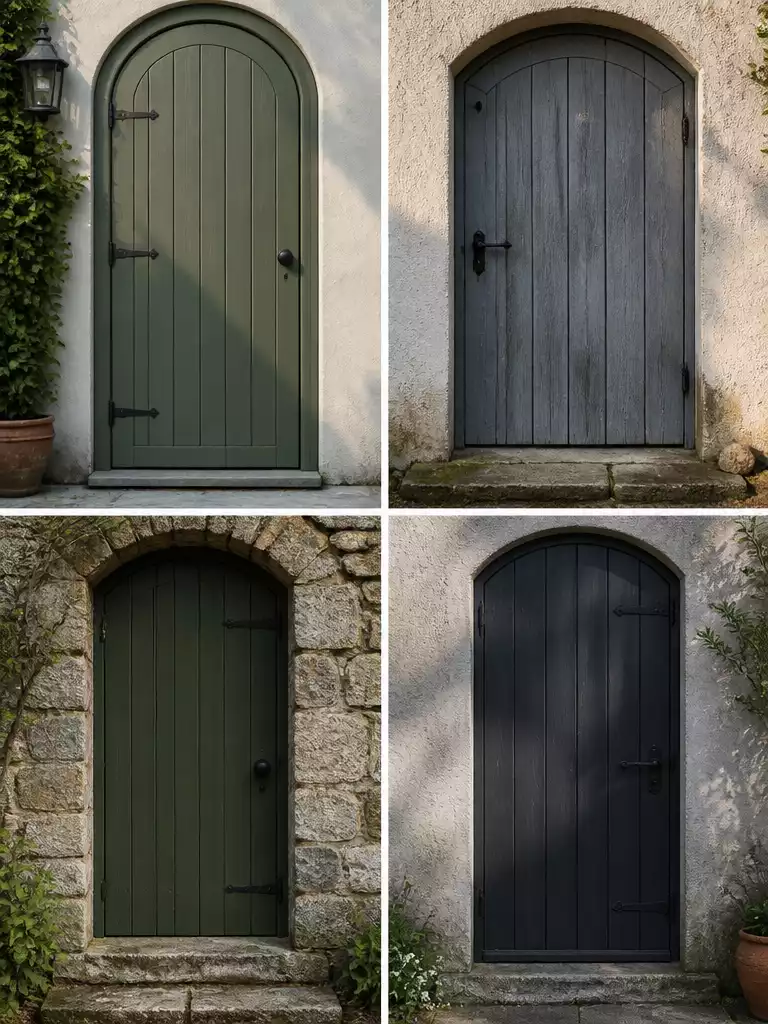
A flat face and a single carved arch — the handmade quality no panel door can replicate.
No Glass, No Moulding, No Panels — Just the Arch Cut From the Wood Itself: This is the only door on this list with no glass, no moulding, and no panel detail — vertical planks, typically 3–5 inches wide, running the full door height, held together by two or three horizontal battens on the back plus a diagonal brace to prevent racking. The face is completely flat. The only decoration is the arch, and that arch is cut directly from the top of the planks themselves — not a separate header piece applied on top. That distinction is what gives it a handmade quality. You can see the wood grain end-cut at the curve of each plank, and no two are identical.
The arch on this door is a shallow segmental curve — the same wide, gentle arc described in item 2 — but here it lives in the end-grain of the wood, not in a separate arched surround. When painted, the plank seams read through the finish as fine lines; in flat or eggshell paint, this is what makes the door look like it has been painted six times over decades rather than finished yesterday. That texture is the point. Painted reads cottage; bare natural wood reads farmhouse or barn, so if your entry is a converted outbuilding, unpainted might work — but for a cottage front door, paint it.
The specific mistake to avoid: full-width decorative strap hinges that stretch nearly edge to edge. Real working strap hinges on historical plank doors were short — about 8–10 inches long — and positioned precisely at the batten locations, three hinges aligned with three battens. The oversized hinge that spans most of the door width is a theater prop. It signals that someone Googled “cottage door hardware” and ordered the most dramatic result. Skip it if authenticity matters to you. This door is right for a stone or rough-render cottage entry with a wide, low opening; it looks compressed and wrong in a tall narrow Victorian doorway, and it’s not the right choice if your entry has no sidelight or transom glass at all — a fully solid door on a dark entry hall will make the interior feel airless.
Our Picks for Plank and Batten Doors
Because the plank and batten door has no glass of its own, privacy products don’t apply to the door face. But most cottage entries with a solid plank door have a sidelight or a small window in the surrounding frame — and that glass needs handling without competing with the door’s plain face. These two options address that specific situation.
⭐ Editor’s Pick

Stained Glass Window Privacy Film
★★★★☆ 4.0
Enhances privacy with a beautiful stained glass effect.
Easy to install | Blocks UV rays | Durable vinyl
A plank door’s sidelight often has an irregular shape — especially when the surrounding frame is stone or arched. This film’s cuttable vinyl format lets you fit it precisely to non-standard glass geometry without leaving adhesive residue on the frame. It adds a stained glass visual effect rather than covering the glass entirely, so the sidelight still transmits light and balances the visual weight of a fully solid door face.
Alternative Pick

Self-Adhesive French Door Curtains
★★★★☆ 4.0
Light-filtering curtains for sliding glass doors.
Easy installation | Durable fabric | Adjustable tie-back
Where the Editor’s Pick applies directly to the glass and stays put, this curtain hangs over it — no adhesive residue, fully removable, and adjustable by season. For renters or homeowners who want to open the sidelight fully in summer and cover it in winter, the tie-back makes that practical. The light-filtering fabric also softens the contrast between a solid plank door face and a bare glass panel beside it, which can otherwise feel abrupt.
⭐ Top Products for Dutch Doors
Huge Gap Door Draft Stopper
Self Closing Hinges for Doors
Aluminum Door Sweep with Vinyl Seal
📋 What to Check First Before Choosing an Arched Plank and Batten Door:
- Door Opening Size: Confirm your entry’s width and height suit a wide, low door; tall narrow frames feel cramped.
- Hardware Scale: Ensure strap hinges are short and aligned with battens, avoiding oversized decorative hinges.
- Finish Preference: Decide if you prefer painted for cottage charm or natural wood for a farmhouse feel before ordering.
Stable Style Door
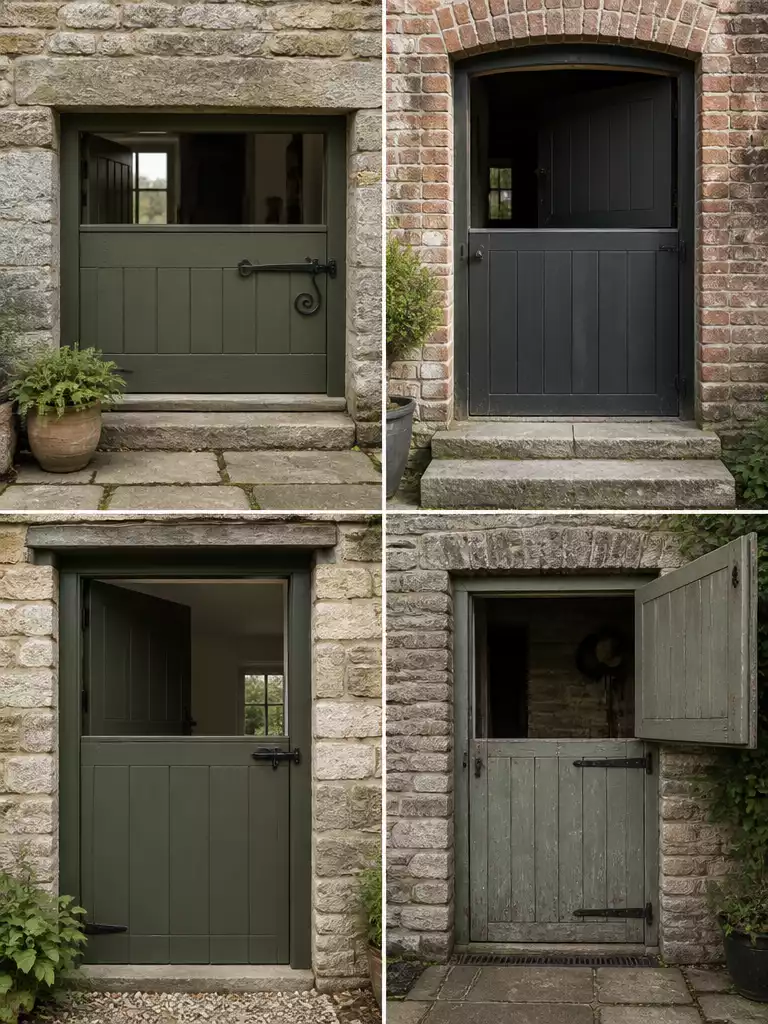
A door that earns its place through agricultural honesty, not cottage styling choices.
Right Entry for This Door Is Wide and Low — Not Tall and Narrow:
The Stable door looks like a Dutch door until you study the proportions. Where a cottage Dutch door splits at roughly 60/40 — taller top, shorter bottom — the Stable door uses an equal 50/50 split because it comes from agricultural stock, not residential design. That wider, lower silhouette reads honest in a broad bungalow porch or a converted outbuilding entry. Put it in a tall Victorian doorway and it looks compressed and wrong.
The hardware is what separates a Stable door from every other split door on this list. It uses a monkey tail bolt — a curved iron rod that drops into a floor socket — to hold the lower half independently open or locked. This is a functional mechanism with a specific name and a specific look: the curved tail sits in a simple bracket on the lower panel face, and it reads immediately as working hardware rather than decorative iron. A homeowner who learns that term will use it when ordering. One who doesn’t will end up with a barrel bolt that belongs on a garden gate.
The sealing problem on a Stable door is worse than on a Dutch door because the equal-height panels meet at exactly mid-door — right where wind pressure differential is strongest. That meeting rail needs compression seals on both faces, not just one side. The Aluminum Door Sweep with Vinyl Seal handles the floor threshold, where a heavy lower panel on an older cottage floor that has settled unevenly will leave a gap no fabric stopper can bridge. For the meeting rail itself — the horizontal seam between the two equal panels — the Huge Gap Door Draft Stopper addresses what standard seals miss: the wider-than-normal gap that a 50/50 split creates compared to a residential door seam.
Best Products for Stable Style Doors
Aluminum Door Sweep with Vinyl Seal Editor’s Pick
★★★★☆ 4.0
Insulates and protects against drafts and moisture at the floor threshold — the primary sealing challenge on a heavy Stable door lower panel.
Key features: Superior draft protection | Energy-saving | Durable construction
Perfect for: Stable doors with a heavy lower panel where the floor threshold gap is uneven due to panel weight or floor settling — common in converted agricultural buildings.
Huge Gap Door Draft Stopper
★★★★½ 4.5
Seals the meeting-rail seam between the two equal panels — the horizontal gap that standard door seals are not designed to handle.
Key features: Fix huge gap | Durable material | Multifunctional
Perfect for: Homeowners whose Stable door meeting rail has a visible gap when both panels are closed — particularly in older cottage frames where the panels have shifted over time.
Skip the Stable door entirely if your entry is a tall, narrow Victorian opening — the compressed proportions will read as a mistake, not a choice. It belongs on a wide, low facade: a stone bungalow, a converted outbuilding, a cottage with a broad horizontal face. If that’s your entry, the monkey tail bolt and the 50/50 split will read as exactly right — not styled, just honest.
⭐ Top Products for Dutch Doors
Aluminum Door Sweep with Vinyl Seal
Huge Gap Door Draft Stopper
📋 What to Check First for Stable Style Doors:
- Opening dimensions: Confirm your entryway width and height suit a wide, low door rather than a tall, narrow frame.
- Monkey tail bolt fit: Measure floor clearance to ensure the curved bolt can securely drop into the socket without obstruction.
- Seal compatibility: Check that compression seals fit both faces of the mid-door seam for effective weatherproofing on 50/50 split panels.
Approaching the midpoint can feel like the moment where enthusiasm meets detail. Every thoughtful choice shapes the charm of a cottage door, and subtle details often make the biggest difference. This is about embracing a gentle, authentic style rather than chasing perfection.
✨ Keep This in Mind:
- Opt for finishes with texture that feel lived-in, like those discussed in traditional front door ideas.
- Choose hardware that fits the door’s scale to maintain its understated presence.
- Less is more when accessorizing—each addition should support, not compete with, the door’s storybook appeal.
- Colors that echo the landscape create a sense of belonging and history.
Top Half Glass Door
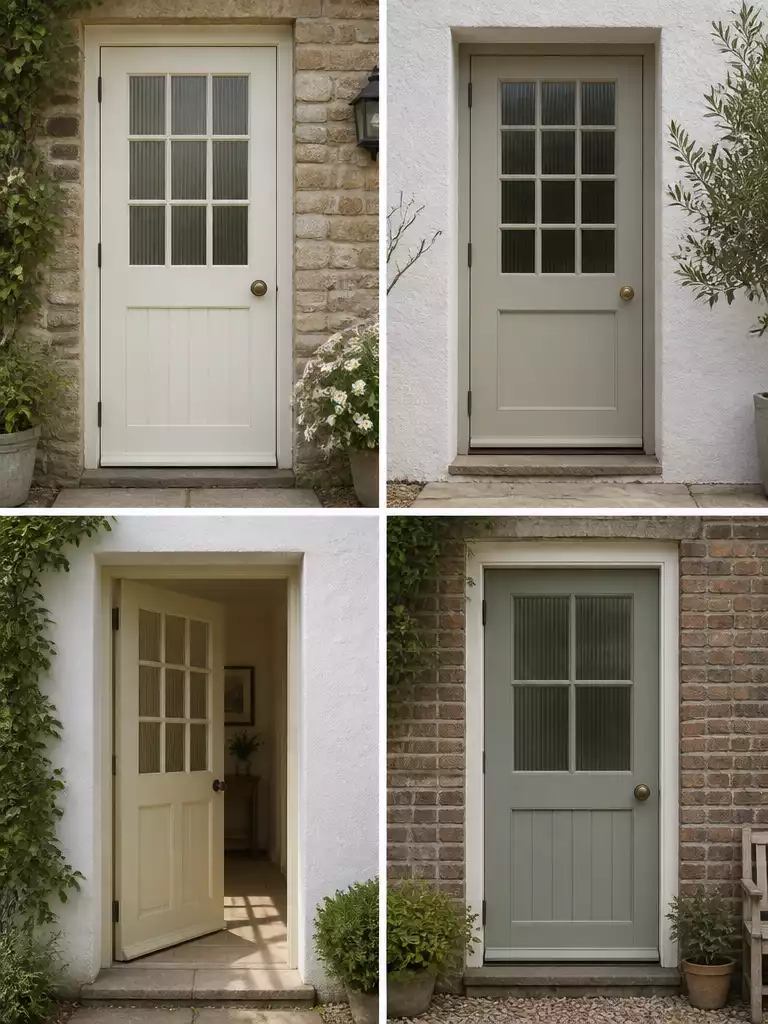
Natural light floods the entry hall without changing how the door reads from the street.
The Glass Grid Specification That Separates Cottage From Contemporary:
A top-half glass door solves the dark cottage entry hall problem — low ceilings, small windows, heavy beams all conspire against that first interior space. The fix isn’t a skylight or a side window; it’s a column of divided light directly in the door. Specify a 4-over-4 or 6-over-6 grid with painted wood glazing bars about 1 inch wide. Thin aluminum bars read modern. A single large glass sheet in the top half reads contemporary. Those two specifications — pane count and bar width — are the entire difference between a cottage door and a renovation mistake.
The glass type is the decision most buyers skip, and it’s the one that matters most at night. Clear panes in the top half work fine at noon. At 9pm with the entry light on, they become a direct view into your hall from the street. Reeded glass — also called fluted glass, with parallel vertical ridges pressed into the surface — transmits nearly as much light as clear glass while blocking the view in both directions at all hours. It’s the historical choice for cottage doors, and it reads as original rather than frosted-for-privacy because it genuinely is original. Ask for it by name when ordering; most door suppliers carry it but don’t lead with it.
Skip this door if your entry hall already gets good light from a sidelight or a generous fanlight above — adding a glass-panel door to an already-bright entry solves nothing and introduces the nighttime exposure problem for no gain. It’s the right door for a cottage with a single solid entry on a north-facing wall where the hall is genuinely dark by mid-morning. One practical companion worth noting: a glass-fronted door on a pedestrian street makes the entry more visible and more approachable, which means more door-to-door interruptions than a solid door attracts. The No Soliciting Sign for House (★★★★½) handles that directly — laser-engraved rather than printed, so it holds up against weather without fading against a pale door finish.
⭐ Top Products for Dutch Doors
Huge Gap Door Draft Stopper
📋 What to Check First Before Choosing a Top Half Glass Door:
- Entry Hall Light: Confirm your interior feels dark mid-morning to ensure the glass adds needed brightness.
- Privacy Needs: Evaluate if reeded glass or privacy film is necessary to prevent nighttime exposure from street view.
- Facade Style: Make sure the door’s divided light grid aligns with your home’s heritage style rather than a modern look.
Diamond Pane Glass Door
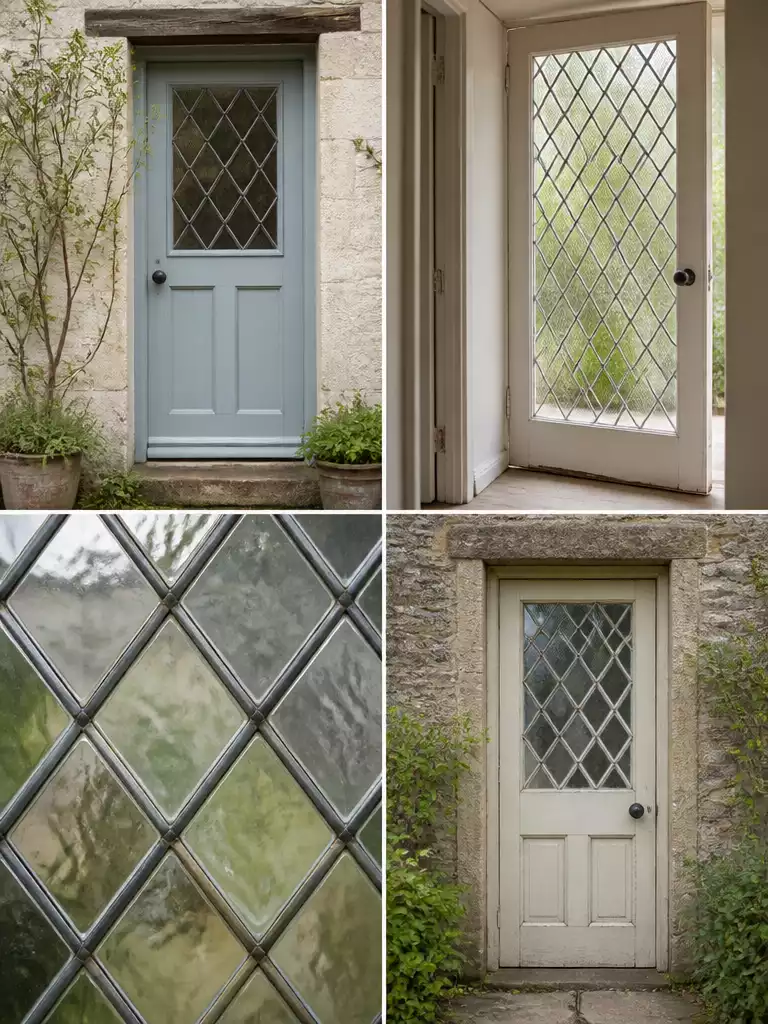
Five hundred years of domestic glazing history, alive in every small pane that catches the light differently.
Panes Over 8 Inches Across Kill the Effect Entirely:
Diamond pane glazing is the oldest surviving window pattern in domestic English architecture — continuous from the Tudor period through the Arts and Crafts movement — and when it appears on a cottage door, it isn’t decoration. Each diamond should measure 4–6 inches across its widest point, set in metal came (the H-section lead or zinc strips holding each pane). At that scale, adjacent panes catch light at slightly different angles, producing the characteristic shimmer that no printed film replicates. Scale up to 8 inches or more and the pattern reads as a design choice rather than a historical reference. That shimmer disappears. So does the authenticity.
The came lines are what create the pattern — the glass itself is almost always clear or very lightly tinted. A door’s glass section needs to be proportioned so complete diamonds fill the grid without being cut off at the borders; a half-diamond at the edge looks unfinished and is the most common error in modern reproductions. A section 12 inches wide and 18 inches tall accommodates a complete grid of 4-inch diamonds. Wider or taller sections need the arithmetic redone before ordering.
On maintenance: came glazing — whether lead or zinc — expands and contracts with temperature, and over decades the panes can develop a slight bow or the came can loosen. This is not a flaw. It’s what real antique diamond glazing looks like. The mistake is trying to prevent movement by specifying rigid resin came instead of metal. Resin cracks rather than flexing, and it reads as fake immediately. Accept the movement; it’s the material aging honestly. Skip this door if you want something that looks factory-perfect in ten years — diamond pane glazing is right for homeowners who understand that the slight irregularity that develops over time is exactly what makes it worth having.
Best Options for Diamond Pane Glass Doors
⭐ Editor’s Pick
Glass Door Pivot Hinge for Glass Doors
★★★★½ | Editorial Score: 4.5
Diamond pane glass panels are heavier than standard solid inserts — the came and multiple individual glass pieces add significant cumulative weight that standard butt hinges may not distribute evenly over time. A pivot hinge designed specifically for glass doors handles that weight correctly from the start. The polished chrome finish is period-neutral enough to sit alongside historic glazing without competing with it.
Key Features: Easy installation | Secure glass hold | Polished chrome finish
Front Door & Window Curtains
★★★★½ | Editorial Score: 4.5
Diamond pane glass is clear or lightly tinted — it doesn’t obscure views, and on a south- or west-facing entry the multiple small panes transmit heat into the entry hall through the afternoon. A thermal curtain on the interior side provides nighttime privacy and reduces that heat gain without touching the exterior glazing pattern. Different problem from the hinge, different moment in the day.
Key Features: Effortless installation | Thermal insulated | Durable
⭐ Top Products for Dutch Doors
Huge Gap Door Draft Stopper
Self Closing Hinges for Doors
📋 What to Check First Before Choosing Diamond Pane Glass:
- Glass Section Size: Confirm the glass panel fits whole 4–6 inch diamond panes without cutting any off at edges.
- Came Material: Verify the came is metal (lead or zinc), not resin, to ensure long-term flexibility and authenticity.
- Weight Support: Check the door frame and hinges can handle heavier glass panels with multiple panes and came work.
Leaded Glass
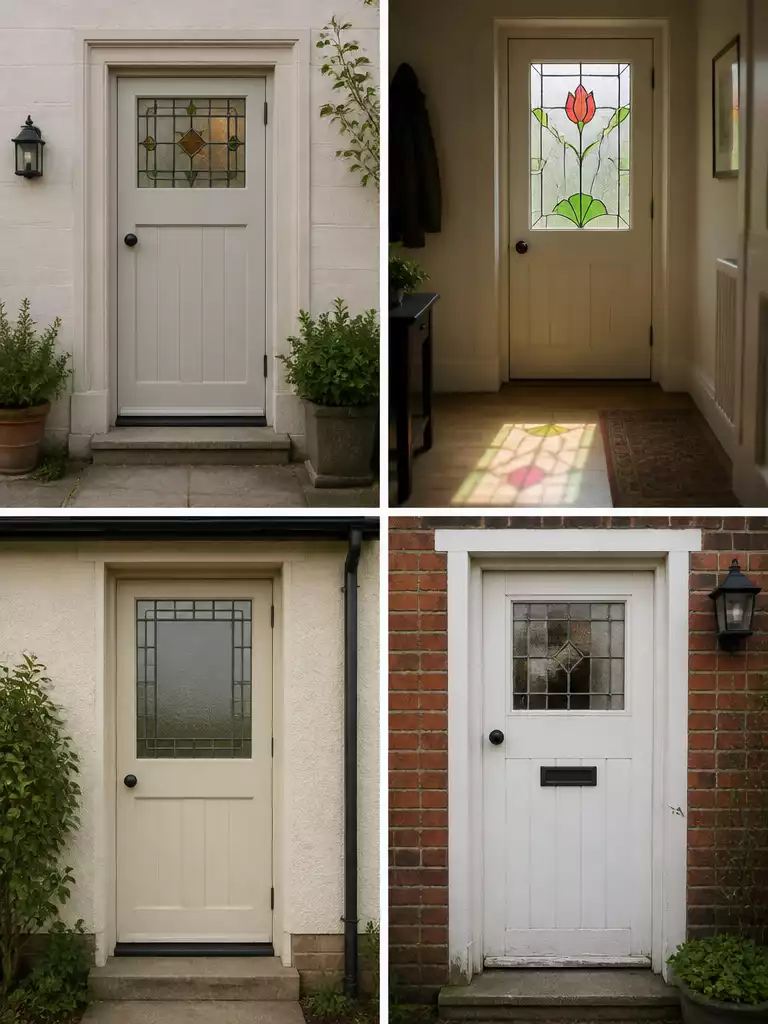
Hand-worked came lines that cast amber and sage light into your entry hall each morning.
More than 30% colored glass and it reads as a church, not a cottage: Diamond pane glass (item 6) uses came to repeat a grid. Leaded glass uses came to build a composition — a specific pattern made once for that one door. The Arts and Crafts period (1880s–1920s) produced the designs that read as cottage: simple geometric borders in amber, pale green, or soft blue, with clear glass filling the majority of the panel. Keep colored panes below 30% of the total panel area. Go beyond that and the door stops reading as cottage and starts reading as Victorian Gothic or ecclesiastical.
A leaded glass panel isn’t a stock item — it’s either custom-commissioned from a glazier or sourced as an antique panel with the door built around its dimensions. The antique route is slower, but it produces the most convincing result because the glass itself is genuinely old, with the slight variations in thickness and tint that no new reproduction replicates. The custom route gives you control over dimensions and composition, but ask the glazier for at least one element that isn’t perfectly mirrored — a motif that sits slightly off-center, a border that doesn’t match exactly on both sides. A perfectly symmetrical leaded panel reads as manufactured. A slightly asymmetrical one reads as made by hand, which is exactly what it should be.
Skip leaded glass entirely if your entry faces west and you have no interior curtain or blind — colored came-work in direct afternoon sun fades upholstery and timber floors within a few years. This door is right for a homeowner who is prepared to treat the panel as an investment: a quality custom leaded panel runs several hundred dollars minimum, and an antique period panel in good condition costs more. The pivot hinge below is the structural companion that protects that investment; the thermal curtain addresses the UV and nighttime privacy side without touching the exterior panel at all.
—
Top Picks for Leaded Glass Doors
Glass Door Pivot Hinge for Glass Doors
★★★★½ | Editorial Score: 4.5
A custom or antique leaded glass panel is heavier than a standard door insert — the came adds significant weight, and antique panels often use thicker glass than modern stock. This hinge is designed specifically for glass-door weight distribution, protecting the panel from the stress that an undersized standard hinge creates over time. Polished chrome finish is period-neutral enough to sit alongside Arts and Crafts came-work without competing.
Key Features: Easy installation | Polished chrome finish | Durable
Front Door & Window Curtains
★★★★½ | Editorial Score: 4.5
Where the pivot hinge solves the structural problem, this curtain solves the interior UV and privacy problem. A leaded panel with any colored glass transmits tinted light into the entry hall — which is beautiful in the morning but causes UV exposure to flooring and furniture positioned near the door. A thermal curtain on the interior side handles both concerns without altering the exterior panel’s appearance from the street.
Key Features: Effortless installation | Thermal insulated | Durable
⭐ Top Products for Dutch Doors
Huge Gap Door Draft Stopper
Self Closing Hinges for Doors
Aluminum Door Sweep with Vinyl Seal
📋 What to Check First Before Choosing Leaded Glass:
- Panel Proportions: Confirm the glass panel size fits whole motifs without awkward cut-offs or overlarge colored sections.
- Sun Exposure: Assess if the door faces direct afternoon sun to plan for UV protection inside with curtains or films.
- Design Symmetry: Decide if you prefer slight asymmetry for authentic hand-crafted feel versus a perfectly mirrored pattern.
Half Round Window Door
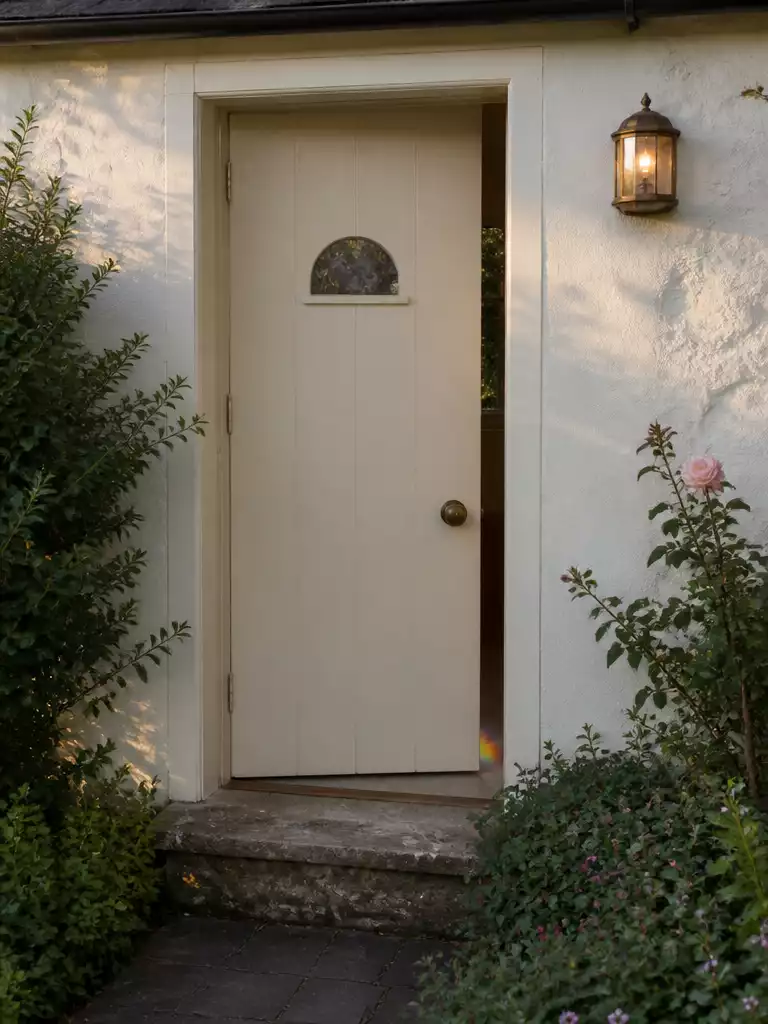
A single beveled semicircle that turns morning light into something worth walking toward.
Keep It Under 12 Inches or It Stops Being a Cottage Detail: The half-round window that reads as cottage lives in the door panel itself — not in the transom space above the door, which is a fanlight and a different architectural element entirely. At 8–12 inches in diameter, positioned centrally in the upper third of the door, it provides outward visibility from inside without creating an inward sightline from the path — the viewing angle is simply too steep for someone standing at ground level to see through. Once it grows past 14 inches, the character shifts. It stops reading as a quiet cottage detail and starts reading Federal or Colonial Revival.
The glass type is the decision most people get wrong here. Clear glass in a half-round window gives you nothing — it’s a circle of outdoor view that anyone can see through from both sides at close range. Beveled glass is the historical choice: a thick edge ground at an angle that refracts direct light into a small spectrum on the interior wall or floor. This isn’t a decorative effect someone invented — it’s what beveled glass does in morning light, and cottage owners have always known it. If your entry faces east and you install a beveled half-round, you’ll see a small rainbow on the hall floor every clear morning. That’s the functional argument for specifying it over frosted or reeded glass in this specific application.
This door is wrong for anyone who wants a glass element they can dress or cover seasonally — the half-round is fixed, non-opening, and too small for any standard privacy film or curtain to address. No product on this list applies here, and that’s the honest answer: the door does the work on its own. It’s right for a homeowner with a solid entry that already works but feels closed-off, who wants one quiet detail that catches the light without changing the door’s silhouette from the street.
⭐ Top Products for Dutch Doors
Huge Gap Door Draft Stopper
Self Closing Hinges for Doors
Aluminum Door Sweep with Vinyl Seal
📋 What to Check First Before Choosing a Half-Round Window Door:
- Door Height and Panel Size: Confirm your door’s upper third can fit an 8–12 inch semicircle without crowding or imbalance.
- Lighting Direction: Ensure your entry faces east or a direction that receives direct morning light to see the beveled glass rainbow effect.
- Privacy Needs: Evaluate if a fixed, small half-round window meets your privacy standards since it cannot be covered or opened.
Soft Sage
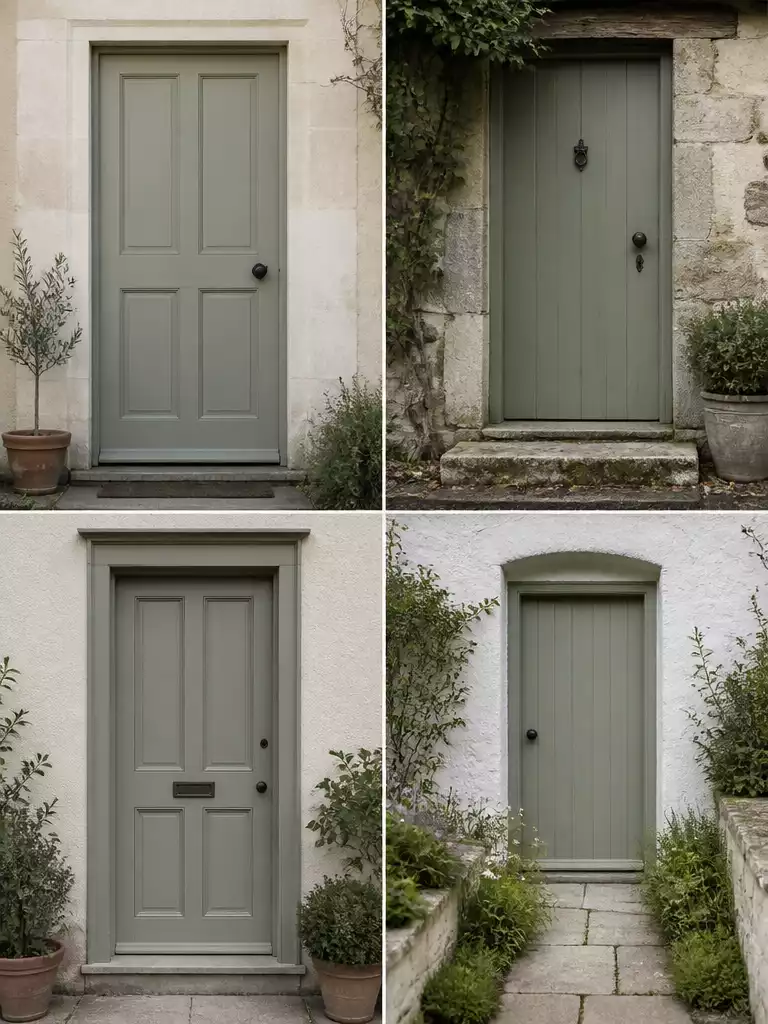
A door color that looks inherited rather than chosen, in any light.
Sage Isn’t Green — the Grey Undertone Is Everything: Soft sage reads authentic on a cottage door because it already exists in the materials around it — the grey-green of weathered slate, lichen on limestone, aged copper guttering. A door painted in a color that already lives in the building looks like it belongs to the house rather than being applied to it. Three paint references with the right grey undertone: Farrow & Ball Mizzle No. 266, Little Greene Sage (mid-tone), or Benjamin Moore HC-114 Gloucester Sage. In a dead flat or eggshell finish — not gloss — the grey comes forward and the green recedes, which is what gives sage its depth at distance. Gloss finish makes the same color look like a design choice. Flat finish makes it look like it has always been there.
Evaluate any two sage samples in overcast daylight, not direct sun. In sun, the green comes forward and the grey recedes — the door looks brighter and fresher than it will on the other 200 days of the year. Overcast light shows you the version you’ll actually live with, and it’s the version that separates a true grey-sage from a colour that’s just calling itself sage on the tin.
Skip this colour if you want a door that makes a statement — soft sage is specifically for homeowners who want their entry to feel like it was never decorated at all. It’s wrong for a glossy, high-contrast modern exterior. It’s right for pale render, aged brick, or natural limestone surrounds where the door needs to settle in rather than stand out. A flat finish will show dog scratches more visibly than gloss — the scratches catch light differently on a matte surface — which is where the Door Protector from Dog Scratching earns its place: a transparent panel on the lower third preserves the paint without altering what the door looks like from the path.
Recommended for Soft Sage Doors
⭐ Editor’s Pick
★★★★½ | Score: 4.5
A soft sage door in a flat finish is doing quiet, considered work. A laser-engraved, weather-resistant sign in a neutral material sits alongside a heritage-colored entry without competing — the crafted quality of the engraving matches the deliberate quality of the color choice, where a glossy plastic sign would not.
Key Features: Laser-engraved quality | Weather-resistant | Easy setup
Door Protector from Dog Scratching
★★★★☆ | Score: 4.0
Where the Editor’s Pick addresses the curb-appeal context, this addresses the maintenance reality. A flat or eggshell sage finish shows dog scratches more visibly than gloss — the marks catch light differently on a matte surface. A transparent panel on the lower door preserves the paint without changing the door’s appearance from the street.
Key Features: Easy to install | Transparent design | Durable
⭐ Top Products for Dutch Doors
Huge Gap Door Draft Stopper
Self Closing Hinges for Doors
📋 What to Check First for Soft Sage Doors:
- Color accuracy: View paint samples in overcast daylight, not direct sun, to confirm the true grey undertone.
- Finish type: Choose flat or eggshell finishes to keep the aged, inherited look rather than a glossy modern feel.
- Surface prep: Ensure the door surface is smooth yet textured enough to show subtle brush marks without gloss glare.
Buttery Cream
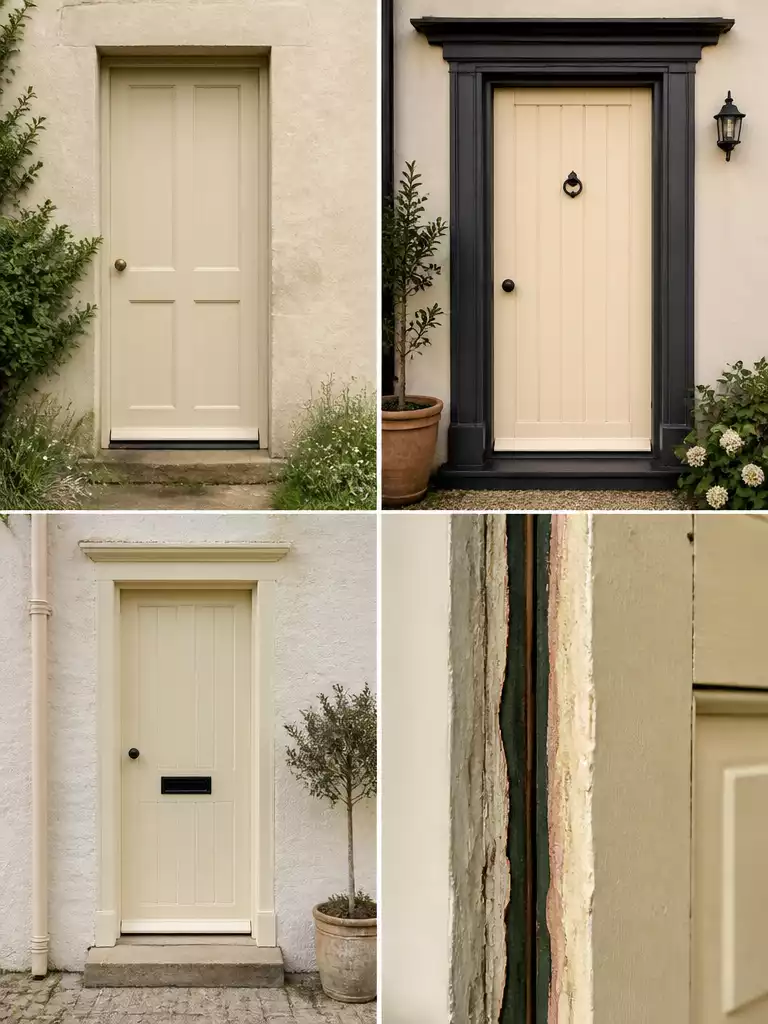
A warm cream door holds its color in any light — sun, shadow, or overcast grey.
White Goes Grey in Shadow. Cream Never Does:
Buttery cream has enough yellow in it that it reads warm even when the sun goes behind a cloud — which is the single most useful quality a pale door color can have. A white door looks bright in direct light and distinctly grey on an overcast afternoon. Buttery cream stays warm in both conditions, which is why it photographs consistently and why it reads as inherited rather than freshly chosen. Three paint references that get the yellow undertone right without tipping into “yellow door” territory: Farrow & Ball Cream No. 44, Little Greene Slaked Lime (mid-tone), and Benjamin Moore OC-14 Chantilly Lace — all carry enough ochre to hold warmth in shadow.
The trim relationship makes or breaks cream. Pair it against bright white casing and the door reads as off-white — like someone ran out of the right paint. Against the same cream (a fully monochromatic entry) or against a dark tone like charcoal or deep taupe, the warmth reads as a deliberate choice. That tonal contrast is what separates a cream door that looks considered from one that just looks faded. The paint buildup at the door’s edge — where multiple coats have accumulated over decades — is actually part of the effect; it’s evidence of a color that’s been lived with, not installed last spring.
Finish matters more than most homeowners expect with this color. A flat finish on buttery cream shows grey urban dust visibly — the yellow undertone makes particulate matter read clearly against it. Satin finish is the practical call: it reads soft and non-reflective from the street but wipes clean without leaving marks in the surface. Skip cream entirely if your entry faces a heavily trafficked pavement with no porch overhang — it will need repainting every two to three years rather than every five. Right for a homeowner who wants the most forgiving, light-consistent color on this list; wrong for anyone who won’t commit to the maintenance a pale warm surface requires.
Best Products for Buttery Cream Doors
⭐ Editor’s Pick
No Soliciting Sign for House
★★★★½ | Editorial Score: 4.5
A warm, welcoming cream door attracts more door-to-door attention than a dark or severe entry — the color signals approachability, which is exactly what you don’t always want. A laser-engraved sign in a neutral weather-resistant material sits alongside a heritage-colored door without competing with it. The engraved finish (not printed) matches the considered quality of the door choice and holds up without fading or peeling against the pale surface beside it.
Key Features: Laser-engraved quality | Weather-resistant | Easy setup
Perfect For: Homeowners with a cream cottage door in a neighborhood with foot traffic, where the warm, inviting color draws more unsolicited visits than a darker entry would.
⭐ Top Products for Dutch Doors
Huge Gap Door Draft Stopper
💡 Practical Tips That Work for Buttery Cream Doors:
- Finish Choice: Opt for a satin finish to balance warmth and ease of cleaning without excess shine or flat dullness.
- Trim Coordination: Match the door trim to the cream or choose a darker tone to keep the warmth intentional, not faded.
- Maintenance Plan: Schedule periodic gentle cleaning for the lower panels where handprints and traffic marks are most visible.
You now have ten thoughtful ways to bring genuine cottage charm to your front door through classic forms, subtle colors, and authentic glass details. Choose what feels achievable rather than trying to transform everything at once, letting your entry evolve naturally.
Each small, considered update invites your home to tell its own quiet story, making your cottage front door feel like a true reflection of heritage and comfort. For inspiration beyond entryways, discover more about beautiful villages in Cork and how local character can influence your design.