
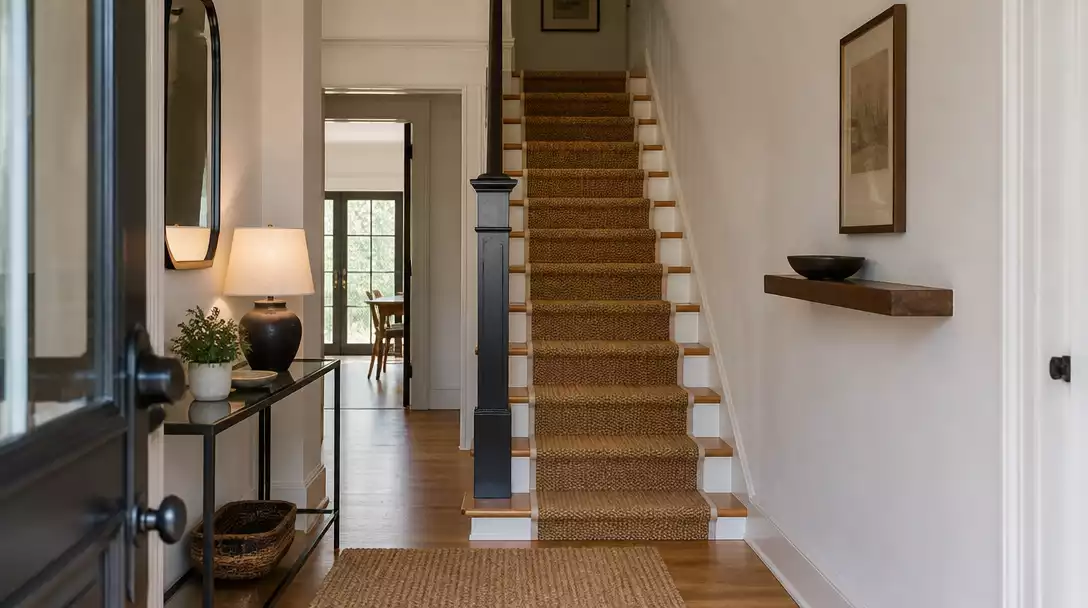
A front door that opens directly into a staircase often feels like a bottleneck, but these tight entryways can function perfectly with the right layout. This guide rounds up 10 practical design ideas worth saving to help you reclaim your space and start with the first, most effective upgrade.
A Runner Down the Stairs
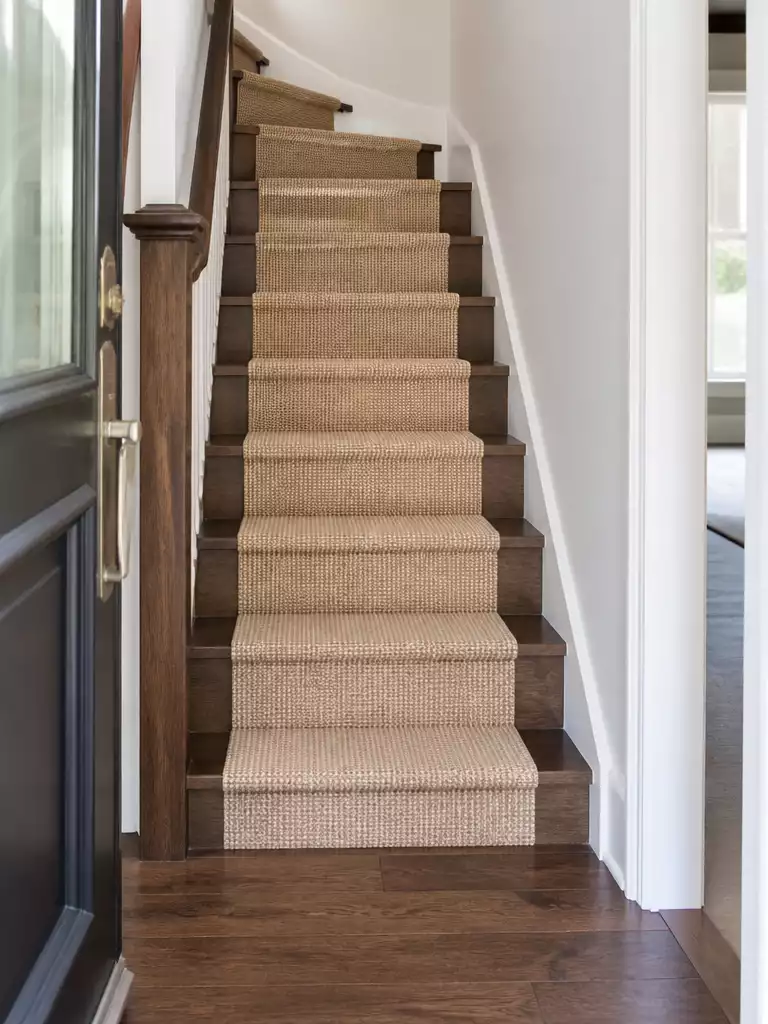
Anchor your entryway with a tailored runner to turn a transit zone into a design statement.
As an Amazon Associate I earn from qualifying purchases. Affiliate links may earn me a commission at no extra cost to you.
Bare wood stairs at the front door often feel like a long, unfinished tunnel the moment you step inside. A well-placed runner breaks that visual monotony, grounding the space while softening the sound of footsteps.
The key to a high-end finish is the tailored margin. Aim to leave 3 to 4 inches of exposed tread on both sides of the runner, which creates a finished look that feels intentional rather than like an afterthought.
Pro Tip: Measure for Geometry
A runner must follow the exact rise and tread depth of your stairs to prevent puckering at the creases. Always use a high-quality pad underneath so the runner stays flush against the nose of the step, preventing floating patterns that create a trip hazard.
For high-traffic entryways, your choice of fiber is the difference between a long-lasting upgrade and a cleaning nightmare. Stick to low-profile materials that won’t add unnecessary bulk to your already narrow stairwell.
Avoid thick pile rugs in these tight spaces, as they create a tripping hazard and add unnecessary visual weight. A flat-weave selection keeps the stairs looking streamlined and open, even in the smallest foyers.
⭐ Best Runners for Your Entryway Stairs
Boho Cotton Woven Entryway Area Rug
Striped Cotton Woven Indoor Porch Runner
Non-Slip Woven Cotton Entryway Throw Rug
💰 What This Really Costs:
- Labor investment: Professional installation typically ranges from $15 to $40+ per linear foot, depending on the complexity of your stair geometry.
- Hidden expense: Don’t overlook the cost of a high-quality rug pad, which is vital for preventing the runner from sliding or bunching.
- Value trade-off: Opting for professional install ensures the pattern aligns perfectly, which is the single biggest factor in achieving that high-end, finished look.
A Bold Newel Post
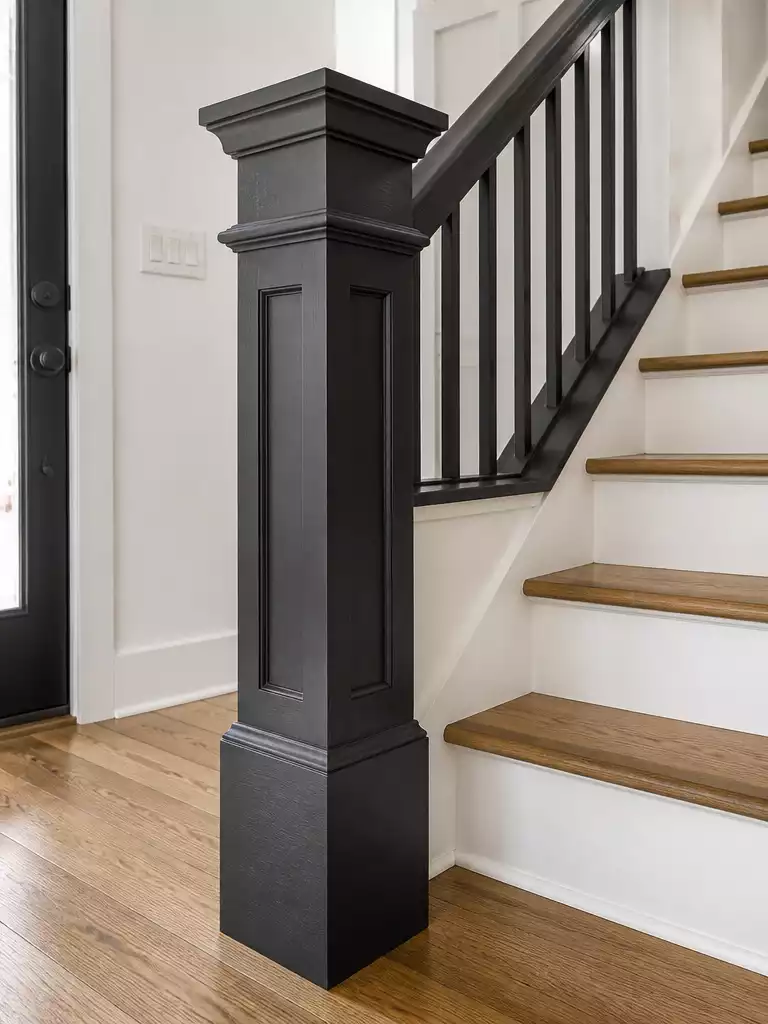
Define your entryway by turning the start of the stairs into a sophisticated architectural anchor.
Think of your newel post as the anchor for your entire foyer. It is often the very first thing guests touch when they step through your front door, making it a high-impact spot for a quick design refresh.
In a tight space, avoid heavy, ornate molding or bulky trim that makes the hallway feel smaller. Instead, look for a sleek, vertical post that draws the eye upward without blocking your sightline into the rest of the house.
Proportional Tip: If you are stuck with a standard, builder-grade post, you don’t need a full renovation to change its look.
Adding a simple, custom-profile cap or a fresh, high-contrast paint color can give it a bespoke feel for a fraction of the cost.
High-contrast finishes work best to define the stair’s starting point. A deep navy, charcoal, or even a matte black post against neutral walls creates a clear transition that separates the arrival zone from the circulation path.
Keep your finish clean and simple to avoid a cluttered look. If your trim is already busy, opt for a monochromatic approach to keep the area feeling open and intentional.
⭐ Standout Finials for Newel Posts
Decorative Turned Birch Wood Newel Finial
Steel Replacement Screw Posts for Handles
💡 Designer Note: Achieving Visual Balance
In a compact entry, the goal is to define the stair transition without creating a visual “stop sign.” If your foyer feels cramped, opt for a painted finish that mimics the wall color to keep the post from appearing too dominant, or choose a slim-profile metal cap to add clean, modern lines that don’t crowd the limited floor space.
When you first step through the door, the immediate visual impact often feels like a heavy weight to balance correctly. However, you don’t need a total overhaul to change how the space feels; focusing on entryway scale and layout is enough to bring clarity to the arrival zone.
<div style="background: #ffffff; border-radius: 8px; padding: 16px 20px; border: 1px solid #c27
Wall-Mounted Hooks and Ledge
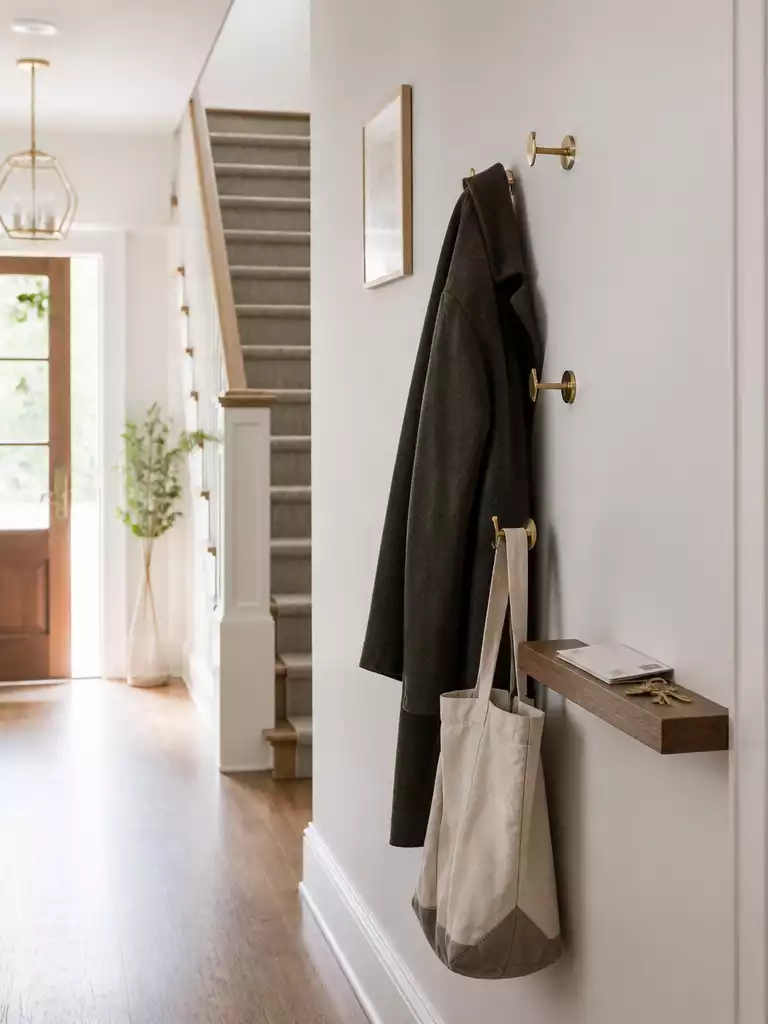
Reclaim your floor space by shifting daily clutter from the stairs to the wall.
Entryways with immediate staircases often suffer from the “dumping ground” syndrome where bags and coats migrate onto the first few steps. This creates a cluttered, unsafe bottleneck that shrinks your already tight footprint.
The solution is to embrace a shallow-depth storage strategy that keeps your circulation path completely clear. A narrow, 4-inch deep ledge is usually all you need to catch keys and mail without protruding into the walkway.
The Vertical Placement Rule
Stagger your hooks at varying heights to prevent a solid wall of fabric from feeling overwhelming. This allows you to accommodate longer coats alongside shorter items like tote bags or hats without creating a visual wall of bulk.
Unlike bulky mudroom benches or freestanding coat racks, this wall-mounted approach preserves your walking clearance. Use a rail system that matches your wall color to make the hardware essentially disappear when the hooks are empty.
- ✓ Prioritize Depth: Keep your ledge under 4 inches to avoid a “shin-bumping” hazard.
- ✓ Clear the Path: Ensure hooks are mounted high enough that coats don’t brush against the legs of anyone walking up the stairs.
- ✓ Material Choice: Opt for metal or wood hardware that complements your existing stair railing for a cohesive look.
Avoid the “Full Mudroom” Trap
Resist the urge to add large, boxy cabinetry or oversized storage cubbies in this zone. Small, narrow entryways function best when the wall remains visually light and the floor stays entirely open.
⭐ Wall Hooks and Ledges We Love
Slim Wooden Wall Shelf With Hooks
Clear Acrylic Floating Wall Ledge Shelf
Transparent Heavy Duty Adhesive Wall Hooks
📋 Quick Reality Check for Narrow Entryways:
- Swing clearance: Ensure your door swing does not collide with the ledge or any hung coats when fully open.
- Wall studs: Use a stud finder to anchor the ledge securely, as it will bear the weight of heavy winter bags.
- Hardware finish: Match your hook finish to existing stair railing balusters or door hinges to maintain a cohesive, high-end visual flow.
A Slim Console Against the Wall
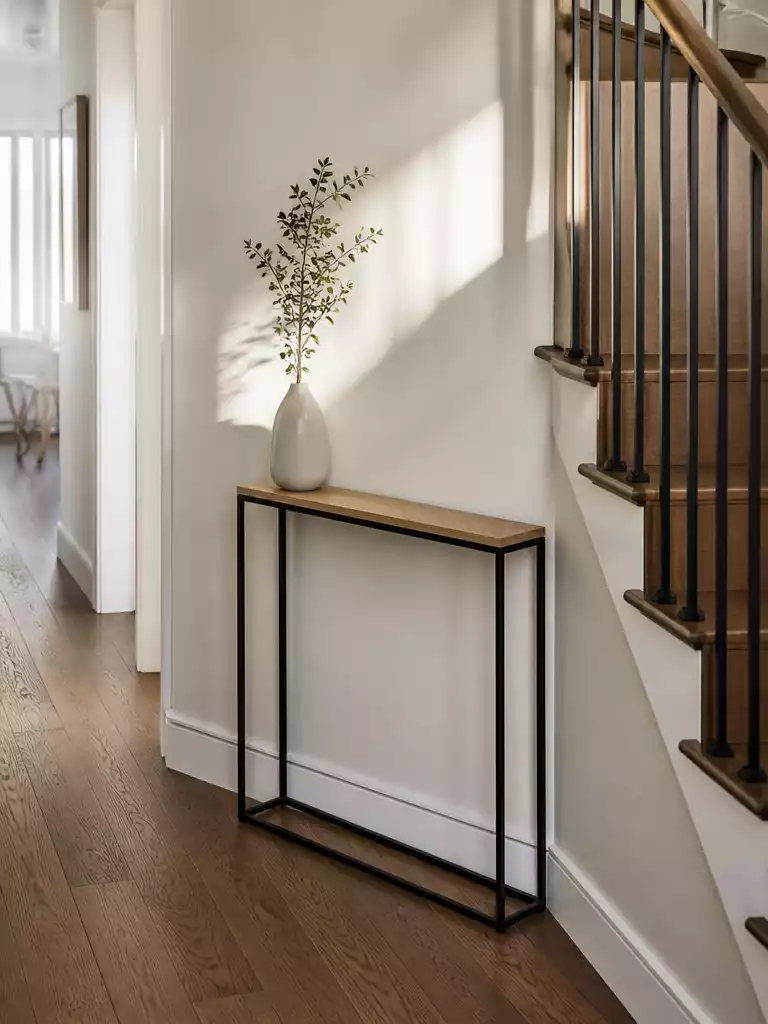
Create a functional drop zone without blocking the path to your front door.
When your front door opens directly into a staircase, the floor space is essentially a hallway that happens to go up. You need a place to set your keys, but a standard deep table will turn your entry into an obstacle course.
The solution is a leggy console table. By choosing a design with an open, airy base—either thin metal or slender wood legs—you keep the floor visible, which tricks the eye into seeing more square footage than is actually there.
The 10-Inch Rule: Anything over 10 to 12 inches deep will likely force guests to pivot awkwardly to reach the stairs. Stick to these slim dimensions to maintain a clear, natural walking radius.
A slim console only stays functional if you strictly enforce a single-item limit. If you pile it with mail, spare change, and multiple accessories, it becomes a magnet for the very clutter you are trying to avoid in a tight space.
Try limiting your surface decor to just one sculptural vase or a single minimalist lamp. This discipline ensures the console remains a helpful landing spot rather than a visual bottleneck.
Console Styling Checklist
- ✅ Secure It: Always anchor the console to the wall with a hidden bracket to prevent tipping in high-traffic zones.
- ✅ Choose Airy Bases: Prioritize frames that allow light to pass through the legs.
- ✅ Minimalist Top: Limit decor to one or two intentional items only.
- ✅ Check Width: Ensure the console length doesn’t extend past the first three steps.
If you have tight clearance, skip the console entirely and opt for a wall-mounted floating shelf instead. This approach gives you the same functional surface without the risk of bumping into table legs during your daily arrival.
⭐ Slim Console Tables for Tight Spaces
Fluted Half Moon Entryway Console Table
Boho Fluted Wood Console Accent Table
Mirrored Half Moon Modern Console Table
💡 Why This Works:
Choosing a console with a leggy, open base creates a psychological “lightness” that prevents a narrow entryway from feeling boxed in. By maintaining clear lines of sight to the floor beneath the table, you reduce visual noise, making the passage toward the stairs feel like a deliberate design choice rather than a cramped hallway.
Visual Benefit: An airy base tricks the eye into seeing more floor space, essential for keeping stairs feeling like a grand feature.
Statement Lighting Overhead
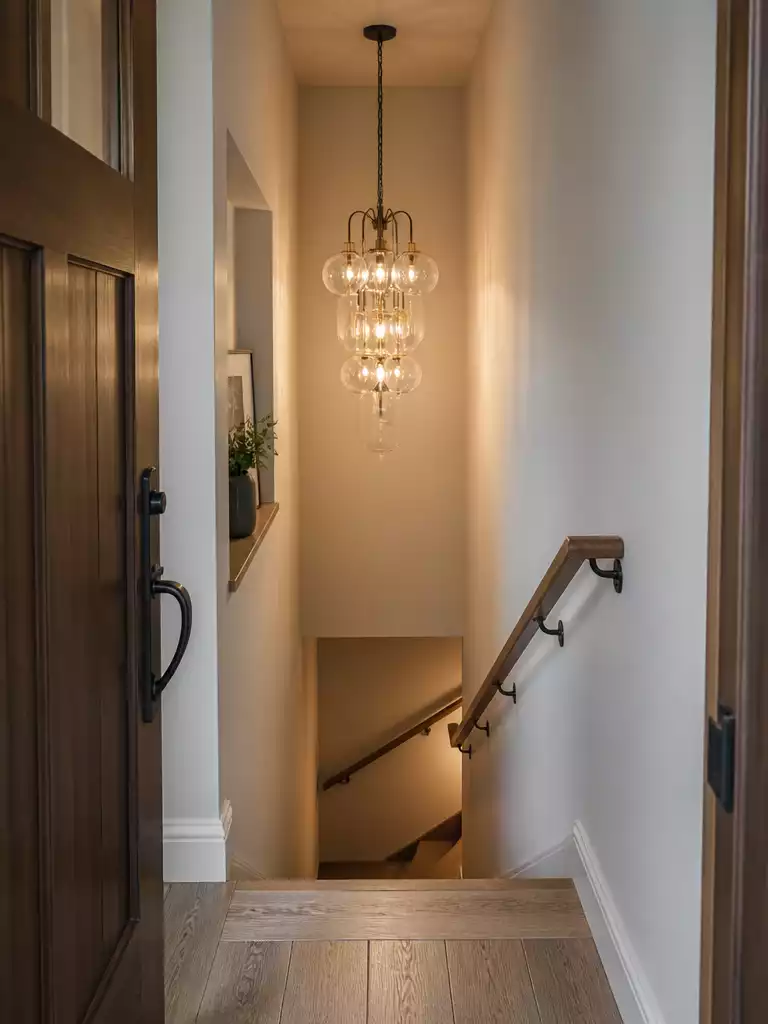
Define your home’s vertical volume with a singular, high-impact light that guides the way up.
The ceiling above your stairs is often the most overlooked square footage in a tight foyer. Choosing the right fixture turns this forgotten space into a visual anchor that defines the vibe of your entire house the second the front door opens.
When selecting a pendant, prioritize scale and sightlines over sheer brightness. A fixture that looks great in a catalog can easily overwhelm a landing, so ensure you choose one that remains transparent or airy to keep the sightline to the top of the stairs clear.
The Clearance Rule: Ensure your chosen fixture hangs so the bottom edge clears the highest step’s headroom by 6 to 7 feet.
This prevents the “low-hanging” feeling that can make a small, stair-adjacent entry feel cramped and claustrophobic.
Material choice plays a massive role in how “heavy” the stairs feel. Clear glass or acrylic fixtures allow light to pass through, keeping the entry feel expansive, while woven natural materials add warmth without adding physical bulk.
If you want to maximize your investment, install a dimmer switch immediately. This simple change allows you to transition from a bright, functional arrival during the day to a soft, ambient glow that makes the narrow stairwell feel curated rather than purely utilitarian.
⭐ Statement Entryway Lighting to Consider
Wireless Motion Sensor Ceiling Light Set
Portable Hanging Lanterns for Emergency Light
Bright Hanging Solar Powered Lantern Lights
🔢 The Right Sequence
Installing a statement pendant in a tight stairwell requires a specific order to avoid damaging your walls or compromising your final clearance height.
- Measure sightlines: Verify the fixture clears the top tread by 6-7 feet before finalizing your electrical box location.
- Test light output: Hold the fixture in place to check for harsh shadows that might obscure individual stair treads.
- Finalize wiring: Install the canopy and adjust the suspension height only after any wall painting is complete.
Art Up the Stair Wall
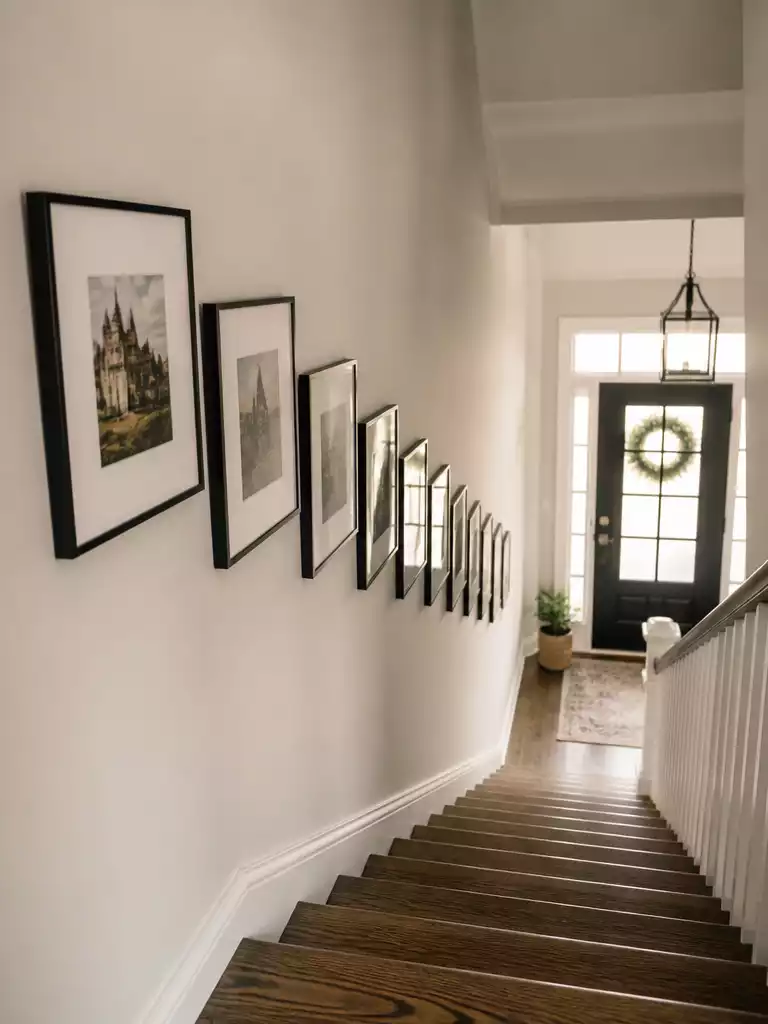
Transform your neglected stair wall into a vertical gallery that draws the eye upward.
The wall running alongside your stairs is often the most underutilized real estate in the entire house. Instead of letting it sit empty, use it to draw the eye toward the upper floor, which distracts from the narrowness of the floor space below.
The key to success here is angled rhythm. You want your frames to follow the slope of the stairs, maintaining a consistent distance from the handrail so the display feels intentional rather than haphazard.
Pro-Tip: Use painter’s tape to map out your arrangement before hammering a single nail. This ensures no frame sits too low, where it could be knocked by a passing bag or shoulder.
For a small foyer, consistency is much more effective than a chaotic mix of styles. Opt for uniform framing where each piece shares the same finish and matting width.
Here is why uniform framing wins in tight spaces:
- Creates a cohesive, tidy line that calms the visual noise of a narrow entry.
- Allows the art itself to provide interest without the distraction of clashing frame styles.
- Makes it significantly easier to swap out prints as your collection grows.
If you are choosing between different types of art, prioritize tall, narrow pieces. These shapes emphasize the verticality of the staircase and make the ceiling feel higher, providing a much-needed sense of scale in a cramped area.
⭐ Art Up Your Staircase Wall
Magnetic Wood Poster Hanger Frame Set
Vintage Travel Collage Poster Art Kit
Inspirational Greenery Plant Wall Art Banner
Designer Note: Mastering the Gallery Layout
To keep your stairwell from feeling cluttered, treat the entire arrangement as one singular, cohesive shape. By aligning the bottom edge of your frames to a consistent “datum line” that mirrors the stair’s pitch, you ground the display. This visual discipline makes even a large collection look intentional, airy, and sophisticated rather than disjointed or overwhelming.
A Mirror to Open the Space
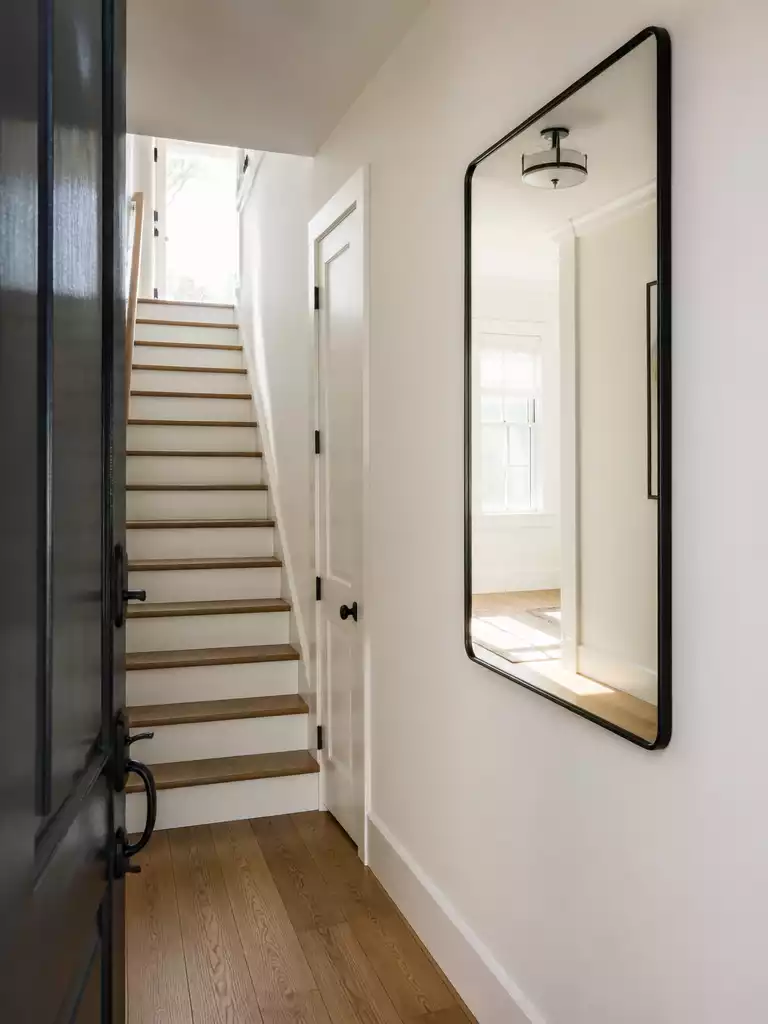
Double your entry’s perceived width and bounce natural light deep into your tight stairwell.
Hanging a mirror in a cramped foyer is one of the quickest ways to trick the eye into seeing more square footage. By placing a mirror opposite a window or near the front door, you can pull natural light into a stairwell that often feels like a dark, enclosed tunnel.
The Eye-Level Rule: Always test your mirror’s placement by standing at the front door to see what it reflects. You want it to capture architectural details or artwork, not the pile of shoes or bags that naturally congregates near the stairs.
In a narrow space, the frame choice is just as important as the glass itself. A thin metal frame or a frameless design ensures the mirror sits flush against the wall without protruding and making the walkway feel tighter.
This solution is best for homeowners who struggle with a “claustrophobic” arrival but have enough wall space to avoid physical obstruction. If your landing is so narrow that you risk bumping the glass with a heavy bag, it is better to skip the mirror and focus on vertical wall art instead.
⭐ Decorative Mirrors to Open Your Space
Rectangle Window Pane Decorative Wall Mirrors
Gold Rectangle Full Length Wall Mirror
Black Framed Bathroom Medicine Cabinet Mirror
⚖️ Quick Decision Guide:
- Choose this if: Your foyer feels like a dark “tunnel” and you need to pull in natural light.
- Skip this if: Your space is so tight that a mirror would constantly reflect messy shoe piles.
- Pair it with: A sleek, thin metal frame that defines the piece without adding visual weight.
Paint the Stairs a Focal Color
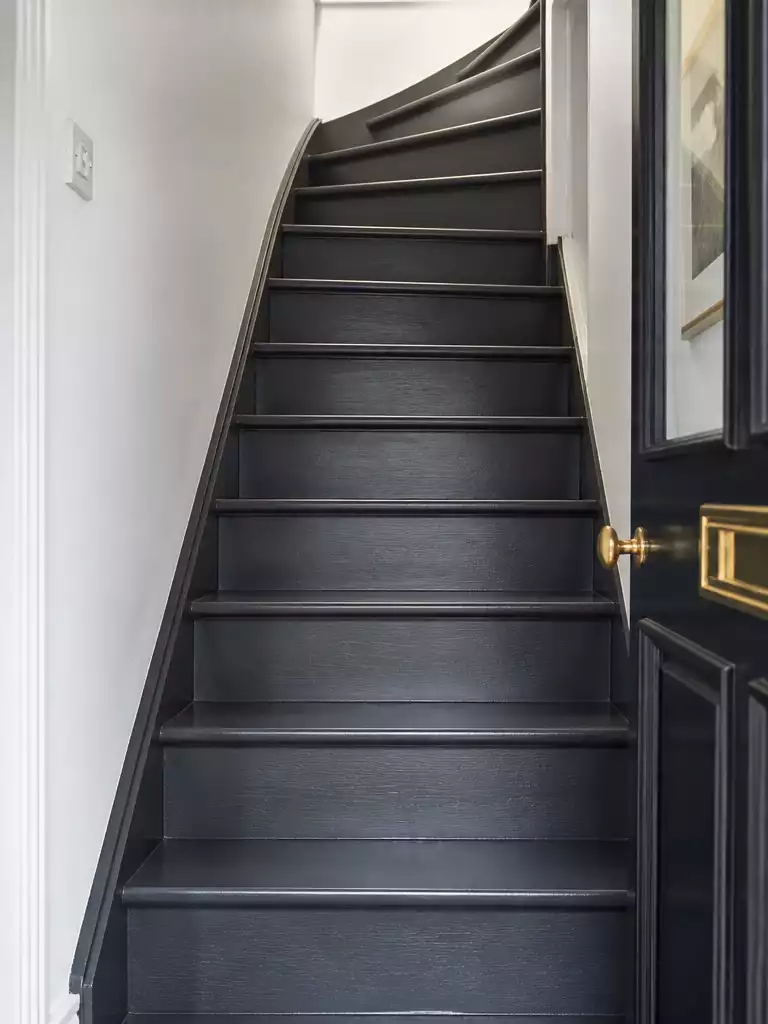
Transform a cramped, builder-grade staircase into a deliberate architectural statement with a single coat of paint.
Painting your stairs is the most efficient way to turn a functional eyesore into a striking design anchor. This approach works best for homes where the staircase feels like a long, unfinished tunnel the moment you walk through the door.
You can choose between two main strategies depending on your foyer’s size and light levels:
- The Monochromatic Approach: Paint the treads, risers, and balusters the same color to create the illusion of a single, continuous sculpture rather than a segmented set of steps.
- The Two-Tone Treatment: Use a high-contrast color on the risers while keeping the treads a neutral, durable shade, which adds visual depth without shrinking the space.
Caution: Durability is non-negotiable.
Standard wall paint will peel and scuff within weeks on high-traffic stairs. Always use a high-quality porch and floor enamel specifically formulated to withstand constant foot traffic and potential slip risks.
Before committing, test your chosen swatch in the morning and evening light. A shade that looks rich at noon can feel incredibly heavy or muddy in a narrow entry shadowed by a closed front door.
⭐ Paint the Stairs a Focal Color
Inspirational Paint Splatter Wall Decals
Sturdy Steel Ladder With Tool Platform
Essential Paint Grade Wood Hole Plugs
💡 Why This Works:
Painting your stairs creates a visual “rhythm” that draws the eye upward, effectively turning a cramped transition zone into a purposeful architectural feature. By minimizing the visual noise of mismatched materials, you force the brain to perceive the staircase as a singular, intentional object rather than a collection of separate, cluttered pieces.
Visual payoff: A unified color palette creates a clean, elongated line that makes the entire entryway feel significantly more spacious.
A Small Landing Bench
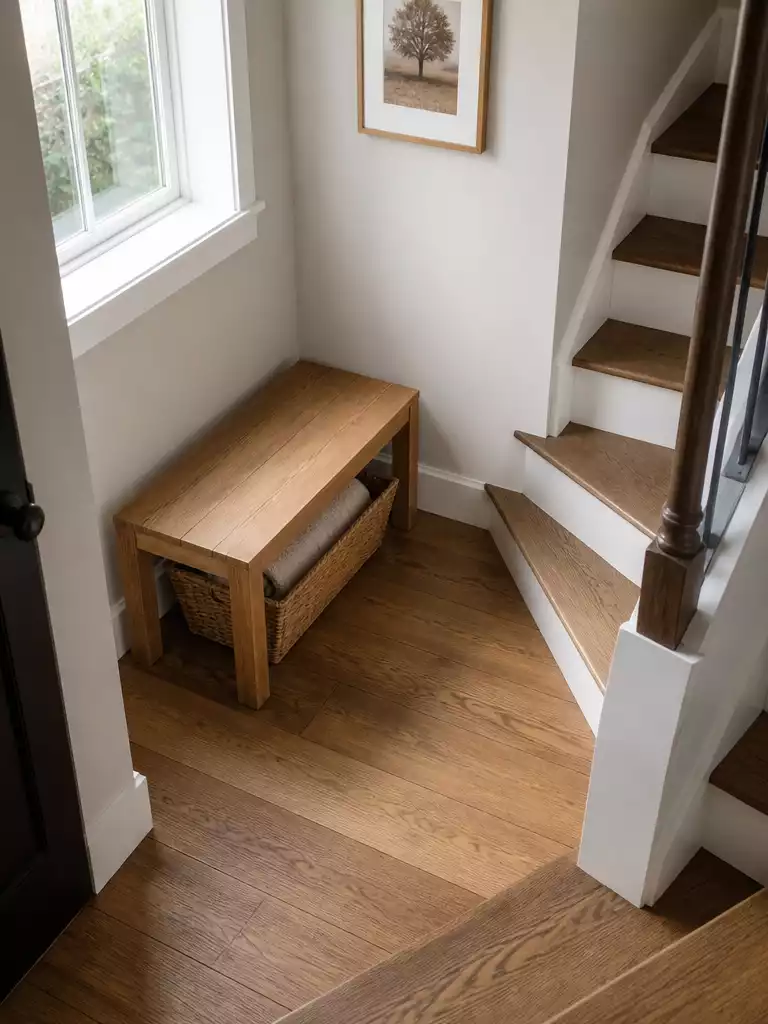
Create a functional perch for shoes without sacrificing the narrow clearance of your landing.
A bench in a tiny foyer is a trade-off between convenience and walking room. If your landing has at least 3 to 4 feet of depth, you have enough space to add a seat without creating a bottleneck.
The Turning Radius Test: Before buying, place a cardboard box of the same size where the bench would go. If you have to step onto the stair tread to navigate around it, the bench is too deep for your space.
Choose backless designs to maintain a sense of openness. A high-backed bench creates a visual wall that makes a tight entry feel significantly smaller and blocks the view of your stairs.
Prioritize pieces that offer utility beyond just seating. A bench with an open base allows you to tuck away baskets for shoes or mail, keeping the floor surface clear and the pathway unobstructed.
Skip this step entirely if your landing is less than 3 feet deep. In ultra-tight foyers, a wall-mounted ledge is the only way to keep the floor clear and safe for foot traffic.
⭐ Small Landing Benches Worth Buying
Solid Rubberwood Entryway Shoe Storage Bench
Narrow Solid Wood Shoe Rack Bench
Modern Upholstered Entryway Shoe Storage Bench
💡 Why This Works
By keeping the bench low-profile and backless, you maintain a clear line of sight to the stairs, which tricks the eye into perceiving the entire foyer as more expansive. This approach provides a dedicated, functional landing zone for daily routines without physically shrinking the circulation path or creating a visual “wall” that blocks the flow of your home.
Visual benefit: Open-base designs keep the floor visible, preserving the sense of spaciousness in your entry.
Warm Layered Lighting
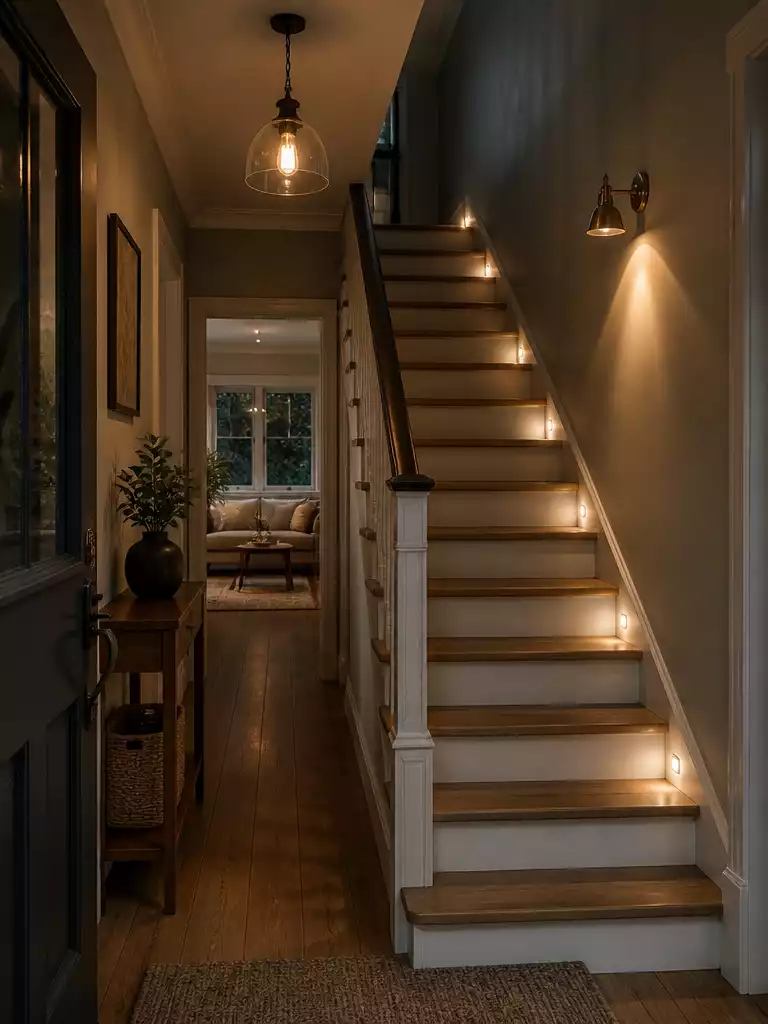
Transform a cramped, shadowy stairwell into a bright and welcoming arrival zone using layered illumination.
Most entryways with stairs rely on a single, harsh overhead bulb that leaves the staircase corners in deep, confusing shadows. Layering your lighting is the fastest way to make a narrow transition feel significantly larger and safer.
By combining multiple sources, you eliminate the “clinical” look often found in entryways. Focus on these three layers to create a balanced, inviting glow:
- Ambient Overhead: A pendant or flush-mount fixture that sets the general mood and defines the stair volume.
- Task Lighting: Wall sconces or slim profile picture lights that highlight art or the stair wall itself.
- Safety Glow: Low-level LED step lights or toe-kick lighting that clearly defines the edge of every tread.
Pro Tip: Stick to bulbs with a color temperature of 2700K or 3000K to keep the space warm.
Cooler bulbs above 4000K can make wood stairs look washed out or sterile.
If your electrical layout is already fixed, don’t worry about major renovations. Smart bulbs synced to a sunset timer ensure your home greets you with a soft, intentional light the moment you walk through the door.
This approach is right for anyone struggling with dark, “tunnel-like” entryways. If you have a bright, naturally lit foyer, you can skip the extra hardware and focus on a single, high-impact aesthetic fixture instead.
⭐ Warm Layered Lighting for Entryways
Solar Wall Lanterns With Motion Sensor
Outdoor Porch Light With GFCI Outlet
Magnetic Wireless Under Cabinet LED Lights
✨ Small Details That Matter
Refining the hardware and fixture finishes acts as the final polish that keeps a small stairwell feeling intentional rather than cluttered.
- Cohesive Metal Tones: Match your new light fixture finish to existing stair hardware to create a unified, high-end look.
- Smart Dimmer Plates: Replace standard light switches with slim, matching wall plates to keep the focus on your lighting design.
You now have ten distinct ways to manage that tight space where your stairs meet the front door. Focusing on the one or two tactics that align with your home’s layout is more effective than attempting to implement everything on this list. A curated approach ensures your entryway functions as a clear point of arrival rather than a crowded bottleneck.
Decide which of these solutions solves your biggest daily obstruction, and prioritize that change first. Reclaiming your floor space by selecting the right under stair storage or lighting ensures the area remains functional. Once you clear the immediate path, you can refine the remaining aesthetic details at your own pace.