
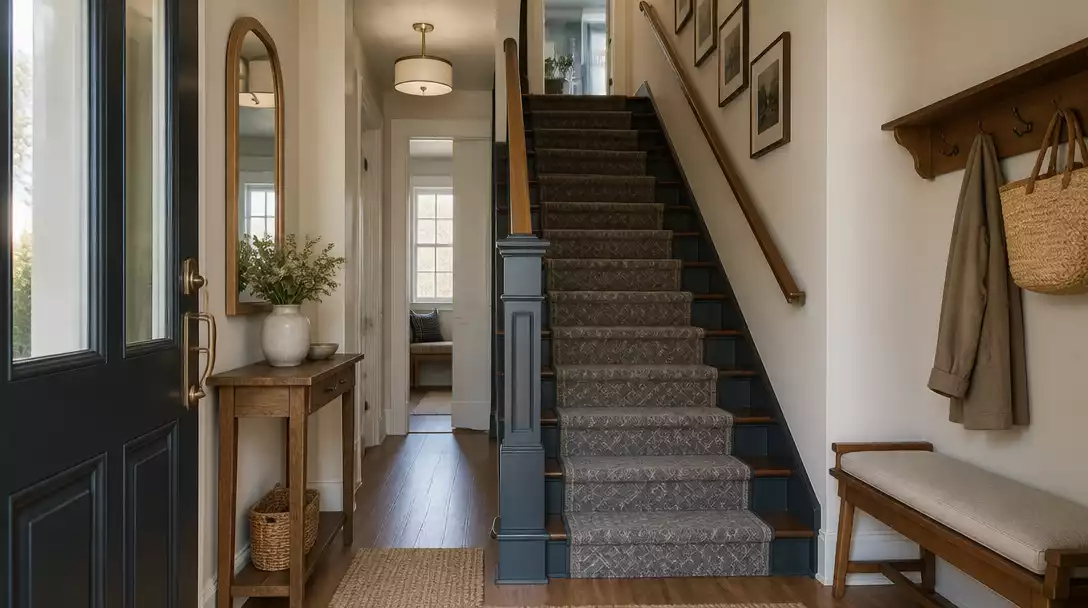
A Better Arrival for Houses With Stairs Right Inside the Door starts with styling a tight entry where the stair opening commands attention from the threshold. This guide rounds up 10 door ideas worth saving to help you find an organized, intentional fit for your home—starting with the stair runner.
A Runner Down the Stairs
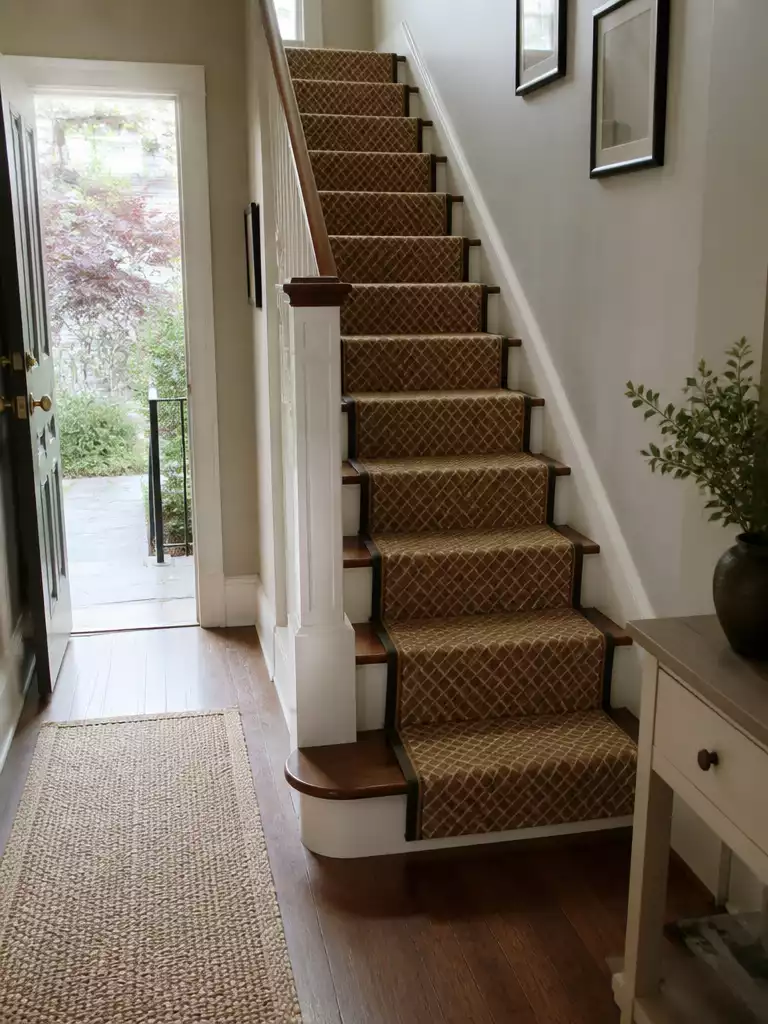
A fitted runner turns the unavoidable stair sightline into a quieter, safer path upward.
As an Amazon Associate I earn from qualifying purchases. Affiliate links may earn me a commission at no extra cost to you.
A bare stair run that starts inches from the front door pulls your eye straight down a hard, echoing slope. A runner gives that unavoidable sightline a finished purpose, especially when the rest of the foyer needs to stay visually quiet.
It is not just a decorative strip: the right material adds traction, softens footsteps, and carries one controlled color or pattern from the threshold toward the upper level. Choose a pattern on the stairs while keeping the walls and nearby console, hooks, or art restrained.
Measure before ordering:
- Stair width and the number of risers
- Tread depth and whether every stair nose is uniform
- Consistent side margins from top to bottom
- Material rated for heavy traffic, vacuuming, and tracked-in dirt
Rods, staples, adhesive pads, or a combination may suit the stair construction and installation system. An experienced DIYer can often handle a straight staircase, but open, curved, worn, or pattern-matched stairs are better left to a professional installer.
Safety check: A runner that slips, leaves uneven edge gaps, or is too narrow can look unfinished and reduce traction. Attractive samples do not matter if the finished installation interrupts safe, unobstructed stair use.
Once the stair surface has a strong visual line, the newel post is the logical place for one concentrated architectural accent.
⭐ Top Stair Runners to Buy
Striped Cotton Stair Runner Rug
Black Boho Washable Runner Rug
Reversible Striped Cotton Runner Rug
💡 Why This Works
A runner gives the staircase a job beyond connecting floors: it becomes the entry’s visual path. That helps the stair opening feel intentional instead of like an interruption, while softened footsteps make the arrival feel calmer. Let the runner carry the personality, then keep nearby furniture, hooks, and artwork edited so the narrow foyer still has breathing room.
Design takeaway: Put the strongest pattern on the unavoidable stair line, not on every surface around it.
A Bold Newel Post
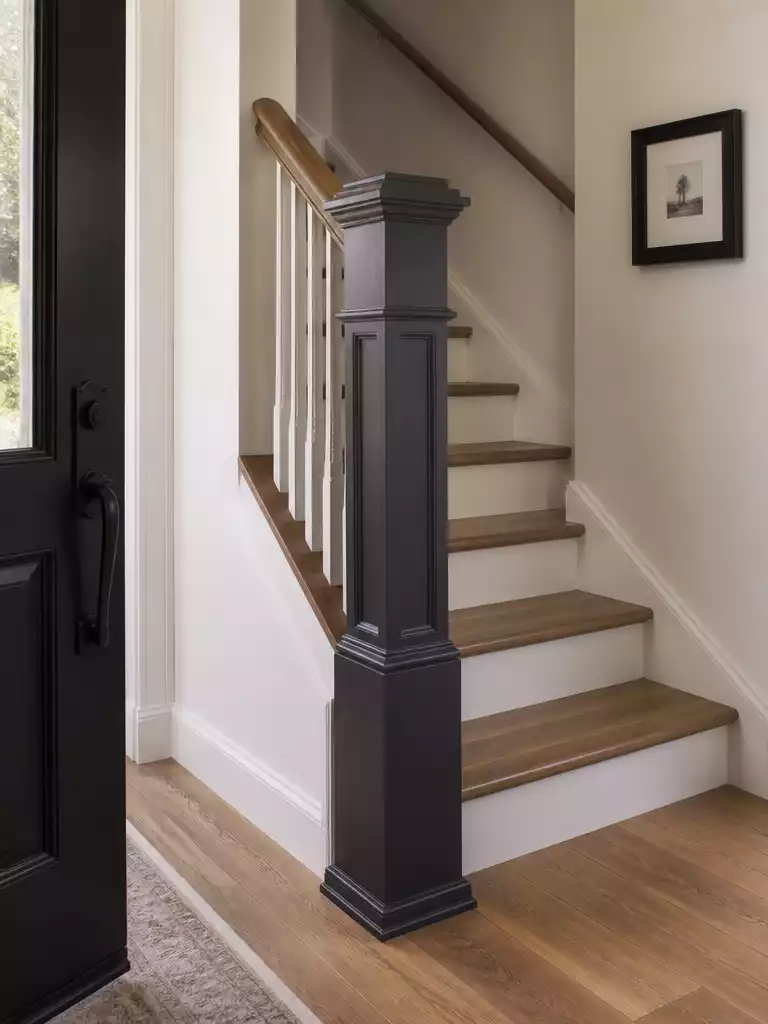
One substantial post turns an abrupt stair edge into a deliberate architectural welcome.
That first stair edge is where the eye pauses after the door opens. A plain, loose-looking newel can make the staircase feel accidental, while a fuller profile or deep painted finish gives the tight entry one clear architectural anchor.
This idea suits homeowners who want impact without adding another table, basket, or accessory beside the stairs. Keep the balusters, rail, and surrounding trim simple so the post reads as one concentrated statement, not part of a crowded stair makeover.
- Choose a substantial profile, deep finish, or contrasting color.
- Repeat that accent only once elsewhere, such as on a small frame or console detail.
- Leave ornate surrounding trim quiet rather than layering on more decoration.
Inspect before styling: Push the post gently and look for movement, damage, or incorrect attachment. Paint can sharpen a sound newel, but it cannot correct a loose post or a problem in the stair support assembly.
Cleaning, sanding, repairing surface flaws, priming where needed, and applying a durable trim finish are reasonable DIY steps only after the post is confirmed sound. If it wobbles, is badly damaged, or supports the stair system, have a carpenter or stair specialist assess it before refinishing or replacing anything.
Once the stair has its strong visual anchor, the wall beside the door becomes the logical place for shallow storage that keeps the walkway open.
⭐ Standout Newel Post Details
Unfinished Birch Decorative Finial
Black Wrought Iron Stair Handrail
💡 Let the Entry View Lead
Choose the newel finish from the doorway, not beside the post. A dark or contrasting treatment should connect with the entry’s strongest visible detail—perhaps a frame, lamp base, or stair-wall accent—so the eye reads one intentional path upward instead of several unrelated focal points.
Guests read the arrival in a quick glance: the stair path, the light, and whether the doorway feels clear before they notice individual finishes. That makes the decision less about choosing every appealing detail and more about correcting the first impression that is most visible; a look at front door mistakes can sharpen that filter.
The entry feels considered when its clearest sightline works, even if several perfectly good ideas stay unused.
Wall-Mounted Hooks and Ledge
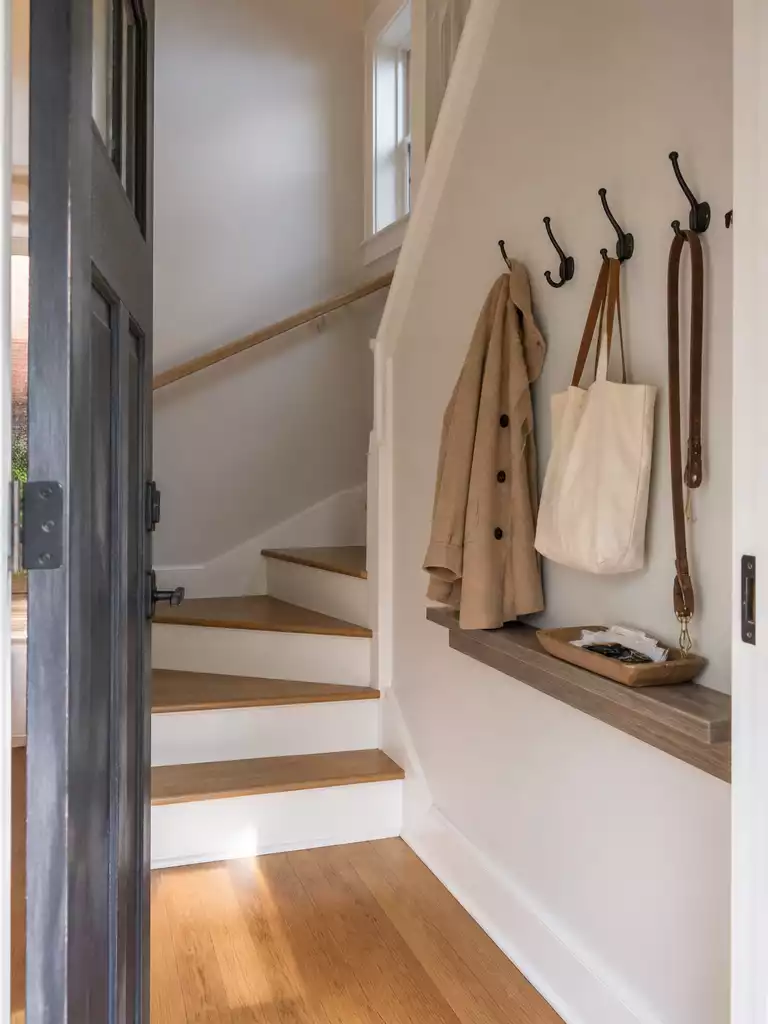
Keep coats and keys organized without sacrificing the narrow route toward the stairs.
Coats and bags dropped beside the first stair turn a narrow arrival into an obstacle course fast. A compact row of wall-mounted hooks with a shallow ledge moves those daily items upward, leaving the floor clear for the door swing and the route toward the stairs.
Mount the hooks about 60 to 66 inches high so they stay reachable without creating a head-strike hazard. Five to seven heavy-duty hooks per linear foot is one practical design recommendation, not a building-code requirement, so use fewer if the wall is narrow or your household needs less storage.
Make the ledge genuinely shallow. Give it a raised lip or use a small tray so keys and mail cannot slide toward the stair opening, then leave the rest of the surface mostly empty.
- Check each hook load rating before hanging winter coats or loaded bags.
- Use metal hardware with anchors suited to the wall; drywall alone is not enough for loaded storage.
- Test the front-door swing, stair-turning zone, and head-clearance area before drilling.
This is the right storage move when there is no room for a cabinet or bench. It is generally DIY-friendly on a sound wall, but insecure fastening defeats the whole point: a falling hook or shelf can become a stair hazard.
Once the wall is handling vertical storage, a narrow console can add a little more surface area without taking over the walkway.
⭐ Hooks And Shelves Worth Buying
Removable Suction Cup Wall Hooks
Black Metal Three Tier Wall Shelf
Transparent Adhesive Wall Coat Hooks
💡 Why This Works
This arrangement gives the entry two useful levels: hooks handle bulky, everyday pieces while the ledge contains small items at hand height. Because the wall carries the storage, the eye can still read the floor and stair opening as one clear route instead of a crowded collection of furniture.
Best visual rule: Let the hooks provide the pattern or finish, and keep the ledge quiet so the arrival feels organized.
A Slim Console Against the Wall
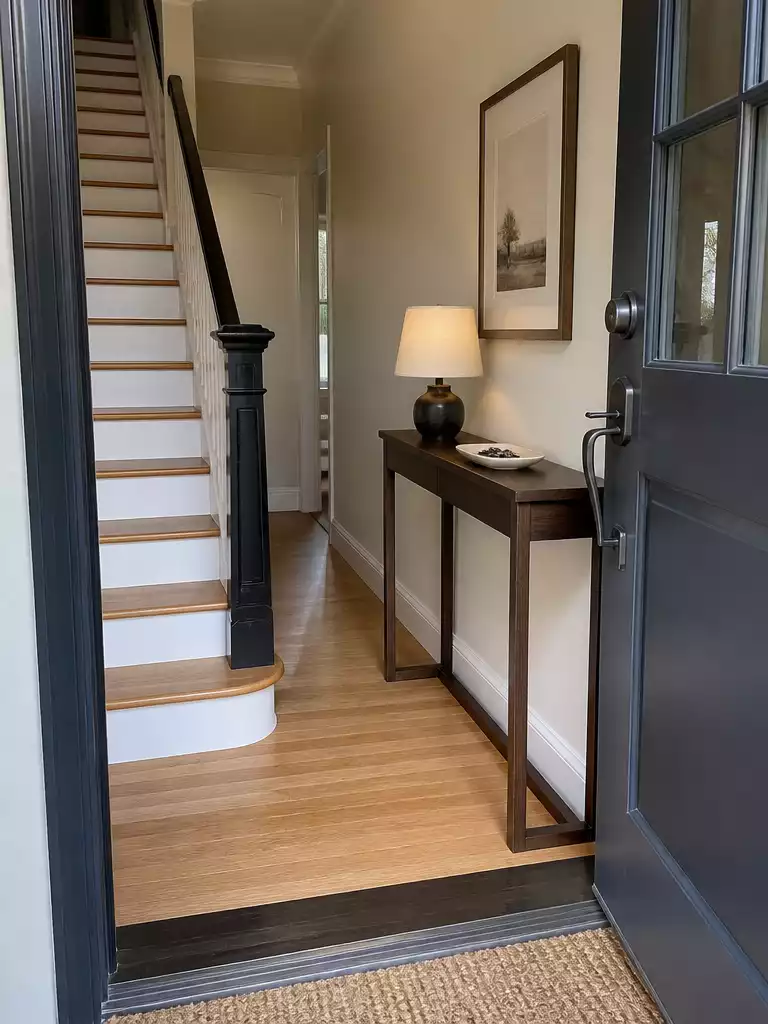
Create a useful drop zone while keeping the doorway and stair approach easy to navigate.
A small tray for keys and a lamp for the mail sound simple—until a conventional entry table leaves only a narrow strip beside the first stair. For this layout, choose a slim console with open legs, a wall-mounted shelf-like surface, or another visually light piece that follows the wall instead of forming a solid block.
Do not shop by the word skinny. No universal ideal console depth is verified, so measure the exact space from the wall to the walking path, then account for the front-door swing and the turn toward the stairs.
Try this before buying: Mark the console footprint with painter’s tape. Enter through the door, open it fully, turn toward the stairs, and reach the first step without twisting around a corner or brushing the furniture.
Style the surface with restraint: use a small tray, one compact lamp if electrical access permits, and either a mirror or one framed piece above it. Skip baskets and bulky cabinets; they erase the breathing room this piece is supposed to preserve.
- Pick a durable finish for this high-contact location.
- Wall-anchor the console when it carries a mirror, lamp, or heavy décor.
- Choose a ledge instead if the taped footprint creates a pinch point.
Once the surface fits, look upward: the ceiling fixture can ease the compressed feeling that furniture alone cannot.
⭐ Slim Console Tables We Love
Fluted Walnut Half Moon Console Table
Modern Fluted Entryway Console Table
Boho Half Moon Console Table
📈 The Long-Term Payoff:
A console rarely adds measurable resale value by itself, but a durable, visually light piece can make the arrival feel cared for and remain useful through changing routines. Choose a restrained finish and flexible styling rather than an overly distinctive design that future homeowners may find difficult to live with.
Best investment: Prioritize secure construction, a durable finish, and a profile that preserves comfortable circulation.
Statement Lighting Overhead
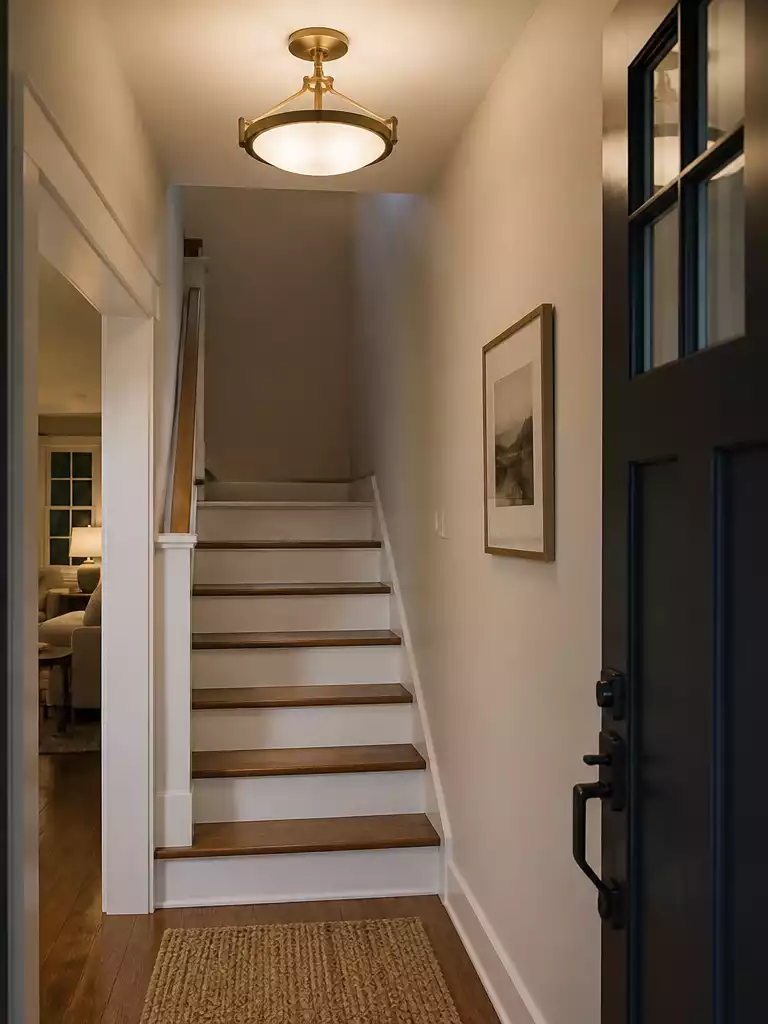
A well-scaled ceiling fixture makes the stair-first arrival feel brighter, calmer, and intentionally designed.
A compact pendant can look inviting over the entry, but a low ceiling or tight stair turn often makes a flush mount or semi-flush mount the smarter choice. Choose the fixture by ceiling height and entry width, not by a universal size formula that does not exist.
Reflective or metallic finishes can bounce available light across a compressed foyer, but they cannot rescue a dim bulb. Check the required lumen output, then select a fixture compatible with a dimmer so the entry can be bright for arrivals and softer later.
Make the bottom-step shadow test. Stand at the first step and switch on the fixture at night; if the light leaves the first treads in shadow, the fixture or diffuser is not doing enough for this arrival.
Before buying, measure the ceiling height, mark the full door swing, and walk the route toward the stairs while imagining the fixture overhead. An oversized pendant can dominate a small foyer, while one that hangs too low can catch attention for the wrong reason when people enter or carry items upstairs.
- Best for: foyers with one central ceiling box and enough height for a controlled fixture profile.
- Choose: flush mount, semi-flush mount, or compact pendant based on clearance and stair visibility.
- Consider instead: wall sconces flanking a mirror when ceiling access is limited.
A licensed electrician should evaluate any project that moves the ceiling box, adds a new fixture, or upgrades the circuit. Once the stair surface has a strong visual line, the newel post is the logical place for one concentrated architectural accent.
⭐ Best Entryway Lighting For Impact
Black Glass Wall Lantern Sconces
Modern Black Outdoor Wall Lanterns
Rechargeable Motion Sensor Light Set
💡 The Detail That Pulls It Together:
Let the overhead fixture be the entry’s single decorative flourish. If it has a noticeable metal finish, repeat that finish once on a frame or console detail, then keep the surrounding ceiling and walls quiet. This gives the stair-first view a polished focal point without making every surface compete for attention.
Art Up the Stair Wall
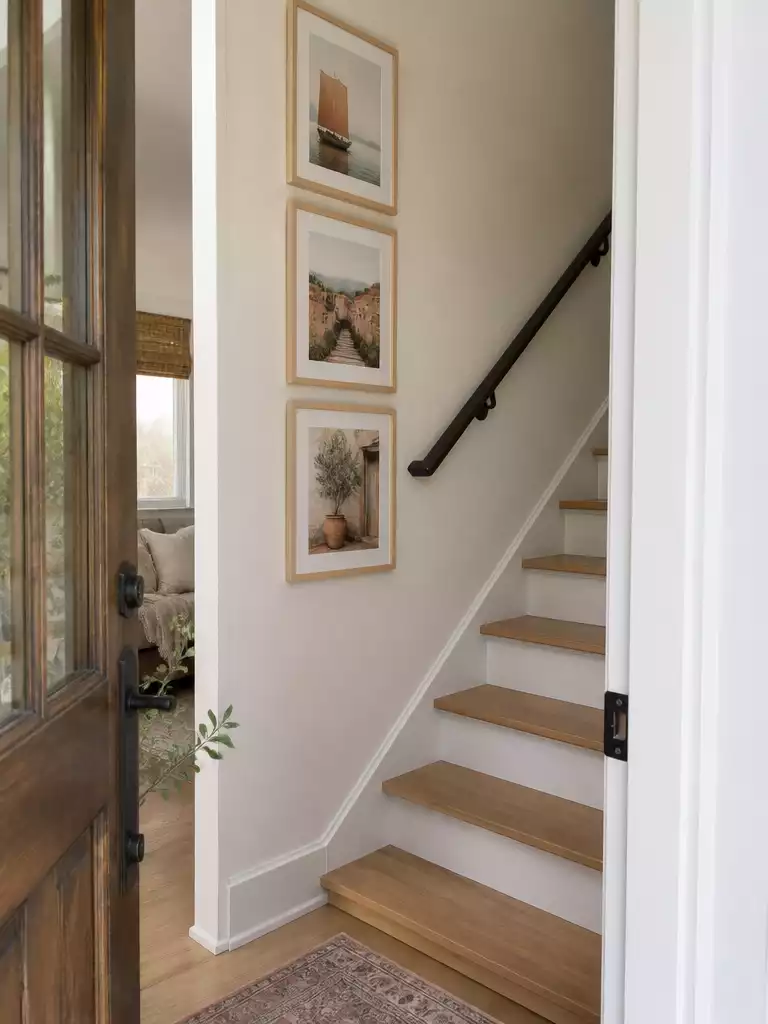
A narrow vertical art arrangement turns the stair wall into an intentional upward focal point.
The blank wall rising beside the stairs can make the entry feel unfinished, especially when the first step is visible from the front door. A controlled vertical stack of two or three artworks follows that upward movement and gives the awkward stair line a clear visual purpose.
Choose simple shapes, a repeated color, or a vertical sequence that can be understood while someone is walking in. Tiny, detail-heavy pieces tend to disappear from the doorway, while a sprawling gallery can make a tight foyer feel even more enclosed.
- Plain stairs and trim: stronger frames can add definition without needing many pieces.
- Heavy railing or ornate trim: lighter frames keep the wall from becoming visually crowded.
- Coordinated palette: repeat one shade from the runner, newel post, or overhead fixture in the artwork.
Before drilling, measure the stair pitch and the clearance around heads and shoulders. Art placed too low can be bumped by people using the stairs, so lightweight pieces are the best DIY fit on sound drywall; heavier frames need studs or weight-appropriate anchors.
Placement check: Stand inside the door and view the grouping in motion. If the lowest frame crowds the landing or the handrail, raise it, reduce the grouping, or skip the arrangement.
Once the stair wall has movement, a mirror can send light and sightlines back across the foyer instead of only directing attention upward.
⭐ Art To Consider Alongstairs
Black Wood Gallery Frame Set
Vintage Travel Poster Collage Set
Black Magnetic Poster Hanger Frame
💡 Why This Works:
Art gives guests a visual pause at the point where the front door, stair opening, and upper-level route meet. A calm, connected composition helps the staircase feel like part of the home’s arrival sequence rather than an unfinished passage, while keeping useful floor space completely clear.
Best visual payoff: Choose artwork with a clear silhouette that reads quickly from the threshold and rewards a closer look upstairs.
A Mirror to Open the Space
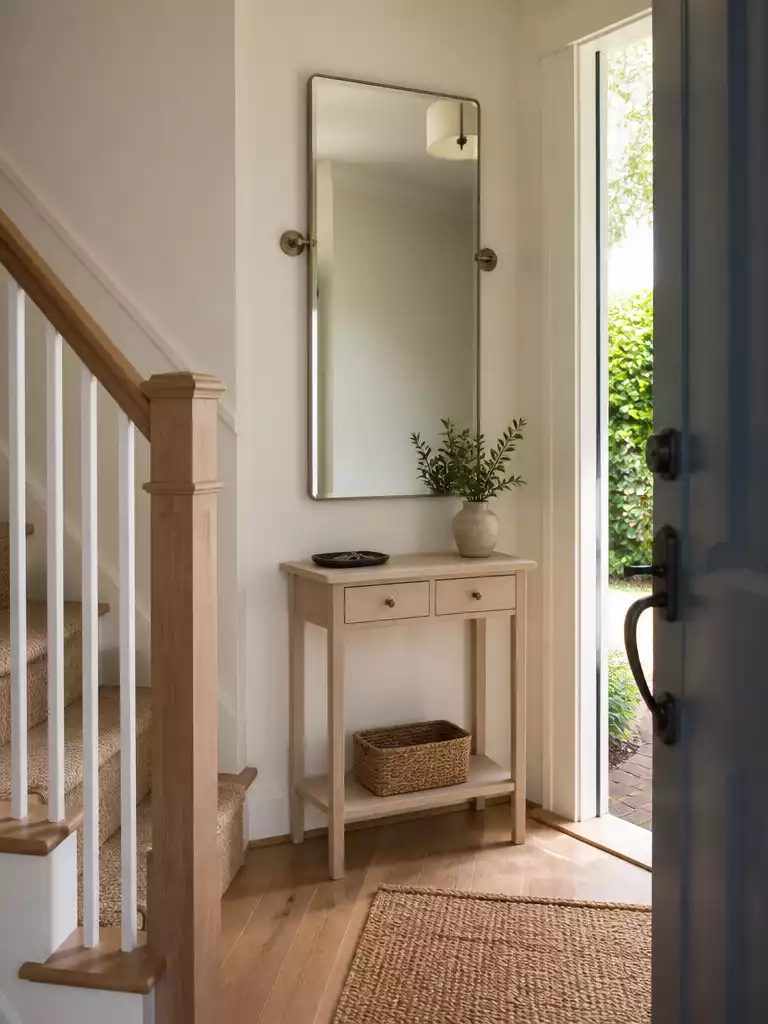
Reflect light across the foyer and make the tight arrival feel calmer, wider, and more intentional.
A medium-sized mirror above a slim console suits the side wall that feels closest when the front door opens. It reflects light and gives that solid boundary a second visual plane without taking any floor space.
Choose the reflection before the frame. Aim the mirror toward a light wall, the spread of the overhead fixture, or a neatly styled surface—not a crowded stair run, a pile of bags, or the open front door.
Try this before drilling: Cut a paper or cardboard template to the mirror size and tape it to the wall. Walk in, turn toward the stairs, and check the reflection for clutter, awkward proportions, and glare.
- Measure the wall, nearby trim, console width, door swing, and stair sightline.
- Skip a tiny mirror that reads like an isolated tile.
- Avoid an oversized piece that crowds the door or stair opening.
- Use secure, weight-appropriate hardware, especially above a console.
Some feng shui guidance avoids placing a mirror directly opposite the stairs, but that is a stylistic belief—not a building or safety rule. The practical test is simpler: the reflection should feel calm, useful, and uncluttered.
Once the mirror opens the visual field, let the stair itself carry the next deliberate move with a focal color.
⭐ Mirrors That Open Small Spaces
Black Windowpane Wall Mirror Set
Gold Full Length Wall Mirror
Black Framed Recessed Mirror Cabinet
💡 The Detail That Pulls It Together:
Let the mirror frame connect two nearby finishes rather than introduce a competing third statement. A dark frame can echo the newel post or art hardware, while a lighter or metallic edge can support a bright fixture. Keep the console styling quieter so the reflection—and the entry’s sense of breathing room—does the visual work.
Paint the Stairs a Focal Color
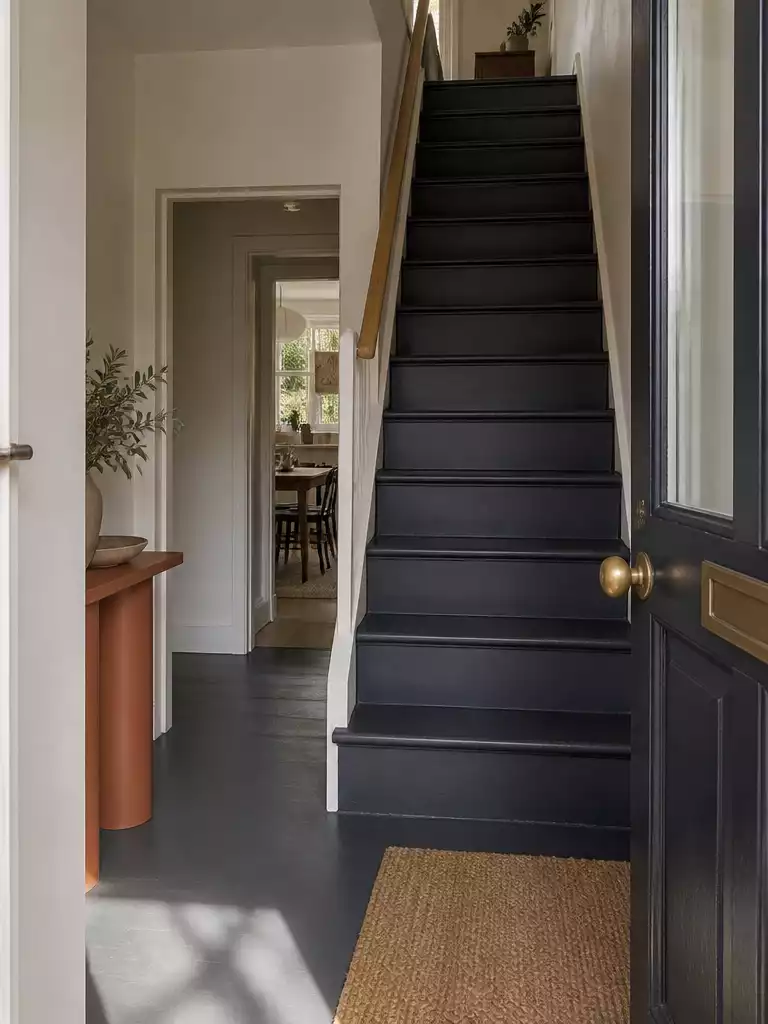
Turn the unavoidable stair run into a confident color feature that guides the eye upward.
A deep charcoal, muted clay, blue-gray, or olive stair finish can make the staircase feel intentional from the moment the front door opens. This is the right move for sound stairs and restrained walls; skip it until damaged treads or structural issues are repaired.
Choose the shade by looking at the entry as a whole, not at a paint card in isolation. Repeat it in one nearby detail—perhaps the edge of a runner, a console finish, or an art frame—so the stairs connect to the room without turning every surface into the same color.
Two focal-color directions:
- Use a saturated stair color against pale walls for a clear directional block.
- Use a muted clay, blue-gray, olive, or charcoal tone when the trim and furnishings already have a quieter palette.
Paint the treads with a system rated for floors or porches, not ordinary wall paint. Check whether the existing finish needs primer, and follow the product directions for preparation, curing, and an anti-slip treatment.
Avoid this mistake: Wall paint on stair treads can scuff quickly and become unsafe as it wears smooth. Painting is generally DIY-friendly when the surface is sound, but damaged treads or major alterations belong with a qualified professional.
Plan the color from the doorway, where the stair run first commands attention. Once that large fixed surface has its focal treatment, decide whether the small landing can genuinely accommodate a bench.
⭐ Wood Stain For Focal Stairs
Mission Brown Exterior Wood Stain
💡 Why This Works:
Because the stairs begin in the doorway’s direct sightline, color gives that unavoidable circulation route a clear visual destination. The effect feels especially polished when surrounding walls, furniture, and accessories stay quieter, allowing the painted run to organize the entry instead of competing with it.
Design takeaway: Let the stair color lead the eye upward while nearby surfaces provide visual breathing room.
A Small Landing Bench
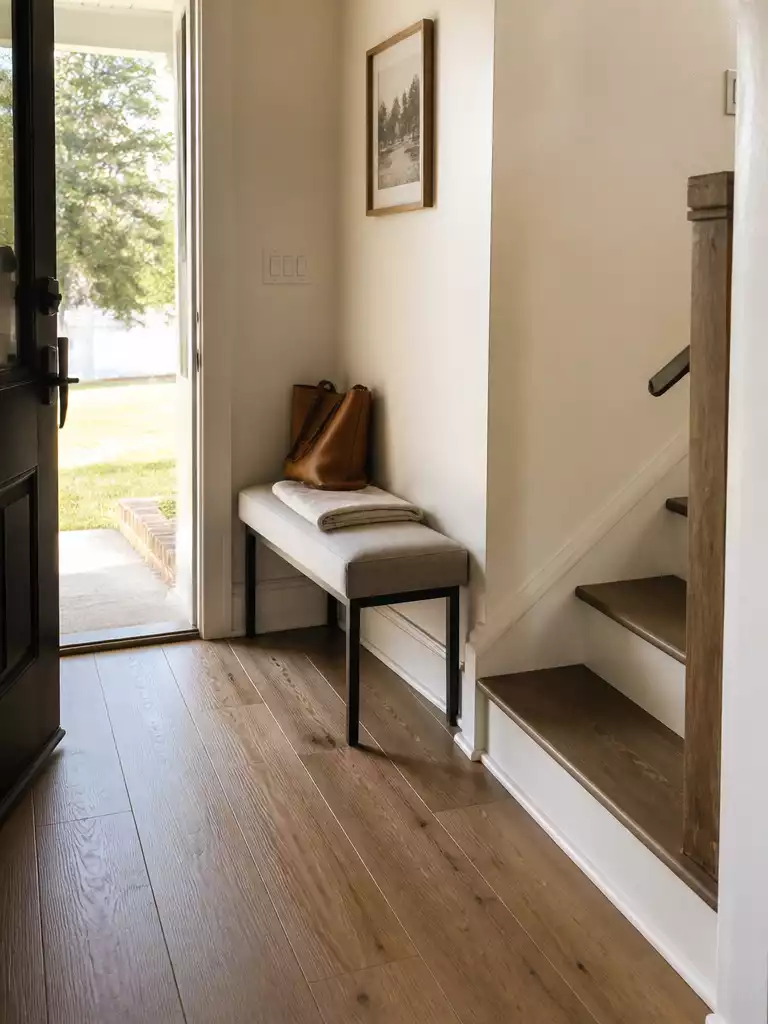
A compact seat keeps arrivals practical without crowding the first stair.
A shallow bench with slim legs can give you a place to set down a bag or put on shoes, but only when the stair approach has room to spare. In a foyer where the first tread begins immediately inside the door, a deep storage chest is the wrong kind of seating.
Measure the actual movement zone first: the clear walking path, the complete front-door swing, the turn toward the stairs, the space around the first step, and the room needed to sit and stand. Do not rely on a catalog label such as small; there is no universal bench size that works for every stair-adjacent entry.
Try the sit-and-carry test
- Walk in through the door and turn toward the stairs.
- Sit down, stand up, and carry a bag past the bench.
- Reject the placement if you must twist, step into the stair opening, or stand in the travel path.
Choose an open profile and leave the space beneath it clear rather than filling it with baskets. That visual gap keeps the first stair visible and prevents the bench from becoming another obstacle.
This idea suits households that genuinely need a seat and can preserve comfortable circulation; everyone else should use a wall-mounted ledge or slim console instead. A lightweight bench used daily may also benefit from wall anchoring, but hardware cannot fix inadequate clearance.
⭐ Entryway Benches To Consider
Narrow Walnut Upholstered Shoe Bench
Compact Upholstered Storage Ottoman Bench
Cushioned Three Tier Shoe Bench
📈 The Long-Term Payoff:
A bench earns lasting value when it solves a daily need without making the entrance harder to use. An open, visually light design can adapt as routines change, while a forced storage bench may become an expensive obstruction. If circulation is tight, a ledge or console is the more durable decision because it preserves flexibility.
Best investment: Prioritize comfortable movement first; seating is useful only when the layout supports it naturally.
Warm Layered Lighting
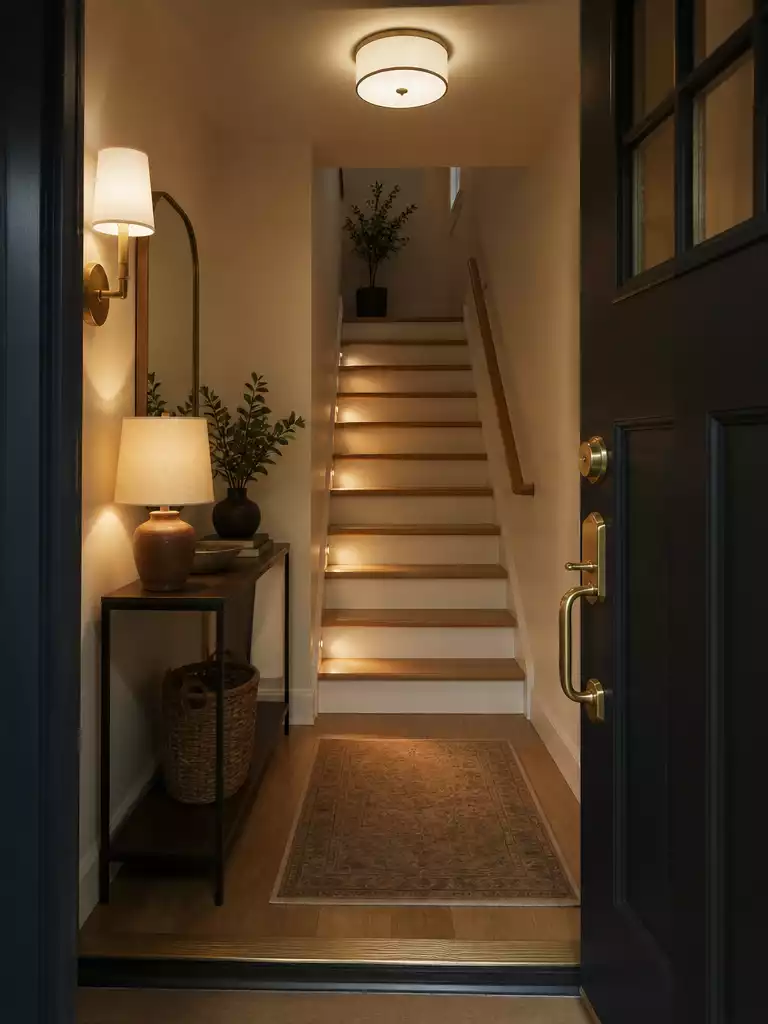
A softly lit stair entry makes every step visible while keeping the arrival warm and inviting.
A single ceiling fixture can brighten the center of a foyer while leaving the stair landing and first tread edges dim. Warm layered lighting is the better fit for stair-adjacent entries because it gives the doorway, console or mirror, and stair line separate jobs.
- Ambient layer: Use a ceiling fixture for general visibility, ideally on a dimmer so arrivals and evening settings feel different.
- Accent or task layer: Add a compact console lamp or a wall sconce near a mirror where wiring and circulation allow.
- Stair-visibility layer: Choose a low-glare source that helps the tread edges, handrail, and landing remain readable without shining into someone’s eyes.
Check the bulb color temperature and dimmer compatibility together; a warm bulb is not automatically compatible with every dimming system. Sconces flanking a mirror can be especially useful when ceiling access is limited, but they still need to preserve head clearance and the unobstructed route to the stairs.
Do this after dark: Walk in through the door and look for shadows across the first steps, hidden tread edges, a dim landing, or glare from the fixture.
Program the brightest setting for arrivals and cleaning, then lower it at night without losing stair-edge definition. If the ceiling box must move or wiring needs to be added or upgraded, bring in an electrician rather than treating the change as a décor project.
⭐ Layered Lighting For Safer Arrivals
Rechargeable Motion Sensor Night Lights
Wireless Keyhole Motion Sensor Light
Black Exterior Wall Lantern Sconce
🔢 Build the Lighting in This Order:
Starting with the main visibility layer prevents accent lighting from disguising shadows or leaving the stair route underlit.
- Confirm the existing ceiling fixture illuminates the entry, first treads, and landing without harsh shadows.
- Add the console lamp or sconce only after checking wiring, glare, head clearance, and circulation.
- Test every layer at night, then set brighter arrival lighting and a lower evening scene.
With all ten ideas in front of you, A Better Arrival for Houses With Stairs Right Inside the Door comes down to one practical question: what will improve the first view without narrowing the route? The stair surface, architectural details, vertical storage, compact furniture, art, reflection, color, and layered light each solve a different part of that tight arrival. You do not need to combine them all. The strongest entry usually comes from one or two choices that suit the available clearance, existing finishes, and way your household moves through the door.
Start by taking a doorway photo, then mark the door swing and stair approach with painter’s tape. That quick check will show whether your best first move is visual, functional, or lighting-related—and it will prevent a beautiful idea from becoming an obstruction. Choose the change that fits the house as it stands, and A Better Arrival for Houses With Stairs Right Inside the Door will follow from a clear, well-measured decision.