
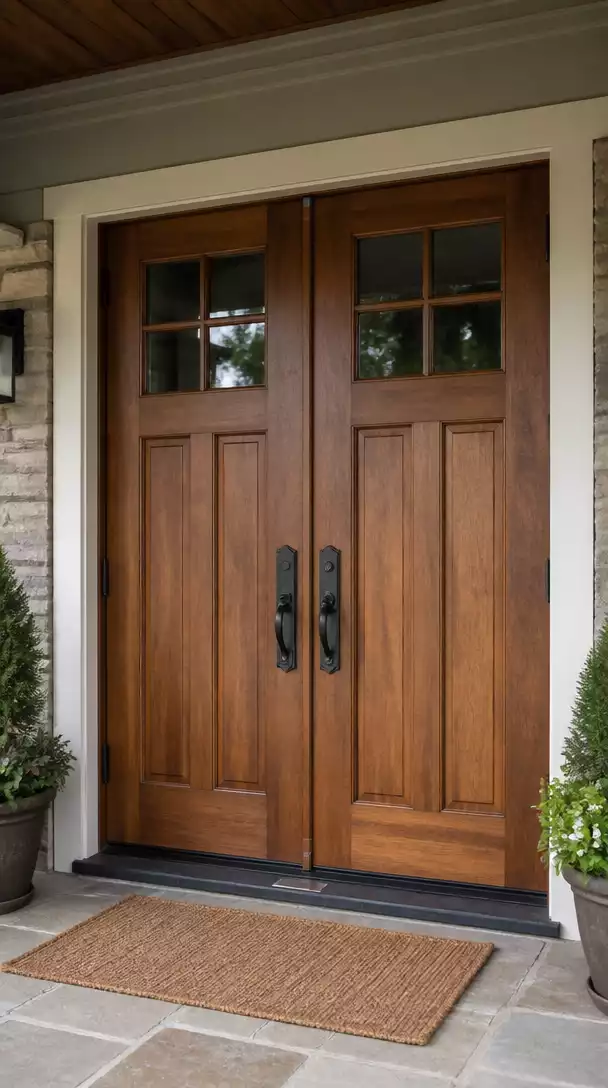
Most wooden double front doors fail because of poor engineering rather than bad weather. This guide bypasses the fluff to focus on the technical durability criteria you need for an entry that lasts 30+ years. It all starts with the biological makeup of the wood itself.
1. Wood Species: Selecting for Natural Tannins and Stability
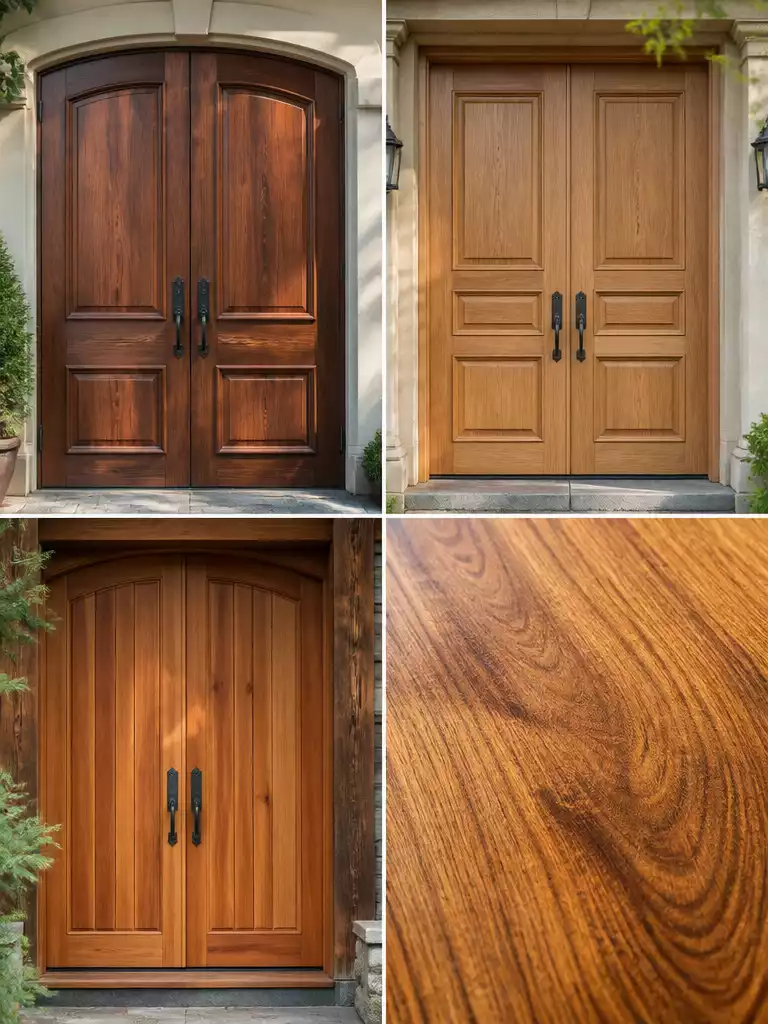
Choose a species rich in natural tannins to ensure your grand entrance resists rot for decades.
As an Amazon Associate I earn from qualifying purchases. Affiliate links may earn me a commission at no extra cost to you.
It is a common mistake to assume that any “hardwood” label guarantees a door will survive the elements. In reality, choosing a Walnut door for a humid, high-moisture climate is often a recipe for structural disaster compared to an option like Sapele.
The secret to a 30-year door lies in the Stability Hierarchy, which ranks wood by its biological resistance to movement. Sapele, a member of the Mahogany family, features an interlocking grain pattern that physically resists the “cupping” or bowing that often plagues wide double-door slabs.
| Wood Species | Rot Resistance | Stability (Warp Risk) | Best For |
|---|---|---|---|
| Sapele | Very High | Excellent | Humid or Variable Climates |
| White Oak | High (Tannic Acid) | Moderate | High-End Traditional Looks |
| Teak / Iroko | Exceptional | High | Coastal / Salt-Air Environments |
| Western Red Cedar | High | Low (Softwood) | Arid, Dry Climates |
When matching a species to your micro-climate, consider the tannic acid content. High-tannin woods like White Oak act as their own natural preservative, but they can blacken if exposed to iron-rich water or poor finishes.
For those living along the coast, Teak or Iroko are the only logical choices to prevent the salt air from degrading the wood fibers. Standard Oak in these environments will often degrade and lose structural integrity within just a few seasons.
Expert Insight: The Moisture Sweet Spot
Always ask your builder for the moisture content of the lumber at the time of the build. A door built at 6–8% moisture content is the gold standard; anything higher ensures the wood will shrink in winter, leaving a drafty gap between your double leaves.
Density is another critical metric, often measured by the Janka hardness scale. However, don’t view this as a measure of “toughness” against kicks or scratches, but rather as a proxy for how much moisture the wood fiber can physically absorb.
⚠️ RED FLAG: Paint-Grade Pine
Avoid using “Paint Grade” Pine or Alder for double doors. These species lack the natural oils and density required to stay square, leading to inevitable warping that prevents the doors from locking properly over time.
Once you have selected the right biological material, the next step is determining how those pieces are physically assembled. Choosing between a single slab and a layered system will dictate how the door handles seasonal stress.
.
📋 What to Check First Before Choosing Your Wood Species:
- Local Climate Patterns: Confirm humidity, temperature swings, and salt exposure to match the wood’s natural durability.
- Lumber Moisture Content: Ask your supplier to verify the wood’s moisture percentage is within the 6–8% ideal range before purchase.
- Wood Grain Orientation: Inspect door slabs for consistent interlocking grain to minimize warping and cupping over time.
Solid vs. Engineered Core: Why “Laminated” Beats “Solid”
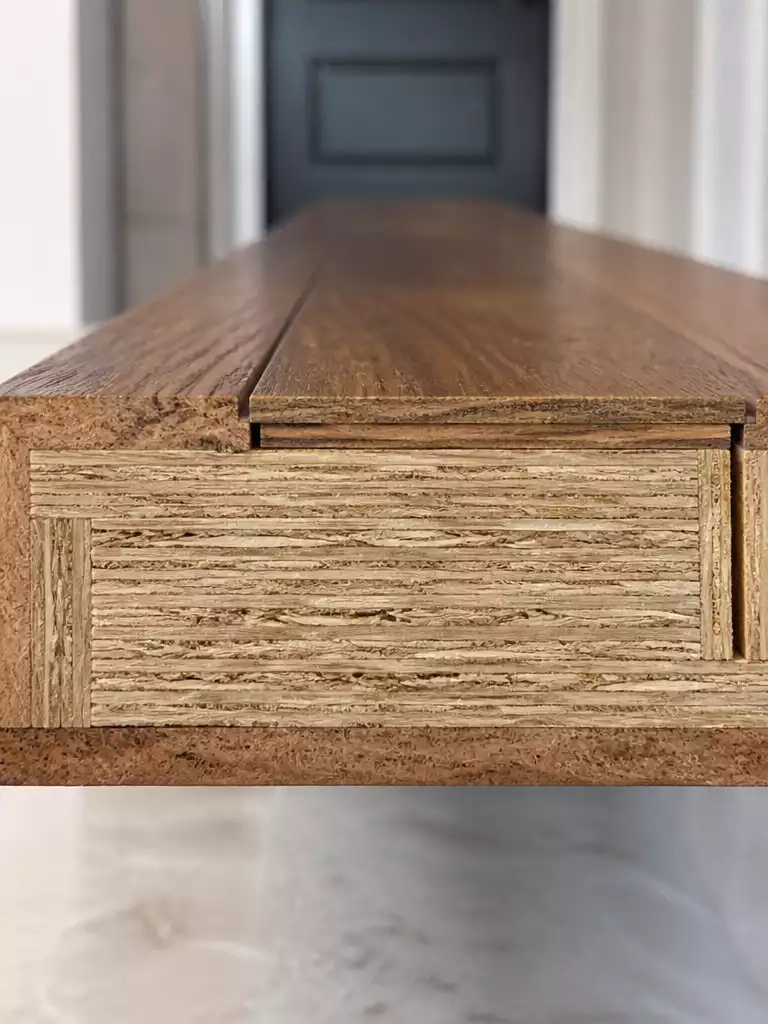
Advanced engineering ensures your double doors remain perfectly aligned and warp-free for decades of use.
There is a persistent “Solid Wood Fallacy” in the home improvement world—the belief that a single, continuous slab of timber is the gold standard for quality. While a solid oak slab sounds prestigious, it is often the primary reason double doors fail to latch properly after just one change in season.
In a double door configuration, the two slabs meet in the center without a fixed post to lock into. If a solid slab bows even 1/8th of an inch due to humidity, the deadbolt will no longer line up with the strike plate, compromising your home’s security and energy seal.
The “Sandwich” Strategy for Stability
Modern “Decade-Proof” doors utilize an engineered core, specifically Laminated Veneer Lumber (LVL). This construction acts like a structural sandwich where layers of wood are bonded with alternating grain directions.
- Grain Cancellation: Because the layers run perpendicular to one another, they “cancel out” the wood’s natural urge to twist or cup.
- Veneer Thickness: High-end doors use a 1/4″ saw-cut veneer rather than a paper-thin peel, allowing you to sand and refinish the door in the future just like solid wood.
- Stave Core Mechanics: Small vertical staves of wood are finger-jointed together, creating a spine that is significantly more rigid than a single piece of lumber.
Beyond warp resistance, engineered cores offer a hidden benefit for your home’s structural health: weight management. These cores are often lighter than a massive solid Oak slab, which prevents the long-term “sag” on the hinges that eventually causes double doors to scrape the threshold.
Expert Insight: When shopping, ask for the specific thickness of the exterior wear layer. If it is less than 1/8th of an inch, you won’t be able to safely sand out a deep scratch or refresh the stain later in the door’s life.
By choosing a laminated core, you are prioritizing the physics of stability over the marketing of “solid” wood. It’s the difference between a door that looks good on day one and a door that still clicks shut perfectly on year twenty.
.
📋 What to Check First Before Choosing Your Core:
- Core Thickness: Confirm the veneer wear layer is at least 1/4″ to allow sanding and refinishing down the line.
- Weight Consideration: Compare door weights to ensure your hinges and frame can support engineered cores without sagging.
- Grain Orientation: Ask how the laminations alternate grain direction to prevent warping in your specific climate.
Joinery and Construction: The Mortise-and-Tenon Standard
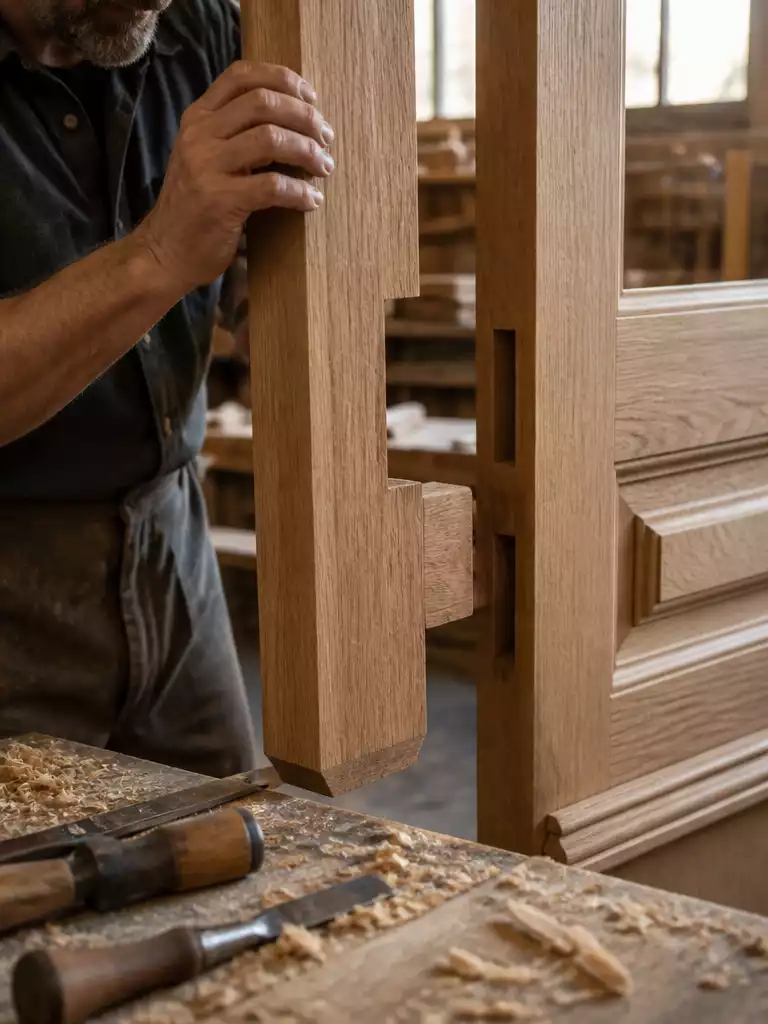
Precision-engineered joints ensure your double doors remain perfectly aligned and structurally sound for decades.
If your door is held together by “dowels and glue,” it is a temporary fixture rather than a permanent entry. Double doors lack a center post to lean on, meaning each 100lb+ leaf relies entirely on its internal skeletal strength to stay square.
The gold standard for this level of stress is mortise-and-tenon joinery, where a deep “tongue” of wood from the rail is inserted into a matching pocket in the stile. Unlike “coping” or simple dowel joints that can snap under the leverage of a heavy door, this interlocking connection provides massive surface area for structural bonding.
The Professional Construction Checklist
When reviewing a door’s build quality in a showroom, look for these three engineering markers of longevity:
- Pegged Joints: Look for small wooden pegs driven through the mortise; these mechanically lock the joint even if the adhesive eventually fails.
- Floating Panels: Ensure the large middle panels can “breathe” within a groove rather than being glued tight, which prevents the wood from cracking the frame during seasonal shifts.
- D4 Waterproof Glue: Ask if the manufacturer uses D4-rated structural adhesive, which is chemically designed to withstand constant exterior moisture.
Water management is the second half of the construction equation, particularly where glass meets wood. Quality builds utilize glazing beads and drainage systems that prevent water from pooling in the joints of decorative grids.
Check for “True Divided Lites” carefully; if the glass is one single pane with a grid stuck on top, ensure there are functional weep holes at the bottom. Without these, trapped condensation will rot the wood from the inside out before you even notice the finish peeling.
By prioritizing structural expansion gaps and deep-seated joints, you ensure the door won’t sag or “rack” over time. This precision is what keeps the two leaves meeting perfectly in the middle, season after season.
.
📋 What to Check First Before Committing to Joinery:
- Joint Fit and Cleanliness: Inspect that mortise-and-tenon joints fit snugly without gaps and show fresh, waterproof adhesive.
- Panel Movement Space: Confirm panels float freely within grooves—tight or glued panels lead to cracking and warping.
- Glazing Drainage: Look for functional weep holes or drainage channels behind glazing beads to prevent trapped moisture damage.
4. Climate Suitability: Matching Species to Exposure
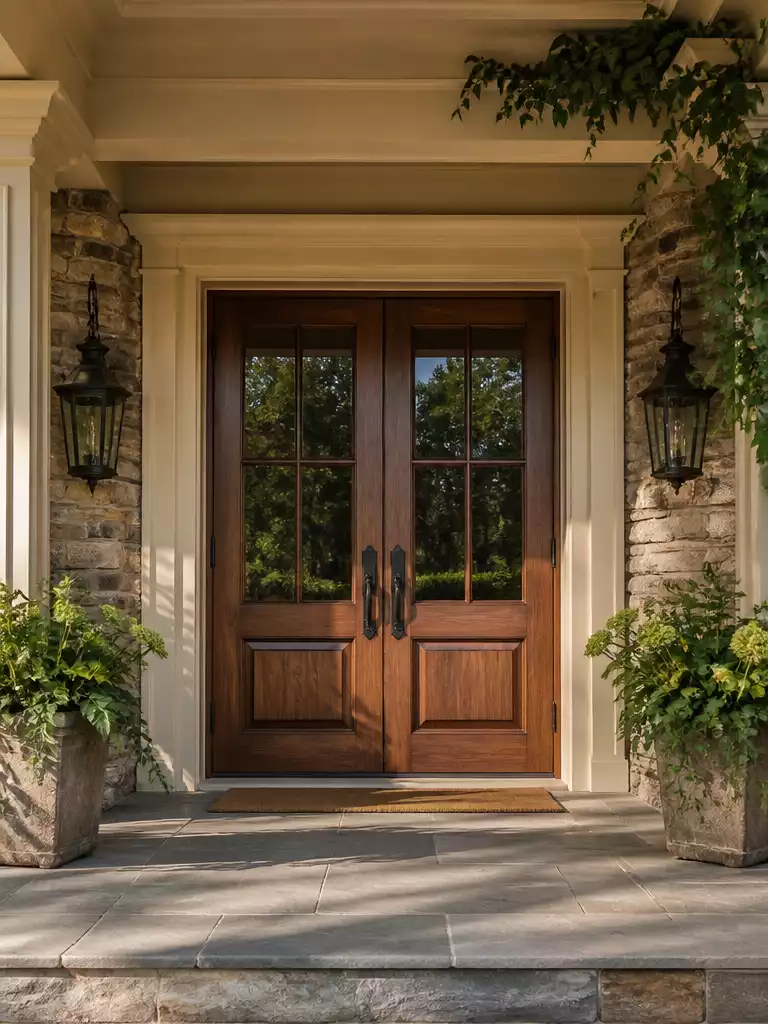
Strategic species selection ensures your grand entrance survives local humidity and harsh sun cycles.
A door that thrives in the dry heat of Arizona will delaminate in the humidity of South Carolina. Selecting the right wood is less about aesthetics and more about matching biological properties to your specific environmental stressors.
The Regional Species Guide:
- Arid Environments: Douglas Fir or Western Red Cedar handle low humidity without splintering or excessive shrinking.
- High Moisture Zones: African Mahogany (Sapele) is the workhorse for the Eastern Seaboard due to its natural resistance to fungal decay.
- Coastal Areas: Iroko or Teak are the only logical choices for salt-air environments where standard White Oak will blacken and degrade within seasons.
The Solar Heat Gain Coefficient plays a massive role in how often you’ll be out there with a scraper. Darker woods like Walnut absorb significantly more heat than lighter species like White Oak, which accelerates expansion and contraction cycles that eventually crack the finish.
Expert Insight: Follow the 1:1 or 1:2 ratio for survival. If your double doors are 8 feet tall, you need a 4-to-8-foot porch overhang to make real wood a viable decades-long option without constant refinishing.
Even the most durable species requires a physical barrier from direct UV and rain. Without a proper overhang, the sun’s rays will literally bake the moisture out of the wood fibers, leading to the dreaded “potato chip” warp that no amount of hardware can fix.
Even the best wood needs a raincoat to survive the first winter. Choosing the right finish is the next line of defense in your door’s structural integrity.
.
📋 What to Check First Before Choosing Your Wood Species:
- Local Climate Data: Confirm annual humidity and temperature swings to match wood species with environment stressors.
- Overhang Dimensions: Measure your porch or awning depth to ensure it meets the 1:1 or 1:2 door height ratio.
- Sun Exposure Orientation: Note whether doors face south or west, as this increases solar heat load impacting wood expansion.
Progress often feels gradual when focusing on technical details, but each step brings you closer to a door that truly endures. Even careful choices add up in creating lasting quality without rushing decisions. This approach is about building resilience over time, not chasing quick fixes.
⚡ Keep This in Mind:
- Climate matching is crucial—consider climate suitability before finalizing wood species.
- Understanding core construction helps you appreciate why engineered options outlast solid slabs; see solid vs engineered core.
- Patience with quality ensures your door lasts decades, not just seasons.
List 5 Finish and Sealant: The Barrier Against Fiber Breakdown
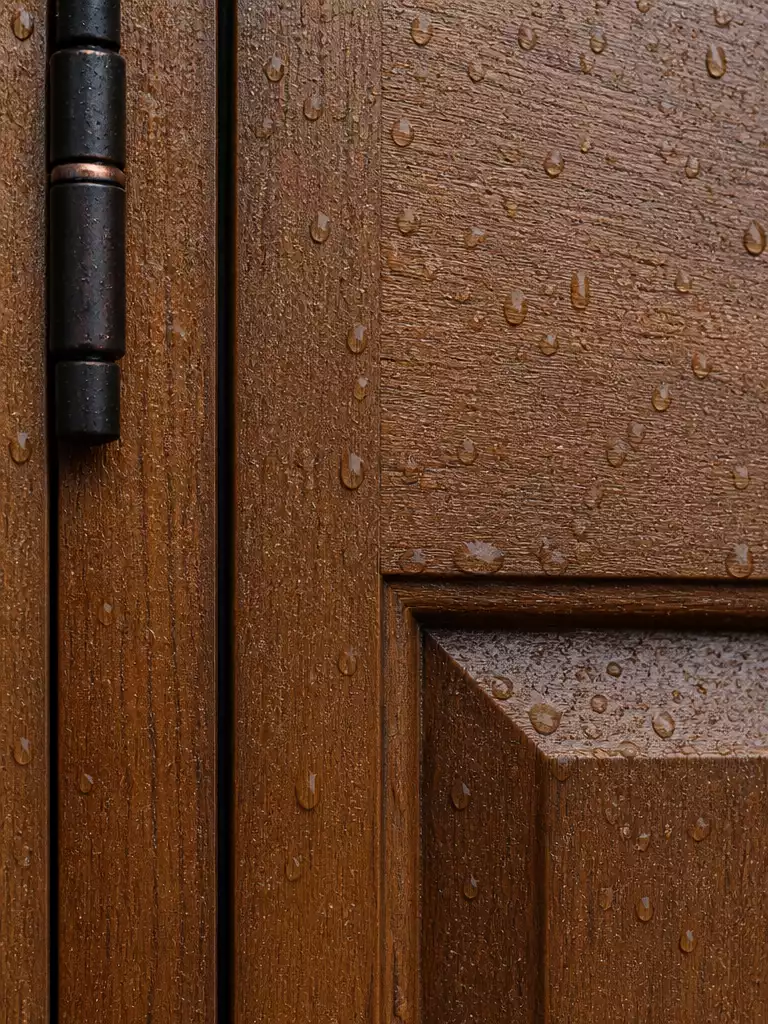
A professional-grade sealant creates an invisible shield that preserves the wood’s structural integrity for decades.
Forget the standard polyurethane you see on hardware store shelves; that brittle plastic coating is the fastest way to trap moisture inside your door. For a double entry to survive thirty years of expansion and contraction, you need a micro-porous finish that acts like a high-performance raincoat.
Professional-grade systems, such as those from Sikkens or Sansin, create a breathable film that blocks liquid water from entering while allowing internal water vapor to escape. This prevents the wood from “suffocating,” which is the primary cause of the peeling and graying seen on lower-quality finishes.
The Factory-Finished Advantage
Whenever possible, opt for a factory-applied finish rather than a job-site brush-on. In a controlled, dust-free environment, the door is typically “hung” and sprayed from all six sides—including the top and bottom edges—ensuring a 360-degree seal that lasts up to three times longer than manual application.
UV inhibitors are the second half of the durability equation, acting as a high-SPF sunscreen for your door’s lignin fibers. Without these stabilizers, the sun’s rays will chemically break down the wood’s surface, causing the finish to lose its bond and flake away within a single season.
Even the most advanced clear coats aren’t a “one and done” solution, as wood remains a biological material that reacts to its environment. Maintaining that barrier requires a disciplined schedule to ensure the fiber never stays exposed to the elements.
The “Maintenance-Free” Myth
Beware of any salesperson claiming a wood door never needs a top-coat refresher; they are simply setting you up for structural failure. A 3-5 year buff and coat schedule is the non-negotiable price of a 30-year lifespan, especially on south-facing entries with high UV exposure.
When you see the finish starting to look dull or “dry,” it’s time to act before the wood itself begins to check or crack. A simple light scuff and a fresh layer of the original sealant will keep the core protected without the need for a full, labor-intensive strip and sand down the road.
.
💡 Practical Tips That Work for Finishing Your Door:
- Edge Sealing: Always verify that the top, bottom, and all edges are fully sealed to prevent moisture penetration.
- Test Water Beading: After finishing, sprinkle water and watch for beading; flat absorption signals missed spots.
- Spot Refurbish: Keep original finish brand handy to spot-apply wear areas without full re-coating or sanding.
6. Panel Style and Proportions: Structural Expansion Gaps
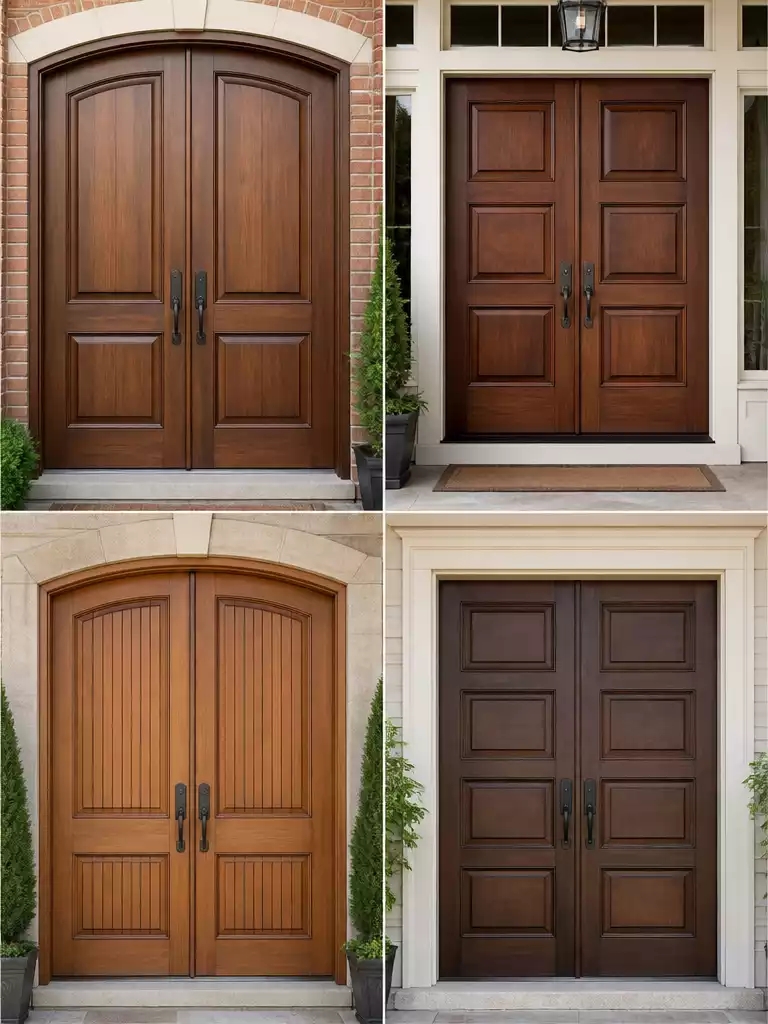
Smart panel engineering ensures your double doors remain perfectly aligned and warp-free through every season.
Large, flat “Modern” slabs are often the hardest to keep straight over time because wood is a living material that wants to move. Traditional multi-panel designs aren’t just a style choice; they are actually a brilliant engineering trick for long-term structural survival.
The “Small Panel” Advantage
Think of each individual panel in a door as a pressure relief valve. By breaking a large double-door leaf into four or six smaller panels, you create multiple expansion joints that distribute wood movement across the frame.
- Distribution of Stress: Smaller panels prevent the entire slab from acting like one giant sail that bows or cups when humidity spikes.
- Floating Technology: High-quality panels “float” in deep grooves rather than being glued tight, allowing the wood to breathe without cracking the outer frame.
- Wind Resistance: Raised panels provide more “meat” at the edges where they sit inside the stiles, offering significantly better resistance against heavy wind loads.
The “spine” of your double door is formed by the stiles—the vertical side pieces—and the rails, which are the horizontal sections. For a double-door system to support its own massive weight and the lockset hardware without cracking, these stiles must be at least 5 to 6 inches wide.
Expert Insight for Heavy-Use Entries: Choose a 4-panel or 6-panel configuration for maximum longevity. The increased number of horizontal rails adds essential racking resistance, which keeps the doors perfectly square and prevents them from dragging on the threshold over the next 30 years.
When you choose a design with substantial stile and rail proportions, you are investing in the door’s ability to resist the “potato chip” effect. This ensures that even in high-moisture climates, the two leaves of your double entry will continue to meet perfectly in the center without Gaps or binding.
.
🛠️ Practical Tips for Panel Style Selection:
- Panel Size Balance: Opt for panels neither too small nor too large to maximize expansion without weakening the structure.
- Edge Detailing: Choose raised panels with deep grooves to improve fit and block moisture intrusion in joints.
- Proportion Check: Verify stile widths support your hardware load—avoid narrow stiles to prevent cracking over time.
7. Glass Options: Thermal Seals and Weight Distribution
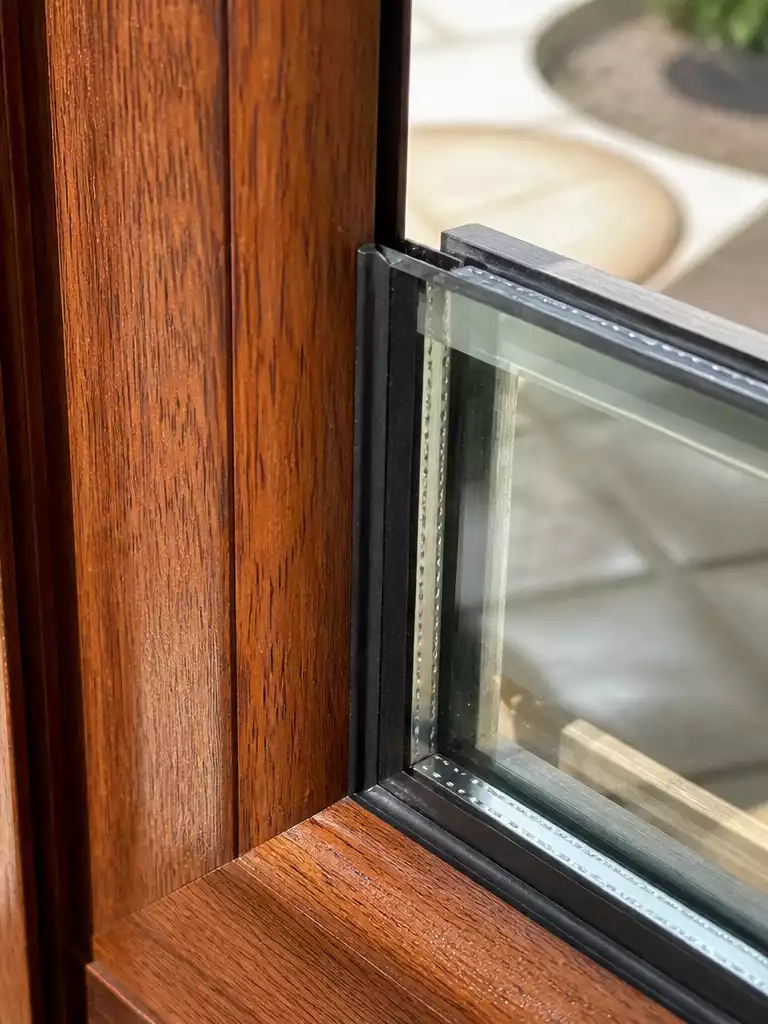
Expertly engineered glass inserts provide thermal efficiency and structural stability for your grand double entry.
Glass in a double door isn’t just a window; it’s a structural component that can either stabilize or stress the wood frame. Because double doors lack a center post, the glass units must be engineered to handle the kinetic energy of two heavy slabs swinging and latching simultaneously.
A double door with full-length glass inserts is incredibly heavy, often adding 50 to 100 pounds per leaf. This massive weight load requires “triple-strapping” the door frame directly into the house studs to prevent the jamb from pulling away over time.
| Glass Type | Best For | Durability Benefit |
|---|---|---|
| Dual-Pane Tempered | Standard Climate | Basic thermal resistance; safety if broken. |
| Laminated Impact | Coastal / Storm Zones | Prevents wind-tunnel effects that rip doors off hinges. |
| Low-E Coated | High UV Exposure | Protects interior wood finish from solar degradation. |
The “Muntin” Mistake
Avoid “removable” wood grilles that snap onto the outside of the glass. These trap standing water against the wood frame and muntin joints, leading to premature rot; instead, specify Between-The-Glass or Fixed grilles for a permanent seal.
In high-wind or coastal areas, impact-rated glass is more than a safety feature—it is a structural necessity. This specialized glass stays within the frame even if shattered, preventing the sudden pressure change that can physically blow double doors inward during a major storm.
.
📋 What to Check First Before Choosing Glass Inserts:
- Frame Reinforcement: Confirm your door frame is triple-strapped to studs to support the added glass weight over time.
- Seal Quality: Inspect the warm edge spacer and silicone seals on IGUs to ensure durability during wood expansion cycles.
- Grille Type: Choose fixed or between-the-glass muntins to avoid trapped moisture that causes rot around wooden grids.
8. Hardware Compatibility: Managing the Mass of Double Slabs
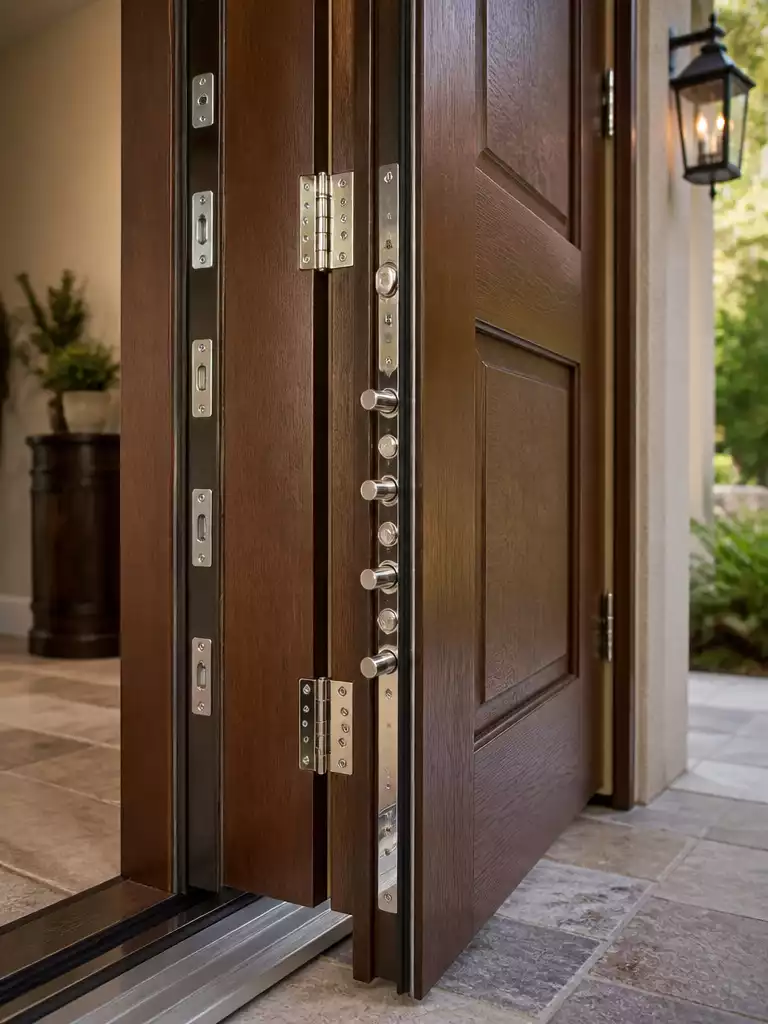
Heavy-duty hardware ensures your massive double doors remain perfectly aligned and draft-free for decades.
Standard hinges and single-point deadbolts are the primary reason double doors eventually sag and leak air. When you are dealing with two massive slabs of wood, the hardware isn’t just a decorative accessory; it is the structural anchor that keeps the system functional.
The Non-Negotiable Hardware Trio
- Multi-Point Locking Systems: A 3-point lock latches at the top, middle, and bottom simultaneously. This physically pulls the wood into the weatherstripping along the entire height, preventing the common “bowing” effect.
- Ball-Bearing Hinges: Standard brass hinges will eventually grind down and squeak under the weight of solid wood. Ball-bearing versions allow for smooth operation without the metal-on-metal friction that leads to sagging.
- Heavy-Duty Flush Bolts: These secure the “inactive” leaf into the header and threshold. If these are flimsy, the whole double-door system will rattle or vibrate every time the wind picks up.
The number of hinges matters just as much as the type. For any double door over 7 feet tall, you must specify 4 hinges per door rather than the standard 3 to distribute the significant vertical load.
Mistake to Avoid: Never use standard residential-grade hinges for 2-1/4″ thick wood slabs. The weight will eventually shear the screws or pull the hinges out of the jamb, causing the doors to scrape the threshold.
Over 20 years, your house will naturally settle, which can throw the alignment of double doors off by fractions of an inch. Ensure your hardware is adjustable; modern adjustable hinges allow you to realign the leaves with a simple Allen wrench in 5 minutes.
“Pro-tip: High-performance multi-point locks aren’t just for security—they provide the necessary compression to maintain an airtight seal against seasonal wood movement.”
Finally, consider the interaction between the active and inactive leaves. A high-quality astragal (the vertical strip where the doors meet) must be paired with structural bolts that reach deep into the framing of the house to keep the center point rigid.
.
📋 What to Check First Before Choosing Hardware:
- Door Weight: Confirm the total weight of each door leaf to specify hinges and locks rated for that load.
- Frame Reinforcement: Check if your door frame has solid blocking or reinforcement to anchor heavy-duty hardware securely.
- Clearance Space: Measure the gap between doors and threshold to ensure flush bolts and locks operate smoothly without binding.
9. Sizing and Standard Openings: Avoiding Custom-Cut Risks
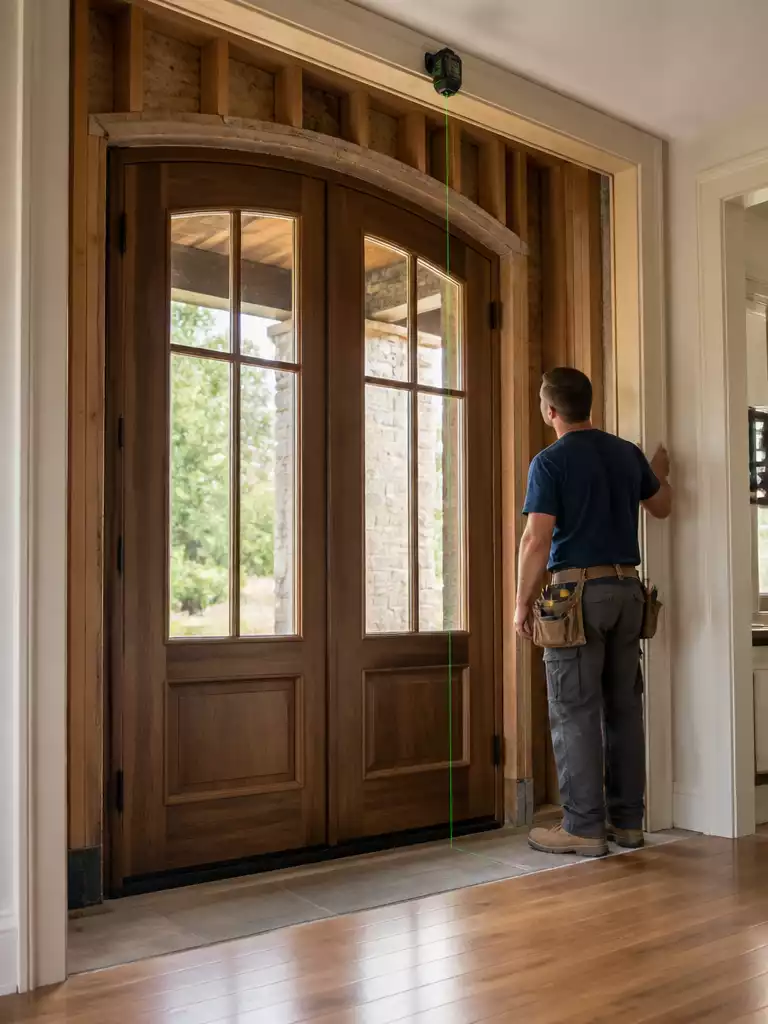
Precision sizing ensures your grand entrance remains structurally sound and perfectly aligned for decades.
Custom-sizing a door by “shaving down” a standard slab is one of the fastest ways to invite failure. When you trim more than a fraction of an inch off the edges, you destroy the factory seal and expose the sensitive inner core to moisture.
Standard widths for double door pairs are typically 60 or 72 inches. If you deviate into custom territory, many manufacturers compromise the structural “spine” by using thinner stiles to meet the dimensions, which leaves your door vulnerable to sagging under its own weight.
The “High-Boy” Rule for 8-Foot Doors
If you are opting for the dramatic look of 8-foot-tall doors, standard thickness simply won’t cut it. You must specify a 2-1/4 inch thickness instead of the standard 1-3/4 inch to prevent the “potato chip” effect—a common type of warping where the tall, thin slab twists at the corners.
The rough opening requires exactly 1/2-inch of “wiggle room” to account for natural home settling and seasonal shifts. If the fit is too tight, the wood has no space to expand during humid summers, leading to jammed locks and sticking frames.
Sizing Checklist for Longevity
- Standard Widths: Stick to 60″ or 72″ total widths to maintain full-strength vertical stiles.
- Thickness Upgrade: Always move to 2-1/4″ thickness for any door over 84 inches tall.
- Expansion Gap: Verify a minimum 1/2″ clearance in the rough opening for seasonal movement.
- Separate Sidelites: Choose “boxed” units rather than a single frame to provide better structural support.
Avoid sidelites that are integrated into the same continuous wood frame if you can. Using separate boxed units provides a much more rigid support structure, ensuring the heavy weight of the double doors doesn’t cause the entire assembly to rack or bow over time.
.
📋 What to Check First When Measuring:
- Rough Opening Size: Measure width and height at multiple points to identify any irregularities or uneven framing.
- Level and Plumb: Confirm the opening is square, level, and plumb with a laser level or carpenter’s square before ordering.
- Clearance Space: Check inside and outside for any trim, threshold, or flooring that might reduce the available width or height.
10. Installation Quality: Weatherstripping and Thresholds
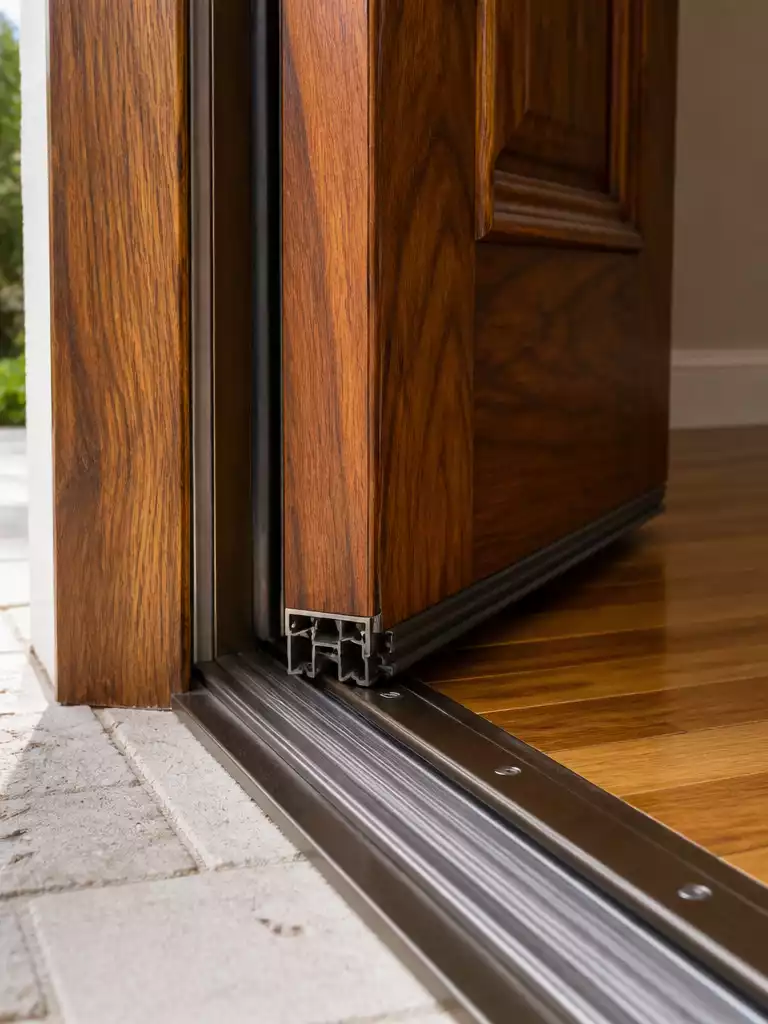
Precision sealing at the threshold ensures your investment stays dry and draft-free for decades.
A $10,000 door installed with $20 caulk will fail in three seasons. Even the most structurally sound Sapele or White Oak slabs cannot overcome the physics of a poorly sealed opening.
When dealing with double doors, the biggest vulnerability is the “astragal”—the vertical seam where the two doors meet. Without a precision-fit seal and a specialized threshold, driving rain can be forced upward and under the door by wind pressure.
The Hardware That Stops the Rot
- High-Dam Interlocking Sills: Unlike flat thresholds, these feature a raised metal “dam” that physically blocks water from blowing under the door leaves.
- Kerf-Inserted Silicone: Skip the sticky-back foam tape; professional installers use silicone gaskets tucked into a pre-cut groove (kerf), which maintains “memory” and seal for 20 years.
- Astragal Boots: This small rubber component at the base of the center strip seals the “daylight gap” where the doors meet the threshold.
Installation isn’t just about the seals; it is about managing the massive weight of the wood. A sagging door eventually drags across the threshold, tearing the weatherstripping and inviting moisture into the end grain.
Expert Insight: Demand that your installer uses “Long-Screws” in at least two holes per hinge. These must reach through the decorative jamb and deep into the house’s 2×4 framing studs to prevent the heavy doors from pulling the frame out of square.
The “Three-Season” Mistake
If your installer fails to seal the top and bottom “end grain” of the door before hanging it, the wood will act like a bundle of straws. It will suck up puddle water or humidity, causing the core to swell and delaminate regardless of how expensive the front finish was.
Once the seals are compressed and the hinges are anchored to the structure, the “Decades not Seasons” clock starts ticking. A perfectly hung door should feel airtight yet close with a gentle click rather than a shove.
.
📋 What to Check First Before Installation:
- Threshold Level: Confirm the door threshold is perfectly level to ensure consistent compression of weatherstripping.
- Door Alignment: Check that both door leaves align flush with each other and the jamb to avoid air gaps or binding.
- End Grain Sealing: Verify all exposed door edges, especially bottoms, are sealed before hanging to prevent moisture ingress.
11. Maintenance Schedule: The Reality of the 30-Year Lifespan
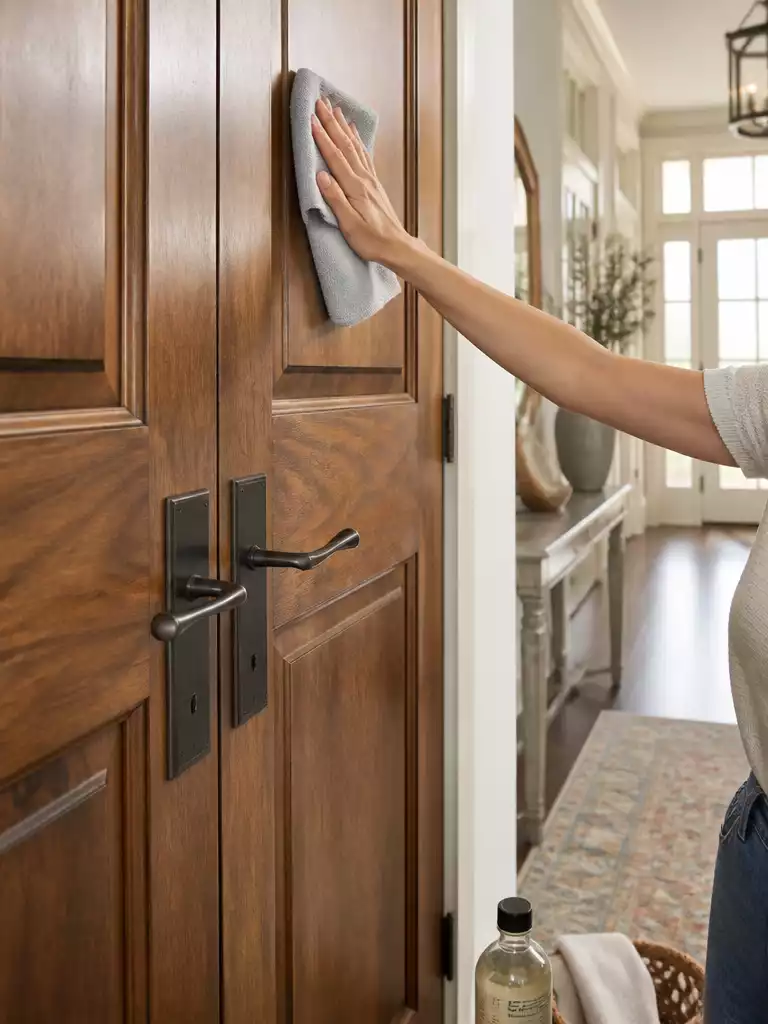
Protect your investment with a proactive care routine that keeps wood looking furniture-grade for decades.
Wood is a biological material that remains “active” long after it leaves the workshop. To reach a 30-year lifespan, you must treat your double doors like a high-performance vehicle that requires scheduled maintenance rather than a “set it and forget it” appliance.
The Proactive Preservation Checklist
- The Semi-Annual Inspection: Every spring and autumn, run your hand along the bottom edge of the door slabs to feel for “checking.” These tiny, hairline cracks in the wood fiber are the first warning sign that your protective finish is thinning.
- The “Buff and Coat” Rhythm: You don’t need to sand your doors down to bare wood if you stay ahead of the curve. Applying a fresh topcoat every 3 to 5 years prevents UV rays from breaking down the lignin that holds wood fibers together.
- Hardware Mechanical Care: Double doors feature heavy internal locking systems that can create friction as the house settles. Apply a dry graphite or silicone spray to the multi-point lock and hinges annually to prevent mechanical stress from cracking the wood around the handle-hole.
The “South Facing” Penalty: If your entry faces South or West, the UV load is up to 4x higher than a North-facing door. You must halve your maintenance intervals; a “buff and coat” every 2 years is often required to prevent permanent sun bleaching.
Ignoring the finish until it starts peeling is the most expensive mistake a homeowner can make. By the time a finish flakes, moisture has already begun to saturate the grain, leading to the structural rot that no amount of restaining can truly fix.
“A well-maintained Sapele or White Oak door doesn’t just last; it patinas. The small effort of a weekend topcoat every few years is what separates a door that rots in a decade from one that becomes a permanent architectural feature.”
Consistency is the secret to longevity. Once the hardware is lubed and the finish is inspected, your “Decades not Seasons” clock remains securely in the green.
.
📋 What to Check First Before Installation:
- Threshold Level: Confirm the threshold is perfectly level to ensure water drains away and seals close tightly without gaps.
- Weatherstripping Fit: Check that kerf-inserted silicone gaskets sit flush and compress evenly when doors close.
- Hinge Screw Depth: Verify the installer uses long screws anchoring hinges into framing studs for lasting support and to prevent sag.
12. Cost vs. Longevity: Calculating the ROI
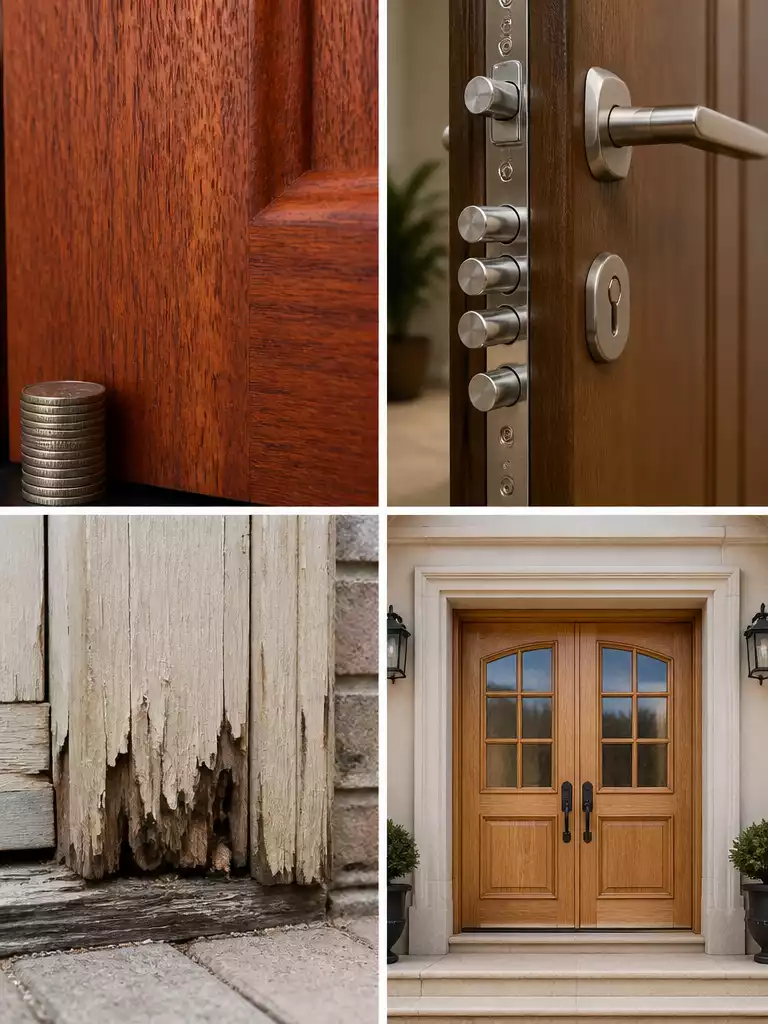
Investing in superior materials now prevents the high cost and headache of early door replacement.
When you are staring at a quote for an $8,000 Sapele double door, it is easy to feel sticker shock, especially when a “solid wood” big-box alternative sits at $2,500. However, the lower price tag is often a down payment on a replacement project seven years down the line.
The true cost of a front door isn’t the checkout price; it’s the “cost per year of service.” A cheap door that warps or rots quickly requires a full tear-out, new trim, and professional re-installation, effectively doubling your initial “savings.”
| Factor | “Budget” Option | “Decades” Tier |
|---|---|---|
| Initial Cost | $2,500 – $3,000 | $7,000 – $9,000 |
| Expected Lifespan | 5 – 8 Years | 30 – 50+ Years |
| Cost Per Year | ~$500 / year | ~$200 / year |
Beyond the raw math of the door itself, consider the impact on your monthly overhead. A high-quality, warp-free seal can save between $10 and $20 per month on HVAC bills by eliminating the drafts that plague cheap double doors.
There is also the matter of appraisal value; real estate professionals frequently cite “furniture-grade” mahogany or oak entries as significant architectural features. Unlike trendy decor, a structurally sound wood entry is a tangible asset that justifies a higher resale price.
Budget Strategy Tip
If your current budget cannot stretch to the $8,000 Sapele or White Oak tier, avoid the temptation to buy a $3,000 “solid” Pine door. You are better off choosing a high-quality fiberglass door that mimics wood; only invest in real timber if you can afford the “Decades” tier materials and construction methods.
Ultimately, choosing the premium option is a strategic move for homeowners who value their time as much as their money. You are paying to avoid the future labor of sanding, the frustration of sticking locks, and the inevitable cost of a second installation.
.
📋 Before You Install: Key Quality Checks
- Threshold Alignment: Confirm the sill’s interlocking design mates perfectly with the astragal seal to block water intrusion.
- Weatherstrip Type: Verify weatherstripping is silicone-based and kerf-inserted, not just foam tape or sticky-back strips.
- Hinge Fastening: Check that hinge screws penetrate framing studs deeply to prevent door sagging over time.
You now have a well-rounded understanding of what makes wooden double front doors durable and enduring. There’s no need to implement every detail at once; focusing on a few key factors can make a meaningful difference in longevity and performance.
With each thoughtful choice you make, your entryway becomes a lasting investment in comfort and protection. Exploring these insights encourages confidence in selecting doors that truly stand the test of time.