
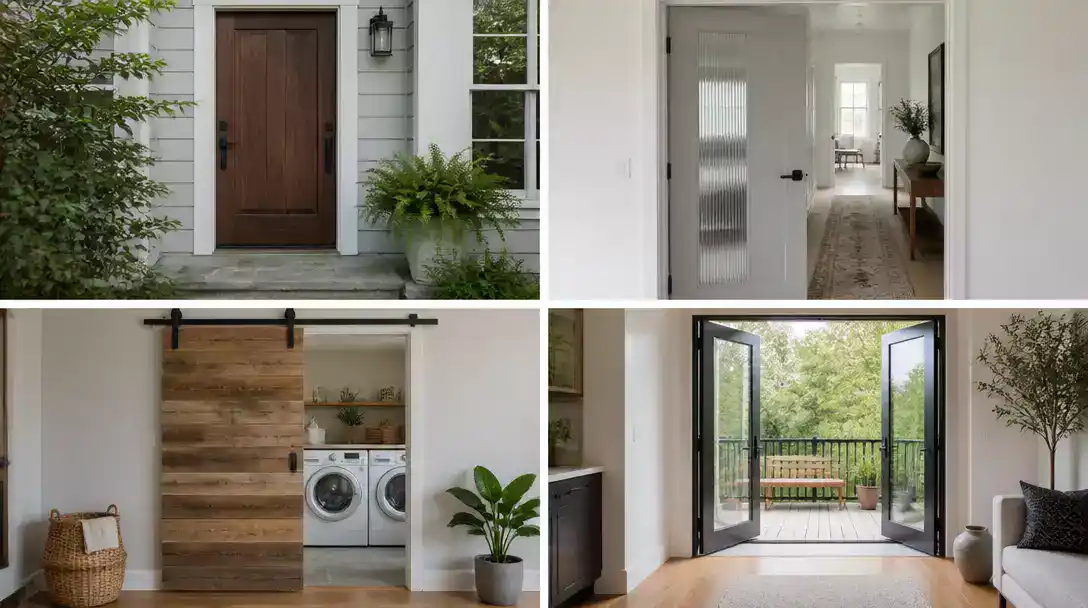
Most doors force you to pick between looking good and being secure—or between saving space and letting in light. These 10 door ideas solve for style, security, and function in equal measure, ranked by real‑world impact—starting with the one that anchors your curb appeal.
Solid Wood Entry Doors
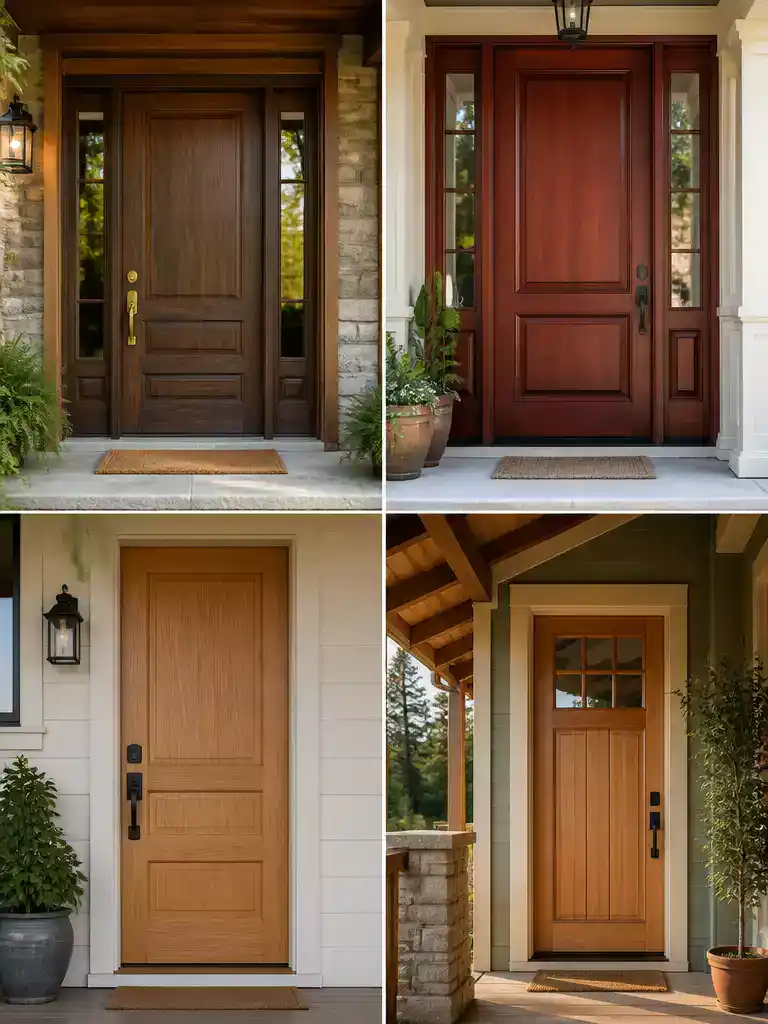
A walnut entry door that grows richer every season—no other material delivers this kind of transformation.
As an Amazon Associate I earn from qualifying purchases. Affiliate links may earn me a commission at no extra cost to you.
You hear it before you see it. A closed fist against a solid wood door lands with a deep, muted thud—not the hollow ping of steel or the plastic rattle of fiberglass.
That sound alone tells you the door is substantial, and it is: a 1¾-inch slab of walnut, mahogany, or white oak weighs enough that casual forced entry isn’t happening without serious effort.
This is the door for homeowners who want their entry to anchor curb appeal with real material presence. Skip it if you’re unwilling to refinish every few years or if a west-facing entry bakes in afternoon sun without an overhang.
The grain itself shifts through the seasons. In dry winter air, panels contract slightly and the grain lines become more pronounced; come humid summer, the door swells back into its frame.
That movement isn’t a flaw—it’s the tradeoff for a door that can be sanded down and refinished after two decades of sun and rain. Steel can’t do that.
Fiberglass can’t either. A solid wood door, properly maintained, lasts 50 years or more. That’s why the upfront cost of $2,000–$5,000 uninstalled makes sense when you amortize it across half a century.
Pro Tip: Choose Your Species for Sun Exposure
West-facing entries that bake in afternoon sun need a stable species like mahogany or fir—not cherry, which develops heat checks. A deep overhang or storm door extends the finish life by years.
On security: the door’s weight intimidates, but the real strength comes from a high-quality deadbolt anchored into the solid frame. Pair it with a reinforced strike plate and 3-inch screws driven into the studs.
No metal skin means it won’t stop a determined crowbar the way steel will. If forced entry is your top fear, skip this door. If pride of material matters more, solid wood delivers something no other door can: a physical transformation you watch from the street, season by season.
Factory-finished doors ship ready to install in a set stain and sheen, while site-finishing gives you full control over the exact tone—worth the effort if you’re matching existing shutters or a custom trim color.
But if you’re less interested in spending weekends re-coating a door and more concerned about a steel-reinforced barrier, steel security doors take a different approach entirely.
.
{!output-tips-writer-1}
Steel Security Doors
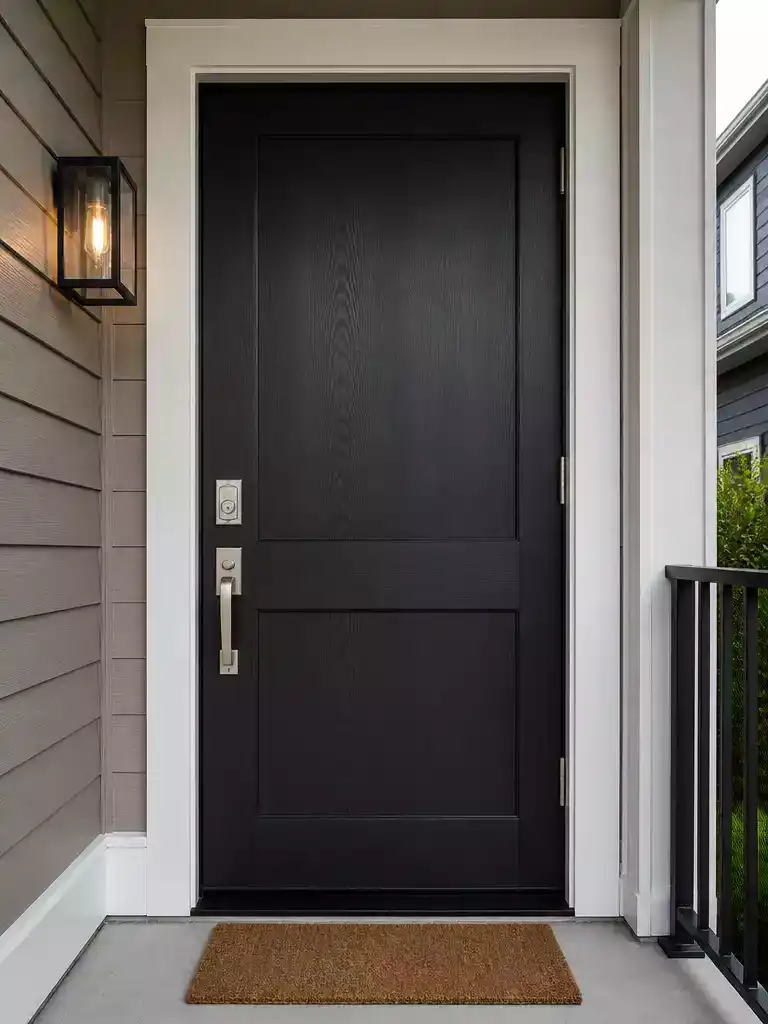
A steel door that passes for painted wood until it shrugs off a crowbar without a scratch.
After a break-in scare or in a neighborhood where security decides every exterior choice, a steel door stops being overkill—it’s the logical pick. Today’s versions don’t look like bank vaults; they come with embossed woodgrain finishes that read as painted oak or mahogany from the curb.
Both gauges still beat wood and fiberglass for sheer intrusion resistance. A quality steel door won’t splinter under a kick, and the polyurethane foam core gives it an R‑value higher than solid wood—no storm door needed in moderate climates.
Common mistake: assuming all steel doors look cheap and magnetic. The best 24‑gauge units use a textured powder coating that hides scratches and feels like satin metal, not a filing cabinet. Always check the manufacturer’s rust-through warranty—a 10‑year or lifetime perforation guarantee separates a real entry door from a disposable box-store slab.
Dent resistance is where you make the real trade‑off. Steel is harder to dent than wood or fiberglass, but if a hard hit goes through the coating, you can’t sand it out. For families with bikes and hockey sticks, touch‑up paint lives near the door; for everyone else, the ding just won’t happen often enough to matter.
Most steel doors come pre‑hung in a frame, which cuts installation time by half a day. Expect to spend $800–$2,500 installed, depending on gauge, glass, and finish complexity—that’s a fraction of what a solid wood door costs while delivering far tougher security.
Money note: The base price looks low, but a factory‑applied woodgrain finish and a multipoint locking system can add $400–$900. Order the door pre‑finished if you want zero maintenance in year one.
Steel handles the security piece brilliantly, but it can’t shake the metallic coldness. That’s where fiberglass front doors step in—giving you the look of wood and the resilience of a battleship.
.
{!output-tips-writer-2}
Fiberglass Front Doors
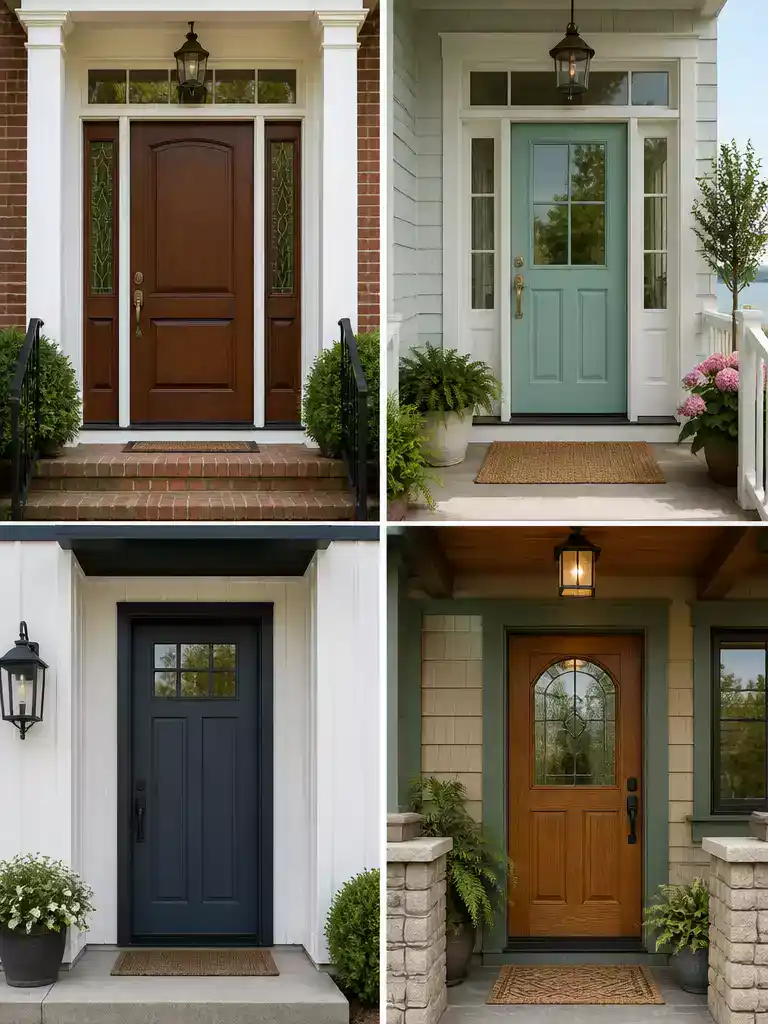
A wood-grain door that laughs off salt air and blazing sun for over a decade.
If your front door faces salt spray, blazing afternoon sun, or rainy winters, fiberglass is the low-maintenance mimic that never warps, rots, or rusts. It’s the only door material that pairs a convincing wood grain with a shrug at coastal humidity and relentless UV exposure.
Manufacturers press actual oak, mahogany, or fir grain textures right into the gel coat, so the surface reads as authentic—even up close. A stain-grade fiberglass door with a UV-cured topcoat holds its color for 15+ years without refinishing, while solid wood needs a recoat every 3–5 seasons and painted steel can chalk in direct sun.
Beyond the finish, the polyurethane foam core gives fiberglass the highest R‑value of any common entry door material. That translates to real energy savings in extreme heat or cold, no storm door required.
- Won’t warp, split, or swell—even in 90% humidity
- Dents and deep scratches can be filled with auto‑body filler and sanded smooth, unlike wood that splinters
- Cost ranges from $1,200 to $4,000, sitting between steel and solid wood in price but often outlasting both
- Available primed or stainable—you control the exact tone
Smart Budget Move:
Buy a stainable fiberglass door (not primed only) and finish it yourself with gel stain to match your shutters or trim. This cuts $300–$500 off the final price compared to a factory‑finished unit—and the result looks completely custom.
Hinge Alert: Fiberglass doors are heavier than steel. Plan for three heavy‑duty ball‑bearing hinges and long screws driven into the framing—skip the short screws that come with the hinge pack, or the door will sag within a year.
If you’d rather skip the yearly sealing ritual of solid wood and the metallic coldness of steel, this is your door. Fiberglass takes everything the weather throws at it and still reads as a warm, wood‑focused entry.
Fiberglass handles exterior abuse beautifully. Shifting indoors, the next door idea transforms dark rooms by letting light travel—without giving up privacy.
.
{!output-tips-writer-3}
Glass Panel Interior Doors
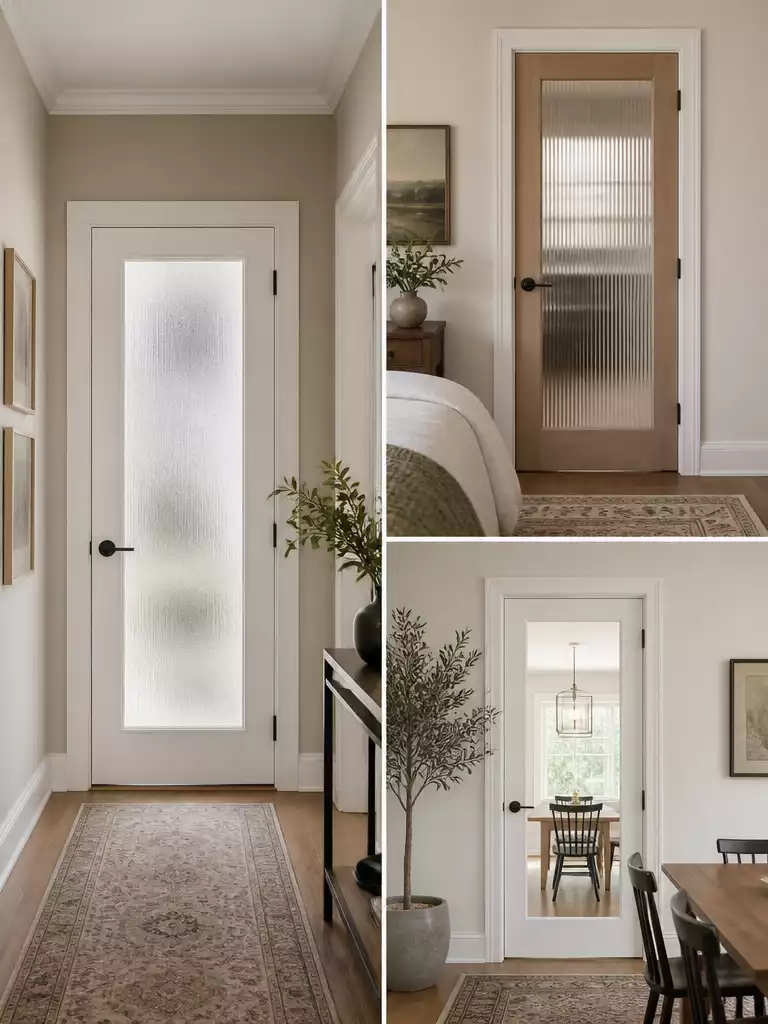
Borrowed daylight transforms a dark hallway into a bright, open-feeling gallery.
A windowless hallway where every door is a flat slab can feel like a tunnel. Swap one of those solid slabs for a glass panel door and daylight from the master bedroom floods the corridor, doubling the sense of space without knocking out a single wall.
Glass panel interior doors borrow light and keep rooms visually connected while preserving clear boundaries. The trick is pairing the right glass type with the room’s privacy needs and the frame material that fits your home’s age and style.
Frame material dictates whether the door feels like considered furniture or a builder-grade afterthought. Painted MDF keeps costs low and paints easily; solid wood frames add warmth and authentic grain that changes over time; thin black metal frames lean crisp and industrial.
Pro tip: A single-panel frosted glass door can replace a windowless bathroom door, borrowing light to make the tiny powder room feel spa‑like while still keeping the view privately blurred. Just make certain the glass is tempered—it’s a safety must for doors and any glass within 24 inches of a door edge.
For privacy, reeded glass obscures shapes from about 3 feet away, while frosted glass blurs details from 1 foot. If you’re placing a glass door right off a busy hallway where people walk inches away, reeded is the safer visual bet.
Standard interior widths—28, 30, 32, and 36 inches—work with most pre‑hung glass panel options. Ordering a custom oversize glass panel or a specialty texture usually adds $200 or more to the slab price, so staying off the shelf keeps the project predictable.
Hollow‑core versions cost less but pass sound straight through. A solid‑core glass panel door with laminated acoustic glass provides meaningful noise dampening—worth the upgrade when the door separates a lively kitchen from a bedroom.
Glass panel doors borrow light; sliding barn doors borrow nothing—they hang on the wall as functional art and save every inch of floor space.
.
{!output-tips-writer-4}
A confident entryway isn’t about spending the most—it’s about spending where it counts. A few smart calls with your budget save more regret than chasing every upgrade.
💡 Worth Your Attention:
- Standard door sizes cut costs by 30–50% over custom widths—your rough opening is easier to adjust than your budget.
- Hardware bought separately online often runs 20% less than supplier bundles—the same model, just sourced smarter.
- Architectural salvage yards still hold solid wood doors for a fraction of new—a century-old oak slab with character no factory replicates.
Sliding Barn Doors
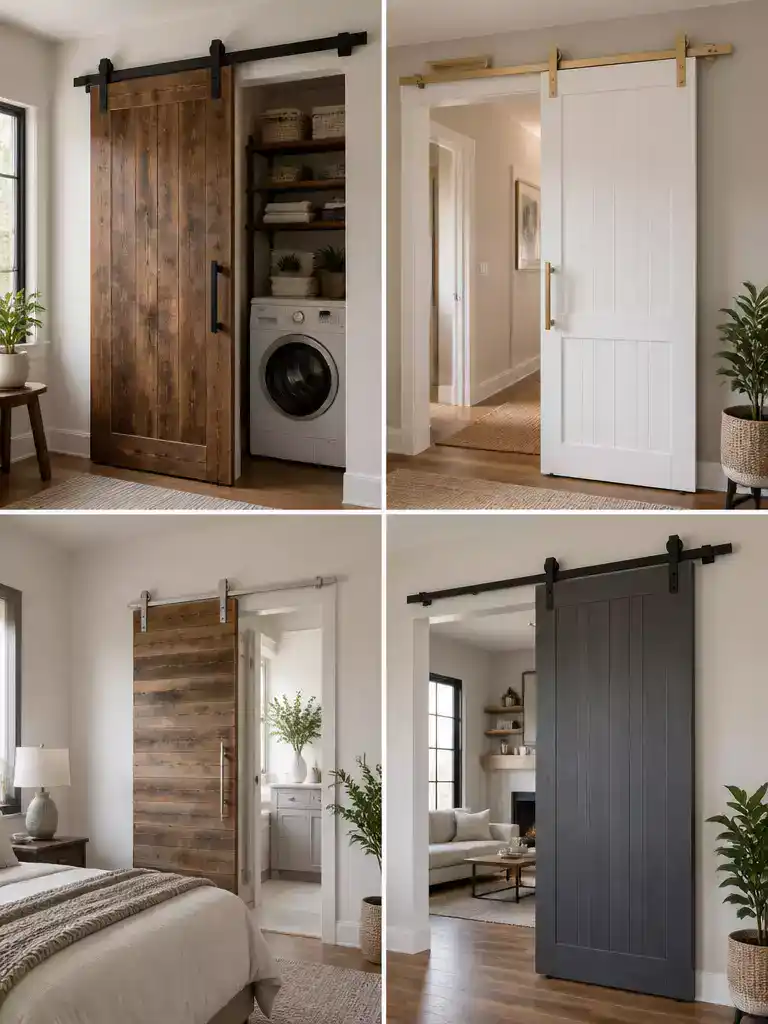
A solid wood slab on a rust-finished track turns a laundry closet into a design feature.
In a room where a swinging door would block a walkway or hit furniture, a barn door glides parallel to the wall, saving floor space and turning a functional piece into a focal wall. The hardware makes 90% of the look, so pick a finish that hits the right note.
Hardware quick-pick: matte black steel straps for an industrial edge, brushed brass rollers for a warmer modern feel, or stainless-steel systems when you want the track to nearly disappear.
The track length must be double the door width—measure your opening and double it before ordering. Wall-mounted tracks work on standard drywall when you hit at least two studs or install a continuous backer board behind the drywall. Ceiling-mounted tracks step in when the wall above is load-bearing or lacks blocking.
Soft-close adapters are a small upgrade that prevent a heavy slab from slamming, and most handle doors up to 200 pounds. That means a solid wood door up to about 36 inches wide is fine, but an oversized 42-inch door may need a commercial-grade roller.
Ideal placements are everywhere a swing door eats floor space: a closet opening in a bedroom, a bathroom door in a tight hallway, a pantry door in a modern kitchen. However, barn doors are better for visual separation than acoustic privacy—there’s always a half-inch gap at the wall, so skip them for bedrooms where you need quiet.
Fix this before you hang the door
The most common mistake: bolting a heavy solid-wood barn door into drywall anchors. Over time the whole assembly sags and rips out. The track must hit at least two studs, or you need a continuous backer board behind the drywall—no exceptions.
A 36-inch solid wood slab suspended on a rust-finished steel track doesn’t just hide a laundry closet—it becomes the feature wall, turning a chore space into a design moment. Match the door finish to the room’s existing trim, or go deliberately dark for contrast.
.
{!output-tips-writer-5}
Pocket Doors For Small Rooms
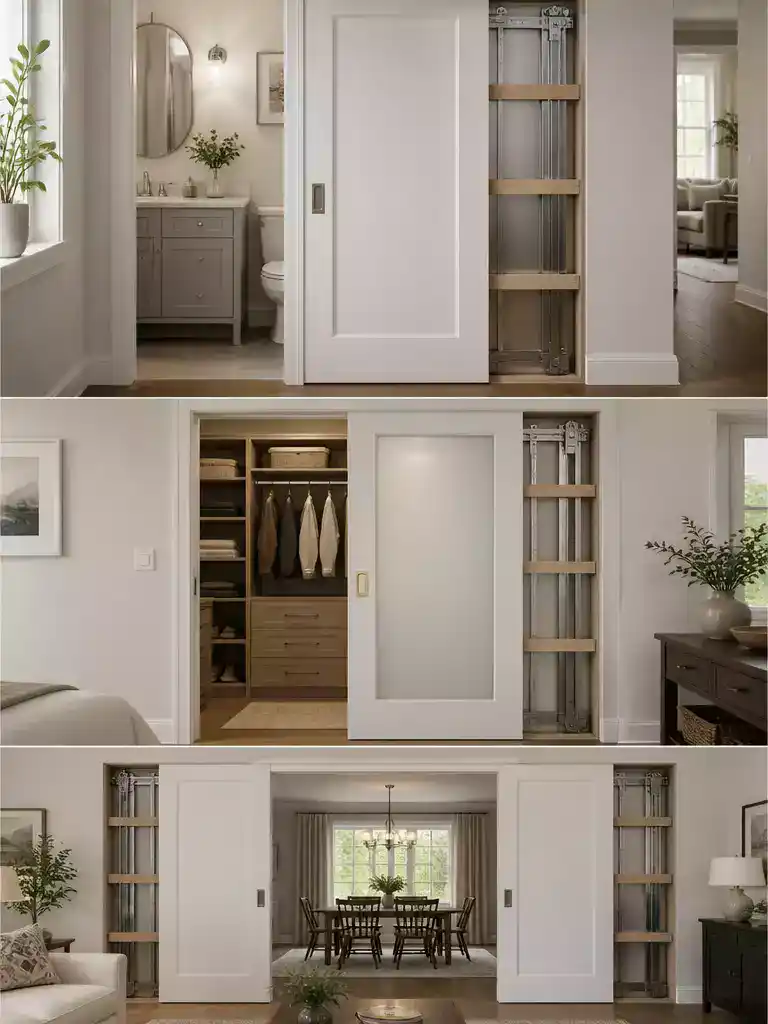
A pocket door sliding silently into the wall, freeing every square inch of floor space in a tiny room.
A bathroom so tight you have to stand in the tub to open the door—that’s the moment a pocket door transforms from nice-to-have to essential.
These doors slide completely into a wall cavity instead of swinging out, making them the ultimate floor-plan cheat code for spaces under 50 square feet.
But they’re not just for powder rooms. Pocket doors earn their keep anywhere a standard swing door would block a walkway, crowd furniture, or eat precious square footage.
- Walk-in closets where a door would hit hanging clothes or racks.
- Small home offices tucked into a hallway nook where a swing door would choke the corridor.
- Laundry rooms and pantries where floor space is already tight.
- Wide living-dining dividers that can open a home for parties and close for privacy.
The trick is in the wall. You need a 2×6 wall cavity or a split-stud pocket frame kit to house the door when it’s open. In new construction it’s trivial—during a renovation, you’ll open the wall, but the square footage you regain pays you back every day.
Hardware is where pocket doors earn their long-term love—or drive you crazy. Here’s the difference:
Pro-tip for budget-minded renovators: buy a high-quality pocket door frame kit ($200–$400) and pair it with a standard slab door. The frame—not the slab—determines how smoothly the door operates for years, so don’t overpay for a pre-assembled system that only gives you a generic door attached to a mediocre track.
Pocket doors can be locked for privacy, but it takes specific mortised edge pulls and privacy locksets—standard knobs won’t work. These are widely available, just not universal, so plan your hardware from the start.
A standard 2×4 wall can work with a thinner steel pocket frame, but a beefier 2×6 wall holds the typical kit and feels more solid when the door is closed. Check your wall thickness before ordering.
One non-negotiable caution: before you open any wall for a pocket door, verify there’s no electrical wiring or plumbing inside that cavity. Relocating either can add hundreds to the project and might kill the ROI if the wall is packed with utilities.
Pocket doors hide in walls; French patio doors do the opposite—they throw walls wide open and erase the boundary between your living room and the outdoors.
.
{!output-tips-writer-6}
French Patio Doors
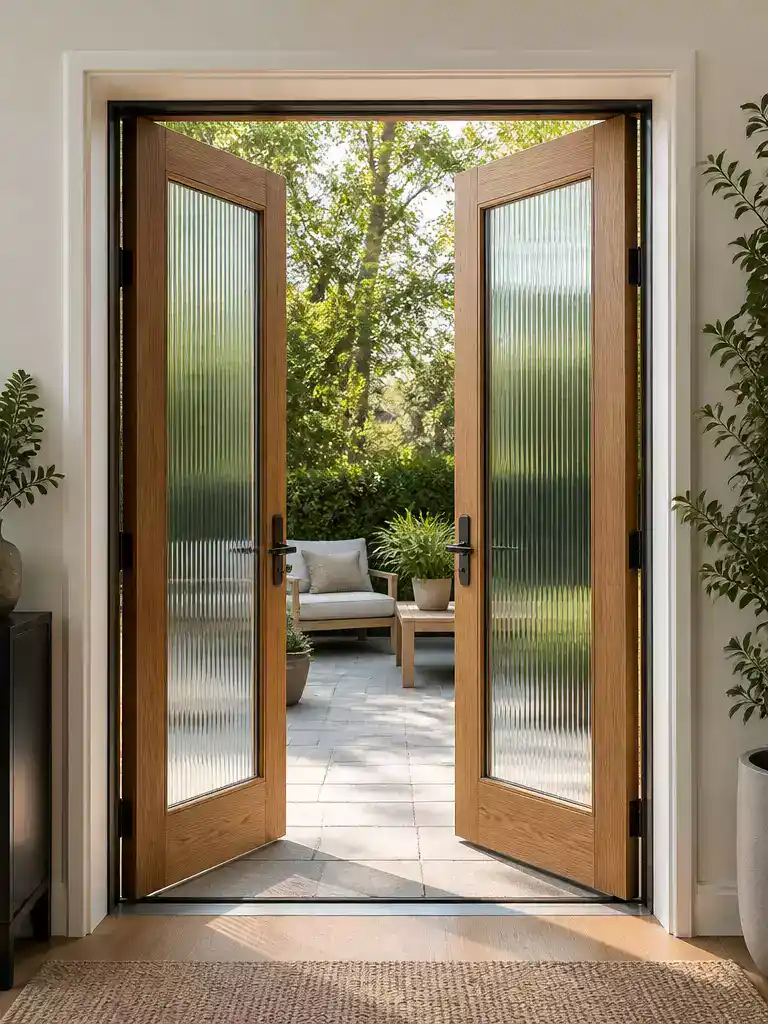
Open the doors, and your living room spills onto the patio — no step, just a clean sweep.
Nothing expands a room like two glass doors swinging outward onto a deck. French patio doors deliver that cinematic moment, but they demand respect — poor sealing, and you’re sitting in a drafty greenhouse.
Swing direction changes everything about how your doors function in the room. Inswing doors open into the room, which can block furniture placement but make it easy to install a screen door.
Outswing doors free up floor space and are ideal for tight rooms, but they catch the wind and require an exterior slope to shed rain. Reversible jamb options let you choose on site, so you’re not locked in before ordering.
Looks aren’t enough — French doors leak air at the center meeting point without a continuous compression seal. Low‑E glass coatings and argon fill between panes cut heat transfer, but the seal along the astragal is what stops drafts that undo any R‑value.
Pro tip: Choose a multi‑point locking system that throws bolts into the head and sill, not just a single deadbolt. It seals the door tightly against the weatherstripping and helps prevent warping over the years.
Rough installed price: $2,500–$6,000, with fiberglass landing in the middle and wood‑clad at the upper end.
- If outswing in a rainy climate, the exterior landing needs a slight slope or floor drain to carry water away.
- ADA‑compliant low‑profile thresholds are available but add roughly $200–$400 to the cost — worth it for a seamless walkout.
The sight of two fiberglass French doors with reeded glass panels open to a morning patio, the threshold flush with the floor so you walk outside without a step — no sliding track, just a clean sweep.
.
{!output-tips-writer-7}
Modern Flush Doors
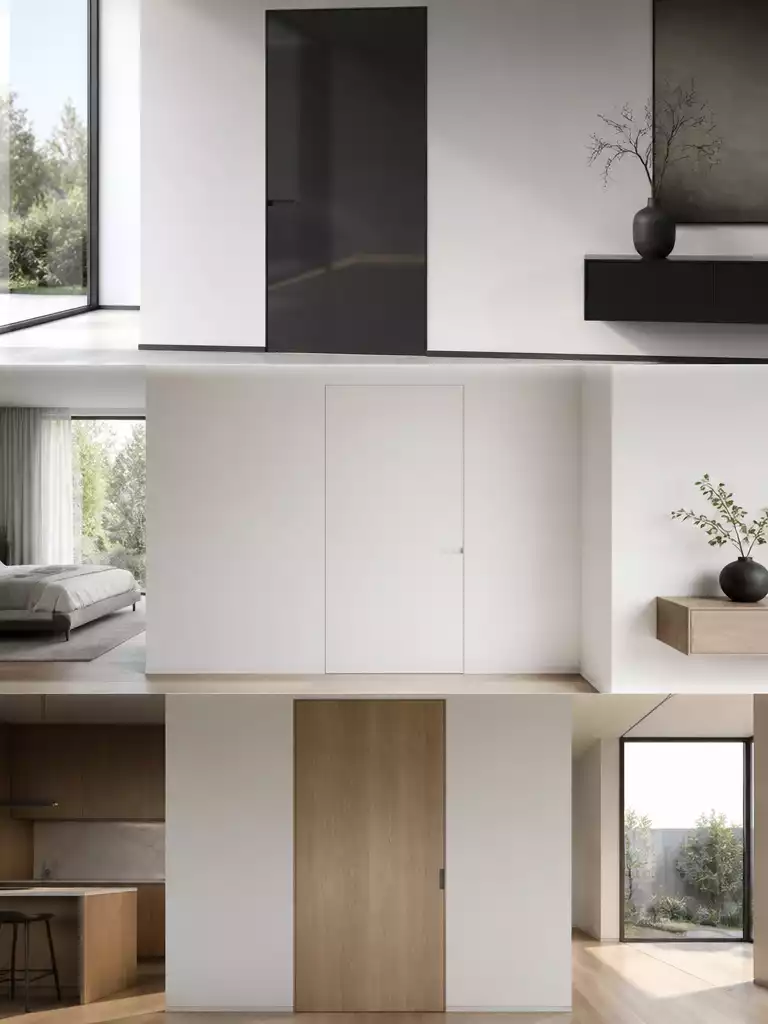
A flush door painted to match the wall, with a recessed pull—guests miss the room entirely.
A modern flush door doesn’t announce itself—it sits so flush with the wall that all you notice is the plane. No raised panels, no visible hinges, no protrusion.
The illusion hinges on concealed hardware. SOSS or Tectus hinges vanish completely when the door is closed, while any surface-mounted hinge instantly breaks the minimal line.
Surface options set the tone:
- High-gloss lacquer – bold color turns the door into a deliberate focal plane.
- Matte wall-matched paint – paints the door the exact wall color for a hidden-room effect.
- Wood veneer – rift-sawn oak or walnut adds organic warmth without a paneled look.
Oversizing the slab—8 ft tall and 3 ft wide—creates a gallery-wall feel. A thick 1¾” door gives it weight and a solid shutting sound.
Common mistake: Pairing a flush door with a standard frame. Visible stops and reveals kill the clean look—true flush doors need a concealed frame or magnetic stop.
Hardware stays invisible too: flush pulls, push-latches, or magnetic catches replace doorknobs. Everything you touch is recessed or entirely hidden.
Because custom sizing is typical, lead times often run 8–12 weeks. Plan accordingly if you’re working against a renovation deadline.
Flush doors hit hardest in hallways and main living zones where sight lines are long. They’re for architectural minimalists—skip them if you love visible handles or traditional paneling.
.
{!output-tips-writer-8}
Dutch Doors For Charm
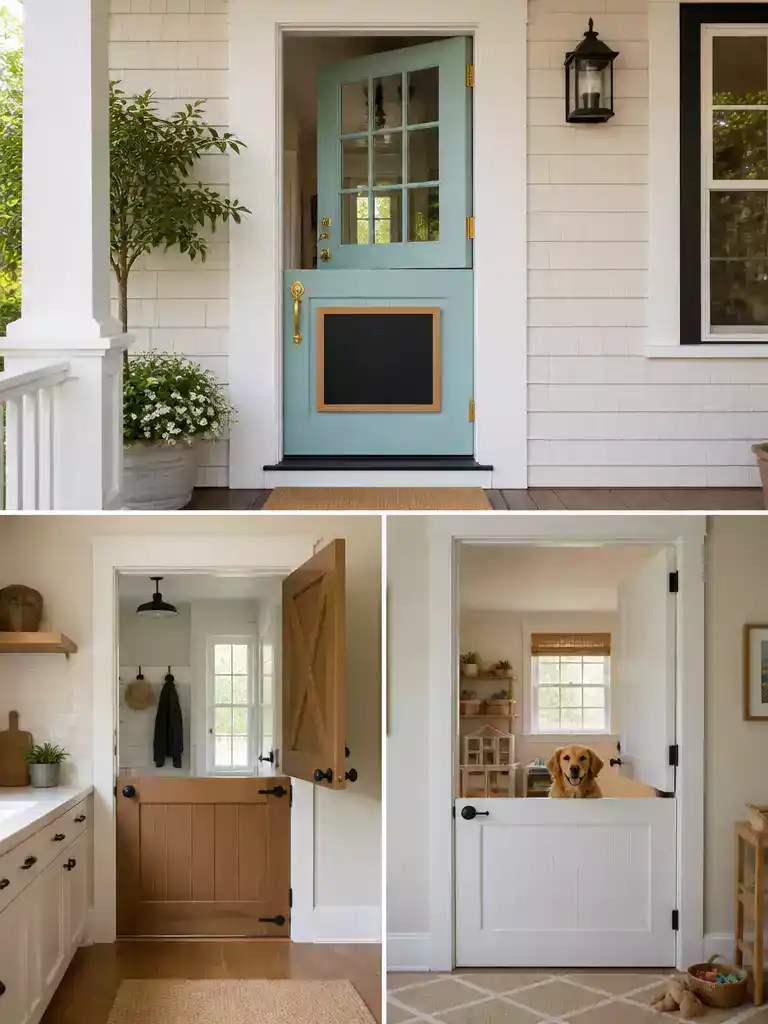
A painted powder-blue Dutch door to a sunlit porch, keeping the breeze flowing and the dog safely inside.
A door that opens top‑half only feels like an open window and a door at the same time — perfect for letting in a spring breeze while keeping a toddler or golden retriever from wandering out.
Dutch doors are practical whimsy: two separate panels that latch together with a Dutch door bolt to act like one solid door.
When you only want the top half open, you unlock the bolt and swing the bottom closed.
Traditional Dutch doors are made from wood — often Douglas fir or pine — but modern composite versions exist that split the look without the risk of the horizontal seam warping over time.
That seam must stay weather‑tight on an exterior door, so a quality compression seal at the meeting rail is critical.
Where Dutch doors shine:
- Kitchen to mudroom or back porch — pass groceries through, chat with kids outside, or let pets see out.
- Playroom to hallway — contain toys and noise but still hear what’s going on, and keep an eye on little ones.
- Interior Dutch door in a home office — keep the dog out while the top half stays open for light and conversation.
Expert insight: An exterior Dutch door needs a substantial bottom deadbolt separate from the top latch because the split‑panel design creates a weak point. Many homeowners don’t realize this until a security check. Also, the top half can be ordered with a retractable screen, so you get bug‑free fresh air without giving up the view.
Custom‑built wood Dutch doors typically start around $2,500, but standard pre‑hung kits from manufacturers like JELD‑WEN can cut that cost in half if your rough opening matches a common size.
Composite versions fall somewhere in between, offering lower maintenance on an exposed back wall.
Safety note: The top‑half‑open feature is fantastic for ventilation, but the bottom half needs a secure lock that little climbers can’t reach. Check that the latch is high enough or use a slide bolt at adult level to prevent curious toddlers from unlatching it.
For all their charm, Dutch doors aren’t code‑required in any fire separation. That’s where our final door type steps in — the unseen guardian that gives you time to escape.
.
{!output-tips-writer-9}
Fire Rated Doors
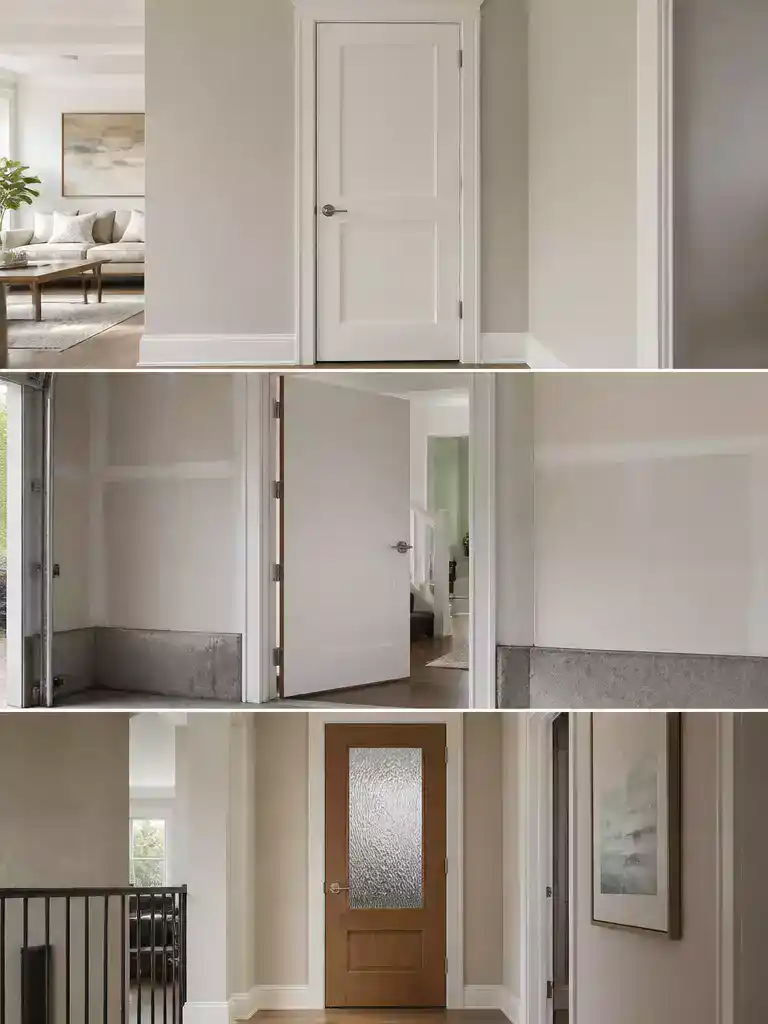
A shaker-panel fire door that matches every bedroom door in the hall until the heat sensor trips and that quiet self-closing hinge buys you twenty minutes.
The door between your garage and kitchen isn’t a design afterthought — it’s a legal fire barrier with a 20-minute rating stamped right on the hinge edge. Modern fire-rated doors prove safety doesn’t have to scream institutional.
They look like normal interior doors. Painting over that fire-rating label is a code violation — leave it alone.
Where They’re Required by Code
- Attached garage to house: The single most common requirement. The door must be 20-minute fire-rated with a self-closing device — no exceptions.
- Basement to main floor: Required in some jurisdictions when the basement connects to living space.
- Between apartment units: Higher ratings apply here — often 45-minute or 90-minute depending on building type.
- Utility rooms with gas appliances: Check local code; many require a fire separation from sleeping areas.
What the Rating Actually Means
The number isn’t how long the door survives — it’s the minutes of protection before flames breach the assembly under test conditions. That’s time to escape, and it matters.
Aesthetics Without Sacrifice
A 20-minute fire door doesn’t have to look like it belongs in a hospital stairwell. Manufacturers now offer wood veneer, paintable MDF, and shaker-panel profiles that match standard interior door styles.
Glass panels are possible too — wire glass is the old standard, but ceramic glass is clearer and also fire-rated. Code limits the panel to 1,296 square inches in a 20-minute door.
Code non-negotiable: The self-closing device — whether a spring hinge or hydraulic closer — must be installed and functional. Propping the door open disables the fire barrier and violates code. If you buy a pre-hung fire-rated unit, the closer comes factory-installed.
What to Expect on Cost and Installation
A fire-rated interior slab costs $150 to $400 more than a standard slab of the same style. The premium covers the certified core, the smoke-seal gasket, and the testing documentation.
If you’re replacing a garage-to-house door, buy a pre-hung fire-rated unit with the frame. Retrofit frames often leave gaps that compromise the smoke seal — and the inspector will catch it.
Pro tip: Check the label on the hinge edge before painting. It’s illegal to remove or paint over that fire rating label. If your inspector can’t read it, the door fails — even if the core is rated.
Fire-rated doors won’t win design awards, but they’re the only door on this list that actively protects your family while blending in with every other door in the hallway. That’s a trade-off worth making.
.
{!output-tips-writer-10}
You’ve now walked through ten door ideas that balance style, security, and function—from century-grade wood to fire-rated guardians. Not every idea fits your entryway, and that’s the point. Pick the one or two that solve your biggest friction first.
The door that greets you every day is the one worth getting right. If you’re still weighing the front door decision, our guide on how to choose a front door that fits your house walks you through the practical trade-offs.