
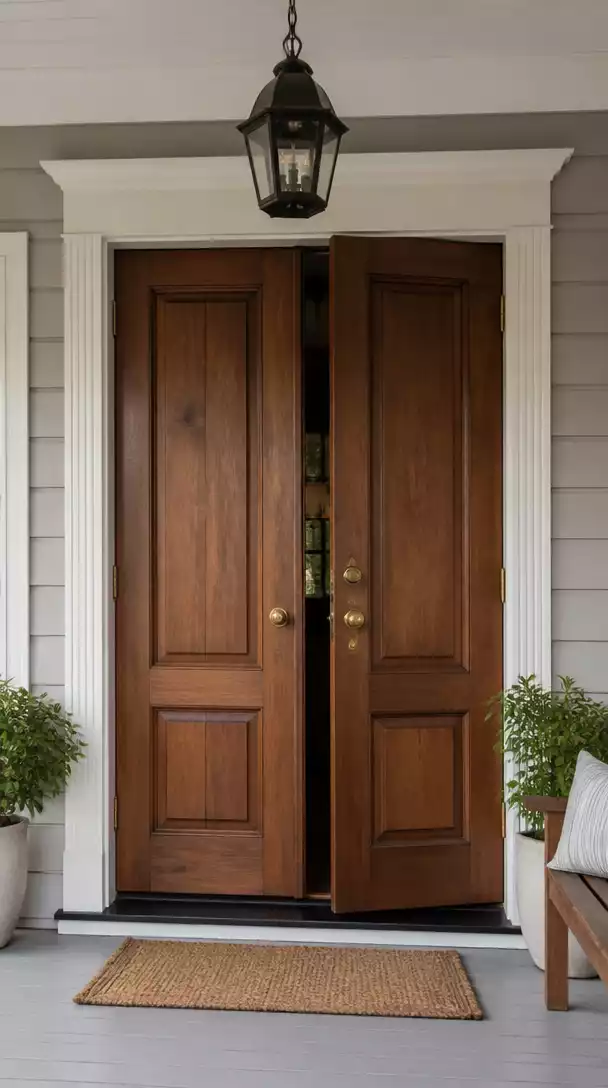
Investing in wooden double front doors is a high-stakes decision where a single spec error leads to warping and rot. This guide narrows the technical noise to 12 ideas worth your attention to ensure your investment lasts decades. We start with the wood species.
Wood Species
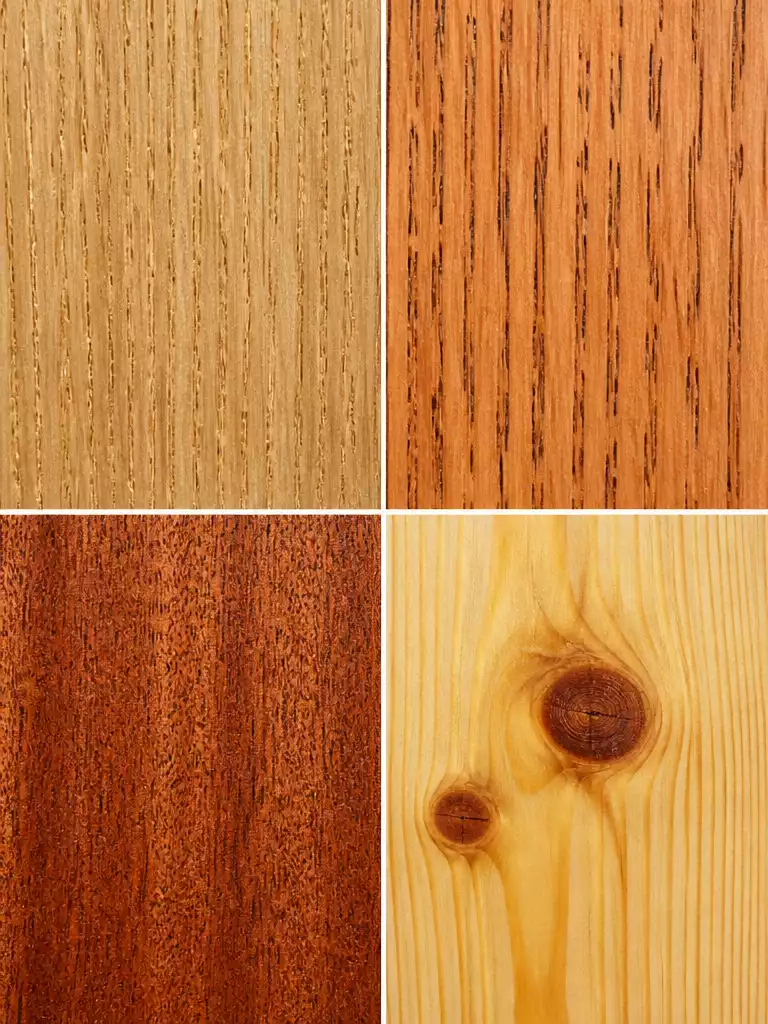
Selecting the right species ensures your grand entrance withstands the elements with timeless structural grace.
As an Amazon Associate I earn from qualifying purchases. Affiliate links may earn me a commission at no extra cost to you.
When you are investing in double doors, the “Species Hierarchy” isn’t just about the color of the stain; it is a technical assessment of how that wood handles a mid-summer downpour or a freezing winter night. Not all hardwoods are created equal, and choosing the wrong one for a large-scale entry can lead to irreversible warping before the second season even hits.
| Wood Species | Janka Hardness | Decay Resistance | Best Use Case |
|---|---|---|---|
| White Oak | 1,360 lbf | Very Resistant | High moisture/Direct rain |
| Sapele Mahogany | 1,410 lbf | Resistant | Large 8ft slabs/Stability |
| Pine/Fir | 380 – 690 lbf | Low | Budget/Full overhang only |
The distinction between White Oak and Red Oak is perhaps the most critical technical detail you will face. White Oak contains tyloses, which are essentially clogged pores that act as a natural dam against rot, whereas Red Oak has open pores that function like a bundle of straws, actively sucking moisture into the core of the door.
The Stability Factor: Sapele Mahogany
For doors reaching 8 feet or taller, Sapele is often the superior choice due to its interlocked grain pattern. This unique biological structure provides dimensional stability that domestic woods lack, meaning the wood expands and contracts significantly less when the humidity spikes.
You should also be wary of “The Softwood Trap” involving Pine or Fir. While they are cost-effective, their low Janka hardness ratings mean they dent easily from hail or flying keys, which breaks the protective finish seal and invites moisture to begin the decay process.
Expert Insight: The Decay Rating
Always ask your manufacturer for the “Decay Resistance” rating. The Forest Products Laboratory classifies woods into categories; for a five-figure double door investment, you should only accept species rated as Resistant or Very Resistant.
Beyond the raw durability of the species, you must consider the tannins—natural chemicals in Oak that can react with moisture to create dark stains if the wood isn’t sealed perfectly. Once you have settled on a species that fits your local climate, the next step is looking past the surface to what is actually inside the slab.
.
🧰 Ask Before You Order
- Species Verification: Are these doors genuine White Oak with tyloses, or a subspecies like Red Oak that requires more protection?
- Tannin Management: What specific primer or tannin-blocker is used to prevent the wood’s natural oils from bleeding through the finish?
- Moisture Content: Was the lumber kiln-dried to a specific percentage suitable for my local humidity levels to minimize post-install shrinking?
Solid vs. Engineered Core
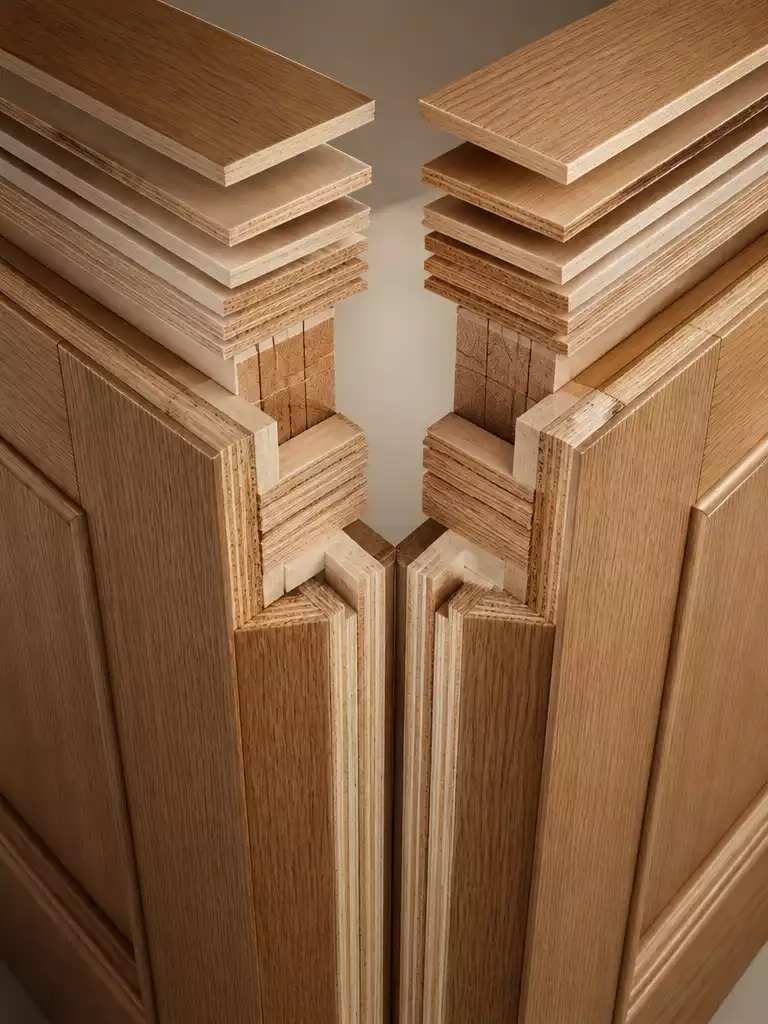
Structural stability begins on the inside to ensure your grand entrance stays perfectly aligned.
The “Solid Wood Myth” is one of the most expensive misunderstandings in home renovation. While a single, massive slab of timber sounds like the pinnacle of luxury, it is actually a recipe for disaster when applied to 8-foot-tall double doors.
Large wood slabs are essentially sponges that retain the “memory” of the tree; they want to cup, twist, and bow as humidity fluctuates. To prevent your doors from developing that dreaded top-corner gap where heat escapes, you need a core designed to fight those natural urges.
The Anatomy of a Stable Core
- Laminated Veneer Lumber (LVL): These cores use layers of wood with alternating grain directions. By stacking the grain at 90-degree angles, the layers cancel out each other’s tendency to move, creating a “spine” that stays dead-straight.
- Stave Core Construction: This method glues together small, finger-jointed blocks of wood. These shorter pieces lack the leverage to warp the entire door leaf, providing a rock-solid foundation for 90-pound slabs.
- Thick Sawn Veneers: A high-quality engineered door uses a 1/4″ thick sawn veneer. This is thick enough to be sanded and refinished multiple times over the decades, unlike “peeled” veneers that are paper-thin and prone to delaminating.
Avoid doors with MDF or particleboard cores for exterior use. Even if they are labeled “moisture resistant,” they lack the structural “bite” needed to hold the heavy-duty hinges required for double doors and will eventually swell if the finish is breached.
For any door leaf over 7 feet tall, an engineered core is a structural requirement rather than an optional upgrade. It provides the dimensional stability necessary to ensure the two doors meet perfectly in the center every time they close.
| Feature | Solid Slab | Engineered Core |
|---|---|---|
| Warp Resistance | Low (High risk over 7ft) | Superior (Built for height) |
| Refinishing Potential | Infinite | High (with 1/4″ veneer) |
| Best Use Case | Standard 6/8 interior doors | Grand scale double entries |
Choosing the right core ensures the door’s “skeleton” is strong enough to support its weight. Once that foundation is set, the focus shifts to the joints that keep the entire frame from sagging.
.
🧰 Questions for Your Door Manufacturer:
- Core Material: Ask if the internal staves are made of solid hardwood or if they use finger-jointed LVL for maximum rigidity.
- Veneer Cut: Confirm if the exterior is a “sawn” veneer rather than “rotary peeled” to ensure the wood won’t check or crack.
- Adhesive Specs: Verify they use Type III waterproof adhesives to prevent the core layers from delaminating during high-humidity summers.
3. Joinery and Construction
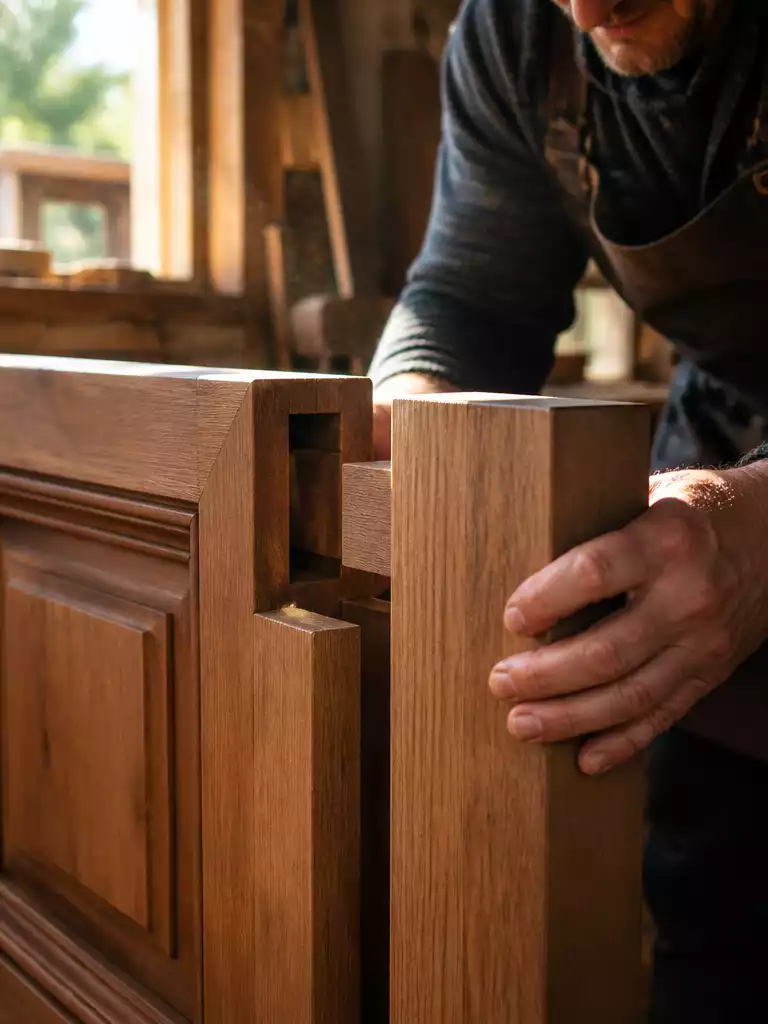
Precision-engineered joints ensure your heavy double doors remain perfectly aligned and swing effortlessly for decades.
If you notice your double doors beginning to “sag” toward each other or scraping in the middle, the culprit usually isn’t the wood itself—it is the joint. Because double doors lack a center post, the entire weight of the slab hangs off the hinges, putting immense leverage and tension on the corners.
Without superior joinery, a door leaf can undergo “racking,” where it loses its rectangular shape and becomes a trapezoid. This structural failure ruins your weatherseal and makes the locking mechanism impossible to align.
The Gold Standard: Mortise and Tenon
This is the benchmark for high-performance doors. It involves a “tongue” (the tenon) on the horizontal rail fitting into a deep “hole” (the mortise) in the vertical stile.
- Maximum Surface Area: Provides the largest possible area for glue bonding, making the joint nearly impossible to pull apart.
- Integral vs. Loose Tenons: Always ask for “Integral Tenons” which are cut from the actual rail wood rather than being a separate inserted piece.
- Weight Support: Necessary for supporting heavy double-pane insulated glass without the frame bowing over time.
Modern manufacturing also utilizes Triple-Doweled joints. While traditionally seen as a tier below mortise and tenon, high-precision CNC machining allows these to be incredibly strong and resistant to “racking” when executed with surgical accuracy.
Beyond the connection points, look for “Cope and Stick” construction. This means the decorative profile you see is actually milled into the structural frame itself, adding to the door’s overall rigidity rather than being a flimsy overlay that can trap moisture.
The “Floating Panel” Rule
A sign of poor construction is a door where the large center panels are glued or nailed in place. High-quality doors use “floating” panels that sit in a groove with Type III waterproof adhesives at the joints only, allowing the wood to expand and contract without cracking the frame.
When vetting a manufacturer, specifically ask if they use waterproof structural adhesives. Even the tightest joint will eventually fail if the glue softens during a humid summer or a driving rainstorm.
.
🧰 Questions for Your Door Manufacturer:
- Tenon Depth: Ask if the tenons are at least 2 inches deep to properly counteract the leverage of heavy double leaves.
- Adhesive Specs: Confirm they use Type III waterproof glue, which won’t dissolve or “creep” when exposed to high-heat sun exposure.
- Racking Warranty: Ask if the warranty specifically covers “joint separation” or “sagging” under the weight of standard insulated glass units.
4. Climate Suitability
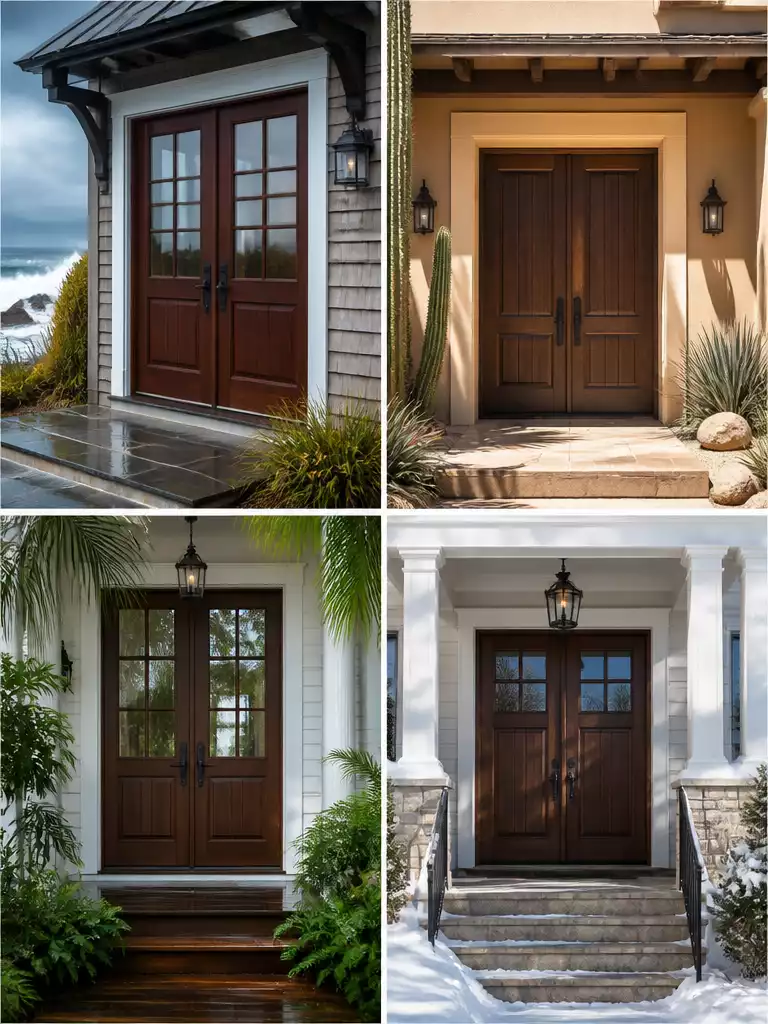
Selecting the right wood for your local weather ensures your entry stays airtight and beautiful for decades.
Your double door is essentially a living organism that breathes differently depending on whether it lives in the humid Southeast or the arid Southwest. Because wood naturally seeks equilibrium with the moisture in the air, the local climate dictates how much those massive 36-inch slabs will move throughout the year.
The T/R Ratio Strategy
To prevent double doors from sticking together in high summer, look for a species with a low Tangential to Radial (T/R) ratio. In humid regions like the South, woods with high stability ratings expand less across the grain, keeping your meeting stiles perfectly aligned even when the humidity hits 90%.
For desert climates, the risk shifts from swelling to “checking,” which are small surface cracks caused by intense UV and bone-dry air. In these zones, oily hardwoods or factory-finished Accoya wood are the smartest picks because they resist the rapid moisture loss that typically fries standard domestic lumber.
| Climate Type | Primary Threat | Recommended Wood |
|---|---|---|
| Coastal / Salt Spray | Fiber “jacking” from salt crystals | Teak or Iroko |
| Arid Desert | Surface checking and UV rot | Mahogany or Accoya |
| Humid South | Swelling and fungal growth | White Oak or Western Red Cedar |
The Southwest Exposure Trap
If your double door faces South or West with no significant porch overhang, standard wood will likely fail. In these high-exposure zones, the sun’s UV rays degrade the lignin (the glue holding wood fibers together), leading to rapid finish failure and structural warping.
Coastal homeowners face an additional invisible enemy: salt spray. Salt crystals can actually grow inside the pores of less-dense woods, physically prying the fibers apart over time, which is why tight-grained, oily species are non-negotiable within five miles of the ocean.
.
🧰 Questions for Your Installer:
- Edge Sealing: Will you specifically seal the top and bottom edges of both door leaves before final hanging?
- Expansion Gaps: How much “expansion shim” space are you leaving between the meeting stiles to account for local humidity?
- Sill Drainage: Does the quoted threshold include a high-dam aluminum sill to facilitate mechanical drainage away from the wood?
The technical specifications of a double entrance can feel like high-stakes homework, but you only need to land a few structural essentials to protect your investment. A durable home isn’t built on a thousand perfect details; it’s built on choosing the right foundation once. Focus on the core stability and climate logic, and the rest of the build will naturally follow.
🎯 The Calls Worth Getting Right:
- Compare structural stability with these wooden double front doors for longevity.
- Prioritize weather-tight seals over purely decorative door mats and hardware.
- Select species that resist bowing in your specific local climate.
List 5 Finish and Sealant
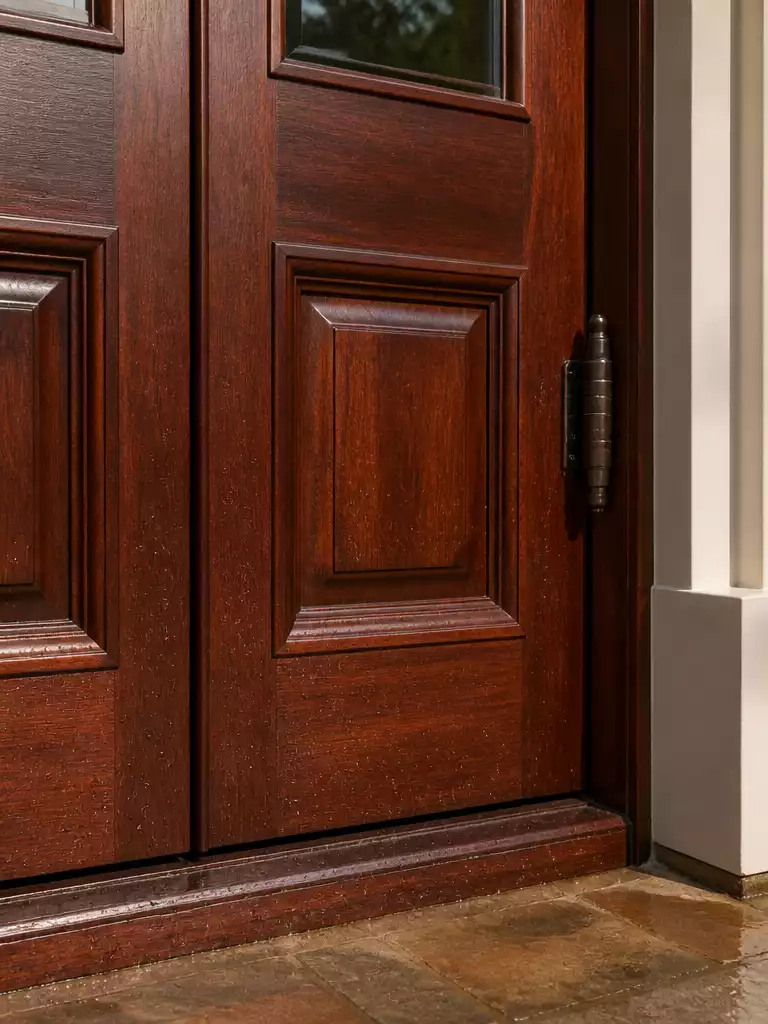
A premium finish serves as a sacrificial skin that preserves the wood’s structural integrity for decades.
Think of your door’s finish not as a decorative stain, but as a sacrificial skin designed to take the beating so the wood doesn’t have to. When this protective layer fails, moisture reaches the fibers, leading to the swelling and rot that eventually kills a five-figure investment.
The biggest decision you’ll face is choosing between film-forming finishes and penetrating oils. While a thick varnish looks glass-smooth on day one, it eventually cracks and peels, requiring a full sand-down to bare wood before you can fix it.
| Finish Type | How It Works | Maintenance Reality |
|---|---|---|
| Film-Forming (Urethane/Varnish) | Creates a hard, plastic-like shell on top of the wood. | High effort; needs complete sanding when it begins to flake or peel. |
| Penetrating Oil (Sikkens/Osmo) | Soaks into the wood fibers to repel water from within. | Low effort; usually just requires a clean and a fresh “maintenance coat.” |
Regardless of the chemistry, your sealant must contain high-level UV inhibitors. Without this “SPF 50 for wood,” the sun’s rays will break down the lignin in the wood cells, turning your beautiful door a ghostly, brittle silver.
The Six-Side Rule
Never allow an installer to hang your doors until the top and bottom edges are sealed. These hidden end-grains act like straws, sucking up moisture from the threshold and causing the door to rot from the inside out—a mistake that typically voids your manufacturer warranty.
Whenever possible, opt for a factory-applied finish. These are typically sprayed or dipped in a climate-controlled, dust-free environment, ensuring the sealant reaches every internal groove and edge before the hardware is even attached.
A field-applied finish—done on your front porch while the wind blows dust into the wet stain—rarely matches the durability of a factory seal. Investing in a professional-grade coating at the start is what separates a door that lasts thirty years from one that fails in three.
.
🧰 Questions for Your Finisher or Installer:
- Application Method: Will the finish be applied via a dust-free factory spray or a standard brush-on field application?
- UV Protection: What specific UV inhibitors are included in the sealant to prevent sun-bleaching and cellular wood breakdown?
- Edge Sealing: Can you confirm that all six sides, including the hidden top and bottom edges, will be fully coated?
6. Panel Style and Proportions
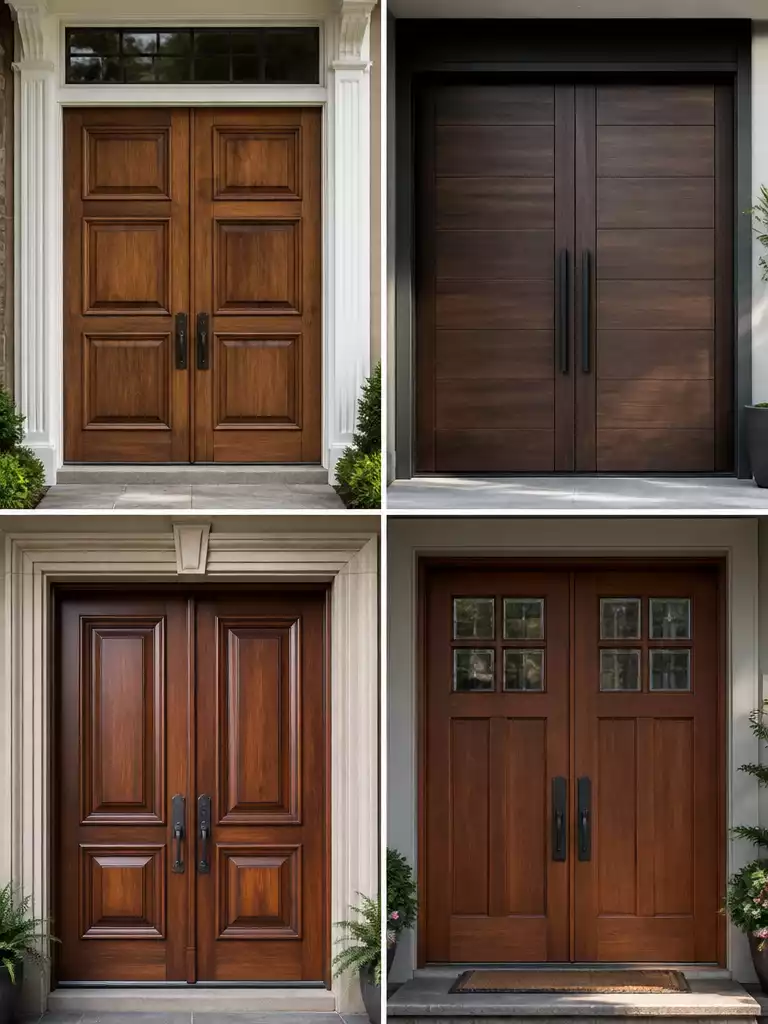
Strategic panel distribution ensures your double doors remain structurally sound and perfectly aligned for decades.
While it is tempting to choose a door based purely on the silhouette, the way those panels are divided is actually a structural insurance policy. Large double doors are heavy and prone to gravity’s pull, making the internal framing—the stiles and rails—the most important part of the design.
The Multi-Panel Advantage
A door with 4 or 6 panels is often more stable than a single large slab. This is because the internal vertical stiles and horizontal rails break up the wood’s natural tendency to move, distributing tension across multiple points rather than one giant surface.
To prevent the wood from buckling or splitting as the seasons change, the panels must be floating panels. This means they are tucked into grooves within the frame rather than being glued or nailed in place, allowing the wood to expand and contract freely.
Aavoid the Glue Trap: If a manufacturer glues panels directly to the frame, the wood will eventually crack or “check” because it has no room to breathe during humidity spikes.
Proportions also dictate how well the door carries its own weight. High-quality double doors require extra-wide stiles (the vertical side pieces) to provide enough “meat” for the heavy-duty locks and hinges needed to support 90-pound door leaves.
- Water-Shed Profiles: If your entrance is exposed to rain, choose flat panels with steep bevels rather than decorative “raised” panels.
- Groove Depth: Ensure the grooves holding the floating panels are deep enough to hide the “unfinished” line that appears when wood shrinks in winter.
- Symmetry: In double doors, the center stiles where the doors meet must be perfectly mirrored to prevent a visual “lean” if the house settles.
Ultimately, the “one big slab” look is the most difficult to keep straight over time. By choosing a multi-panel design, you are utilizing mechanical stability to fight the natural warping forces that plague large exterior wood surfaces.
.
🧰 Questions for Your Door Manufacturer:
- Integral vs. Loose: Are the tenons cut from the rail wood itself or inserted as separate, loose pieces?
- Expansion Gap: How many millimeters of “float” space are engineered into the panel channels for peak summer humidity?
- Stile Width: Will the vertical stiles be widened to accommodate the specific backset of a multi-point locking system?
7. Glass Options
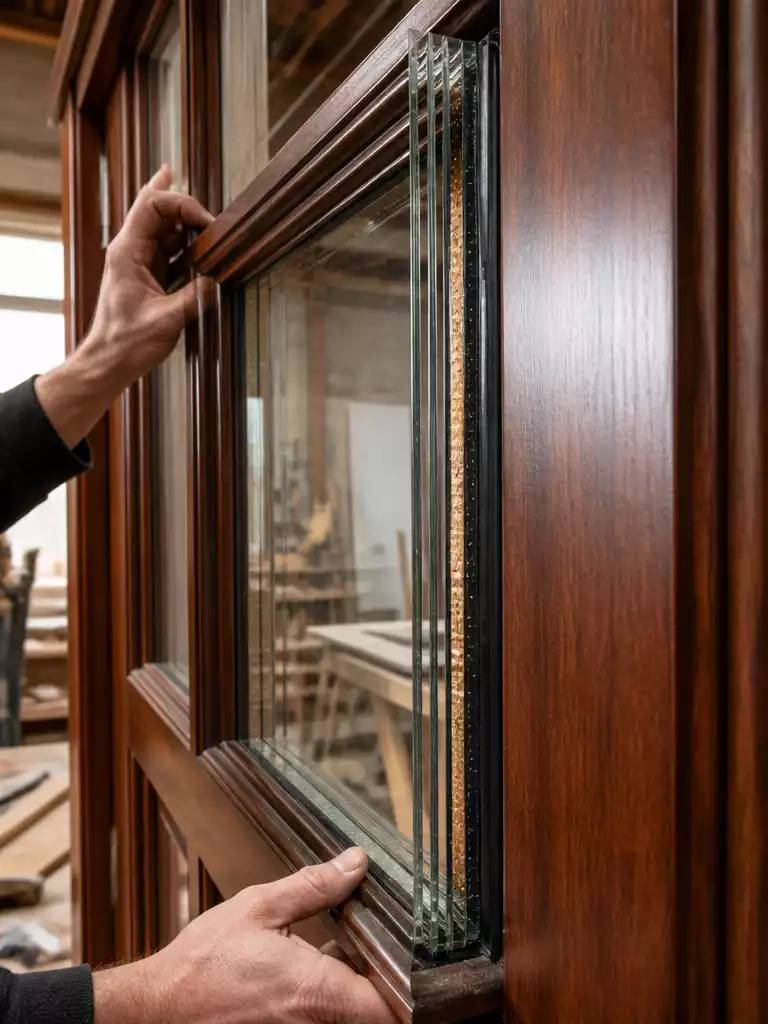
High-performance glass protects your wood investment from internal moisture and harsh solar baking.
In a double door, glass is far more than a decorative window; it is a heavy, structural component that fundamentally dictates how the door swings and ages. Because glass doesn’t expand or contract like wood, the way these two materials interact at the seal is often the first point of failure for cheaper entry systems.
To ensure your door remains airtight for decades, you must prioritize Insulated Glass (IG) units. These dual-pane systems should feature “Warm Edge” spacers, which are non-metallic spacers that reduce heat transfer and prevent the internal condensation that eventually rots wood muntins from the inside out.
Glass Selection Criteria
- Tempered Safety Glass: This is a non-negotiable safety requirement for doors, as it shatters into small granules rather than dangerous shards.
- Low-E Coatings: These microscopic layers reflect infrared light, stopping the sun from “baking” the interior side of the wood, which often leads to uneven drying and warping.
- Weighted Joinery: Because 1/2″ thick insulated glass adds significant weight, your door leaves must utilize heavy-duty joinery to prevent the frames from racking under the load.
In warmer climates, pay close attention to the Solar Heat Gain Coefficient (SHGC). A lower SHGC rating ensures your front entry doesn’t turn into an oven, which can physically fry the protective finish and crack the wood fibers over time.
The Seal Failure Warning: If you notice fogging between the panes, the seal has failed. In a wooden door, this allows moisture to pool against the raw interior wood of the frame, leading to rapid, hidden rot.
Choosing the right glass allows you to flood your entryway with light without sacrificing the structural integrity of the wood. It’s the final barrier that keeps the outside elements where they belong while protecting the delicate balance of the door’s internal moisture.
.
🧰 Ask Before You Order: Glass Specs
- Thermal Performance: Ask for the specific SHGC rating to ensure the glass won’t “bake” the interior wood fibers.
- Spacer Material: Confirm they use non-metallic “Warm Edge” spacers rather than aluminum to prevent internal condensation rot.
- Weight Capacity: Verify the door’s joinery is rated for the extra load of 1/2″ thick insulated safety glass.
Hardware Compatibility
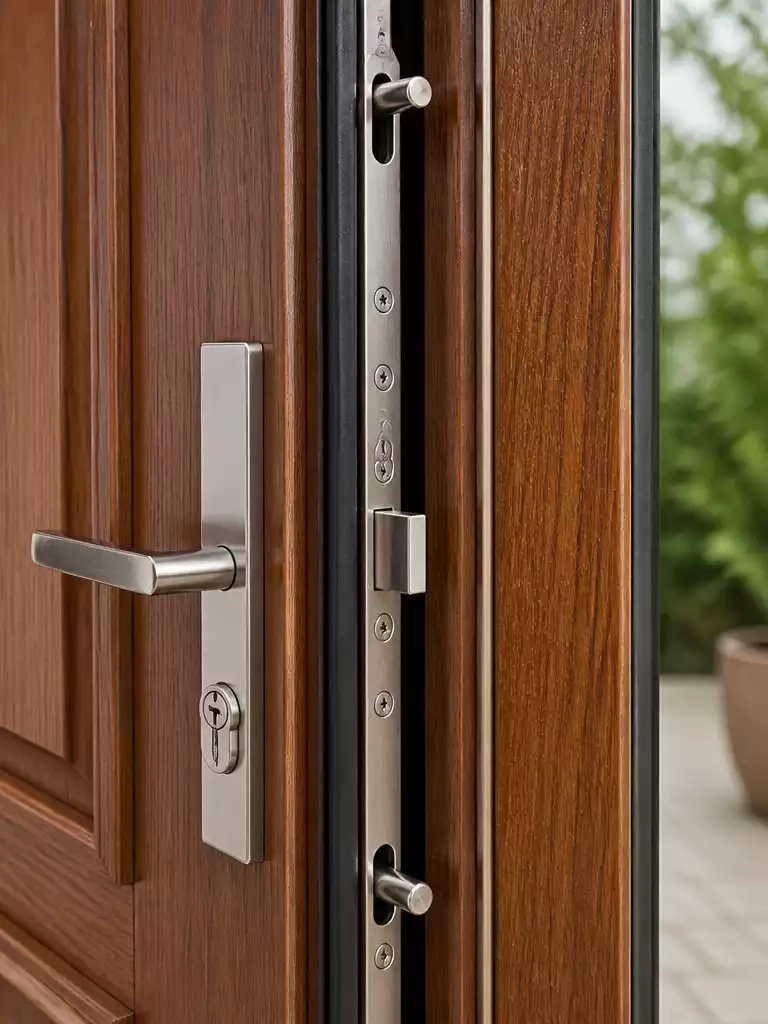
Precision-engineered hardware ensures your heavy double doors remain perfectly aligned and airtight for decades.
Double doors are notorious for “sagging” toward each other over time, creating that dreaded gap where you can see daylight through the middle. The fix isn’t adding more wood or adjusting the trim; it’s investing in hardware that can actually handle the massive leverage of two heavy slabs.
Standard hinges are the first point of failure because a single solid wood door leaf can easily exceed 150 lbs. You need ball-bearing hinges to prevent the metal-on-metal grinding that eventually causes the doors to drag against the threshold or each other.
The Structural Hardware Checklist
- 4 Hinges Per Leaf: If your doors are over 80 inches tall, three hinges aren’t enough to distribute the load effectively.
- Multi-Point Locking: These systems latch the door at the top, middle, and bottom simultaneously, physically forcing the wood to stay straight.
- T-Astragal: This is the vertical strip where the doors meet; look for one with built-in, high-compression weatherstripping.
- Solid Brass or Stainless: Avoid plated “pot metal” which corrodes and creates friction that wears down the door’s pivot points.
Multi-point locking systems are particularly vital for double doors because they act as a structural “spine.” By anchoring the door into the header and the sill, the system prevents the natural tendency of large wood panels to bow during extreme humidity shifts.
Mistake to Avoid: The “Slap-Dash” Astragal
Never use a simple wood-on-wood overlap where the doors meet. Without a proper T-astragal and a mechanical seal, wind will eventually push rain right through the center of your entryway.
When selecting your handleset, verify it is compatible with the weight of your specific wood species. Heavy-duty joinery deserves hardware that won’t rattle or loosen after a few seasons of heavy use.
“A multi-point lock is the best insurance policy against warping. It doesn’t just lock the door; it holds the wood in a permanent, flat plane.”
⭐ Top Products for Hardware Compatibility
🧰 Ask Before You Hire: Hardware Edition
- Integral vs. Surface: Will the multi-point lock be mortised into the door leaf or surface-mounted for easier future adjustments?
- Screw Depth: Do you use 3-inch screws through the hinges to anchor the door directly into the house framing?
- Warranty Voidance: Will drilling for this specific hardware set void the door manufacturer’s warranty against warping or water infiltration?
9. Sizing and Standard Openings
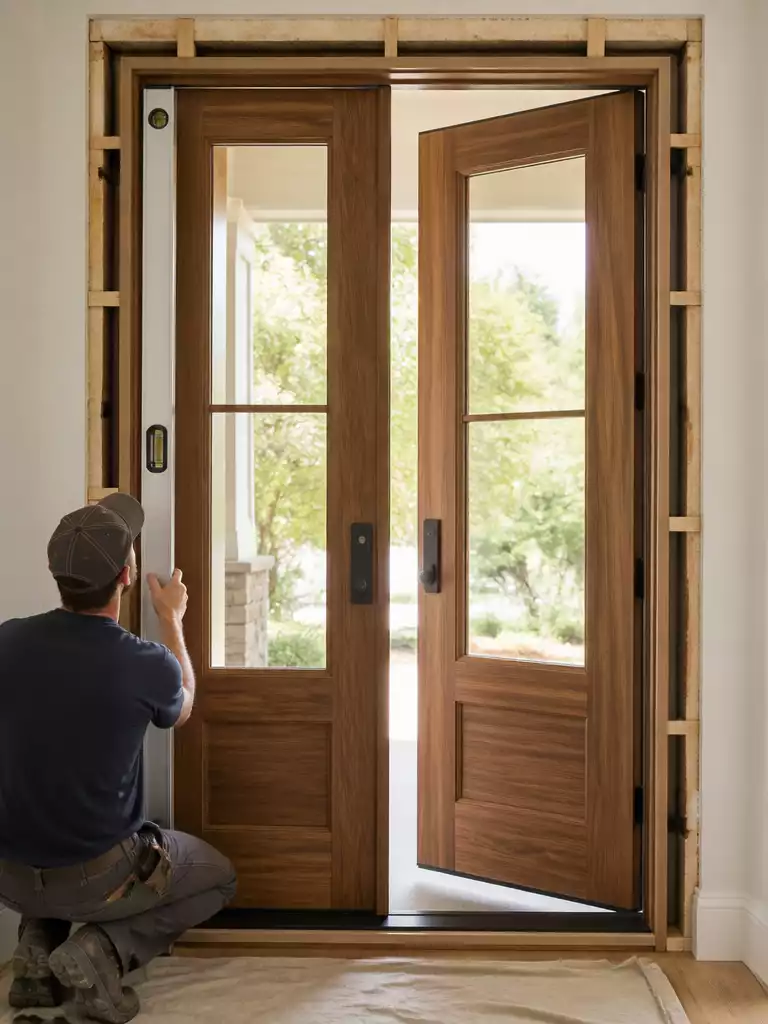
Precise measurements and standard proportions ensure your grand entryway remains structurally sound for decades.
Custom-sized doors often feel like the height of luxury, but they can actually be the enemy of longevity. When you push wood beyond its safe structural limits, you invite physics to work against your investment from day one.
The “middle sag” is the most common failure in double doors, where the two leaves begin to lean toward each other and eventually rub at the top. This isn’t just an eyesore; it destroys your weatherstripping and lets moisture into the core of the wood.
The Rules of Door Geometry
- The 36-Inch Rule: Standard 3/0 (36-inch) leaves are the structural sweet spot. Going wider, such as 42 inches per leaf, creates massive leverage on the hinges and significantly increases warping risks.
- Rough Opening Clearance: You must insist on a 1/2-inch expansion gap around the entire frame. This allows the house to settle naturally without crushing the door frame and causing it to bind.
- Squareness Check: If your opening is even 1/4 inch out of plumb, a double door will never seal correctly. This leads to persistent air leaks that eventually rot the frame from the inside out.
The threshold is where the most “seasonal” doors fail first. A high-quality installation requires a sloped, high-dam aluminum sill that is mechanically designed to drain water away from the wood components.
Without this mechanical drainage, water sits against the bottom rail of your door, wicking into the end grain regardless of how much sealant you apply. Always verify that your sill has a thermal break to prevent interior condensation during winter months.
If you are dreaming of 8-foot-tall double doors, you cannot use standard construction methods. Doors of this height require reinforced stiles and specialized hardware to prevent the “top-corner gap” where heat escapes and wood bows.
Sizing is the theoretical foundation of your door’s life, but the physical installation is where the battle for durability is actually won. Ensuring the frame is perfectly level and the leaves are correctly proportioned prevents the mechanical stress that leads to premature failure.
.
🧰 Questions for Your Installer:
- The Plumb Test: “How many points on the rough opening will you check for squareness before setting the frame?”
- Structural Fastening: “Which hinges will receive 3-inch screws that penetrate the house studs to prevent future door drop?”
- Thermal Break: “Does the threshold sill include a thermal break to stop frost from forming on the interior wood?”
10. Installation Quality
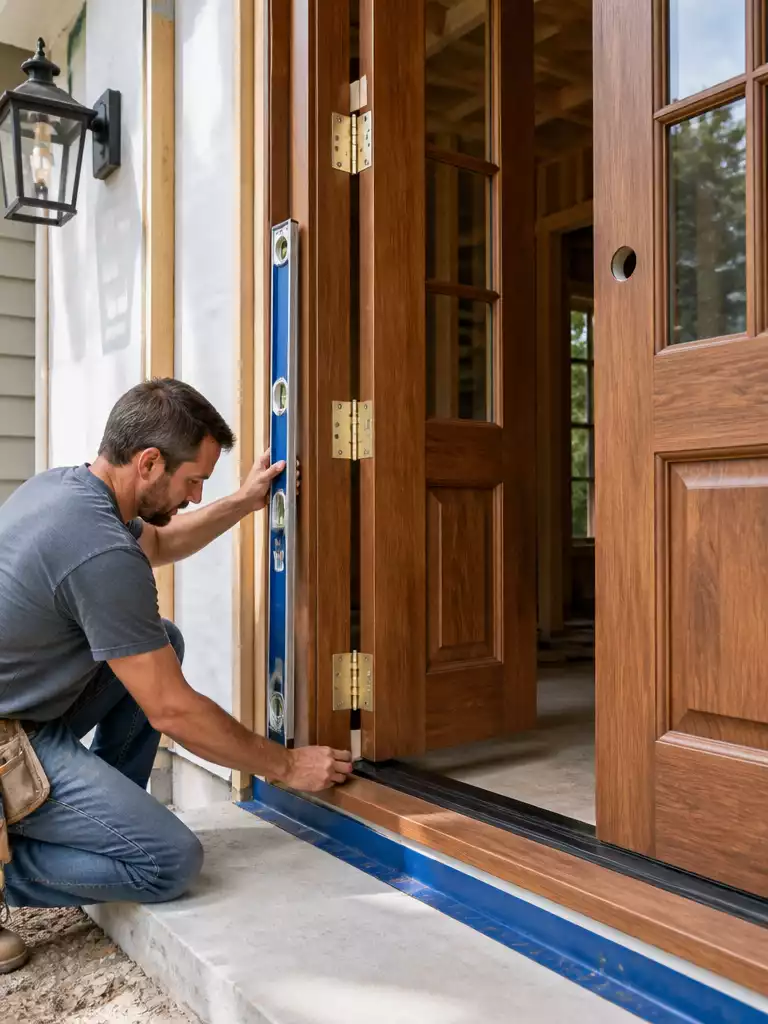
Expert precision during the install ensures your investment stays airtight and functional for decades.
You can buy a $20,000 door, but if it is installed by a handyman instead of a door specialist, it is likely a five-year door. The weight and complexity of double slabs require technical maneuvers that go far beyond just “making it fit.”
The real durability of your entrance is often determined by the components you will never see once the trim is nailed into place. Proper weatherproofing and structural anchoring are the hidden heroes of longevity.
Critical Installation Benchmarks
- Flashing Tape & Sill Pans: A dedicated sill pan and side flashing are mandatory to prevent water that migrates behind the brick or siding from ever touching the wood frame.
- Strategic Shim Placement: Shims must be placed directly behind every hinge point so the immense weight of the door leaf is transferred into the house studs, not the decorative trim.
- The Long-Screw Technique: Ensure at least one screw in every single hinge is 3 inches long; this “bites” into the structural framing to prevent the doors from dropping or sagging over time.
The “Paper Test” for Seal Integrity
After the installer finishes, close the door on a single sheet of paper. You should feel firm resistance when pulling it out at every single point along the weatherstripping; if it slides out easily, the door isn’t plumb and will leak energy.
Precision alignment is non-negotiable for double doors because they lack a center post for support. If the opening is even 1/4 inch out of square, the doors will never meet perfectly in the middle, leading to premature rot from air and moisture infiltration.
Once the unit is perfectly leveled and the hardware is biting into the structural studs, the clock officially starts on your maintenance schedule. Proper installation buys you time, but consistent care keeps the wood in peak condition.
⭐ Top Products for Wood Species
🧰 Ask Before You Hire: Vetting Your Installer
- Composite vs. Wood Sills: Ask if they use a high-dam aluminum or composite sill to mechanically drain water away from the door.
- Shim Material: Confirm they use composite shims rather than cedar; composite won’t compress or rot over years of heavy use.
- Structural Anchoring: Ask how many 3-inch framing screws they use per hinge to ensure the door weight hits the studs.
11. Maintenance Schedule
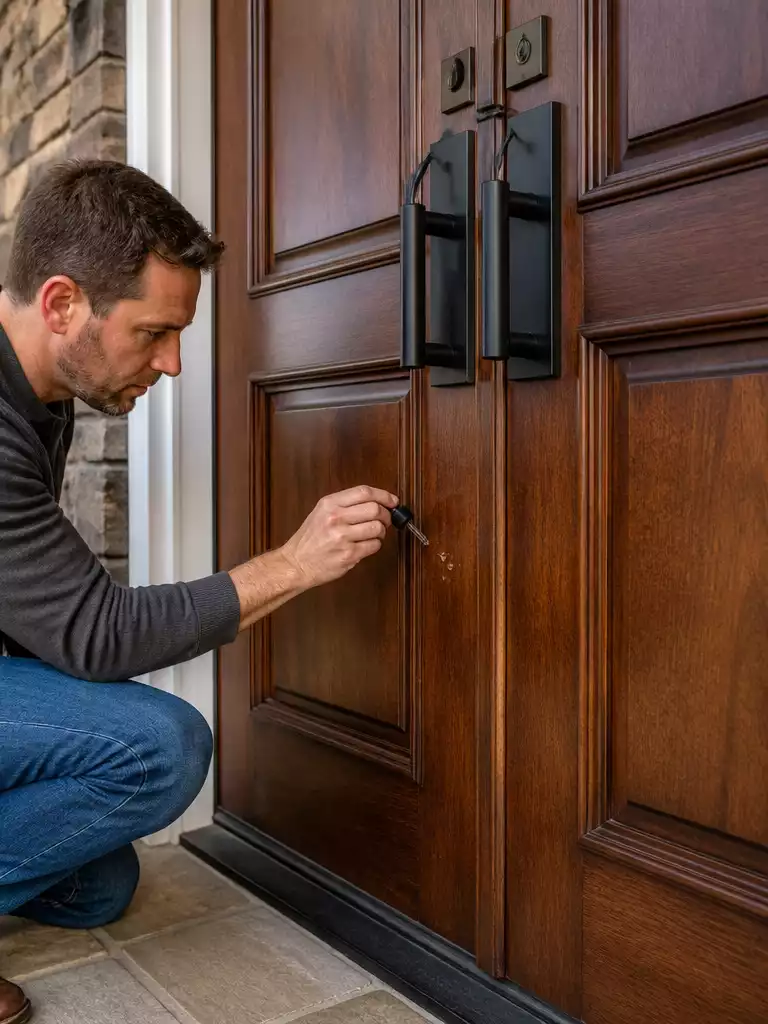
Preserve your investment with a proactive routine that keeps wood looking brand new for decades.
Wood is a living material that never truly stops reacting to its environment. To ensure your double doors last 30 years rather than five, you have to move away from a “set it and forget it” mindset and adopt a proactive health check every spring.
The Annual “Door Health” Checklist
- The Splash Test: Pour a small amount of water onto the door surface. If it beads up like a marble, your sealant is intact; if it soaks in and darkens the wood, you must reseal immediately.
- Non-Detergent Cleaning: Use a soft cloth and plain water to wipe away dust and salt. Harsh soaps can strip away the UV blockers embedded in high-end finishes, leading to premature silvering.
- Hardware Lubrication: Apply a dry graphite or silicone spray to hinges and multi-point locks annually. This prevents the friction heat that causes metal components to grind down and sag.
- Weatherstripping Inspection: Feel for drafts around the perimeter and the center astragal. Replace any cracked or compressed foam to maintain the airtight seal that protects the wood’s interior edges.
Pay close attention to the Joint Check where the horizontal rails meet the vertical stiles. These areas are prone to hairline cracks in the finish due to the natural expansion of the wood.
By catching these micro-failures early, you justify the high initial cost of your doors. This simple maintenance stretches your “cost-per-year” to pennies and ensures the structural integrity remains as solid as the day it was installed.
.
💰 Maintenance & Refinishing Reality:
- The real range: Expect high-quality double doors to cost $8,000 or more, with professional refinishing every 3–5 years.
- Hidden cost: Neglecting the “six-side rule” (sealing top and bottom edges) can void warranties and lead to structural rot.
- Worth it / not: Investing in factory-applied finishes is well spent, as they are applied in dust-free, controlled environments.
Cost vs. Longevity
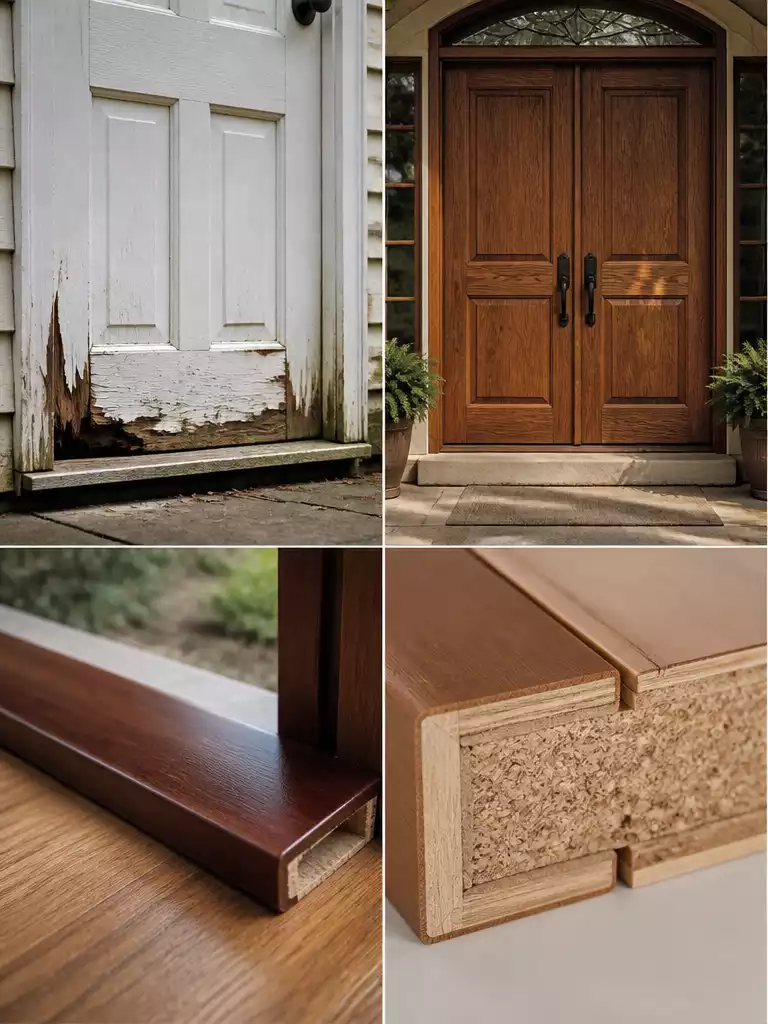
Investing in structural integrity today ensures your grand entrance retains its value for decades.
Thinking about a double door investment requires a shift from “sticker price” to “cost per year.” A $3,000 door that warps or rots within five years actually costs you $600 annually, plus the headache of a mid-winter replacement.
In contrast, an $8,000 premium door engineered to last 40 years drops that cost to just $200 per year. When you choose materials like White Oak or Sapele Mahogany, you aren’t just buying a look; you are securing a structural asset for your home.
The “Cheap Wood” Tax
Opting for budget-friendly softwoods like Pine or Poplar often results in a “seasonal door” that struggles with humidity and UV exposure. These materials frequently require major repairs or total replacement in under a decade.
- Maintenance Spikes: Low-density woods need more frequent sanding and resealing to prevent fiber breakdown.
- Energy Loss: If a cheap door bows by even 1/4 inch, your HVAC system works overtime to fight the resulting drafts.
- Seal Failure: Budget doors often skip the six-side factory finish, leaving the top and bottom edges vulnerable to moisture wicking.
High-quality double doors offer one of the strongest returns on investment in the remodeling world, typically seeing a 70-90% ROI. Because they are considered structural improvements rather than just cosmetic updates, they significantly bolster a home’s resale value.
| Feature | Budget Option | Premium Investment |
|---|---|---|
| Core Construction | Solid Pine (Prone to bowing) | LVL or Stave Core (Ultra-stable) |
| Wood Species | Poplar or Fir | White Oak or Sapele |
| Finish | Field-applied (Site-sprayed) | 6-Side Factory Dipped/Sprayed |
| Expected Lifespan | 5–12 Years | 30–50+ Years |
Ultimately, choosing for durability is the ultimate luxury. By prioritizing the “Big Four”—species, core, overhang, and finish—you ensure your entrance remains as airtight and impressive in twenty years as it was on installation day.
.
🧰 Questions for Your Door Specialist:
- Core Specifications: Ask if the stiles use Laminated Veneer Lumber (LVL) cores or solid wood to verify long-term warp resistance.
- Finishing Process: Confirm if the door is factory-finished on all six sides, including the often-missed top and bottom edges.
- Warranty Triggers: Inquire if specific overhang depths or multi-point locking hardware are required to keep the structural warranty valid.
You’ve reviewed a comprehensive set of details, offering multiple angles to evaluate wooden double front doors for lasting durability. It’s not necessary to apply every consideration—focusing on the few critical factors that align with your home and climate will yield the most meaningful impact.
Prioritize the choices tied to wood species and core construction to ensure decades of performance. Decide on those foundational elements first, and the overall durability and presence of your front doors will naturally follow.