
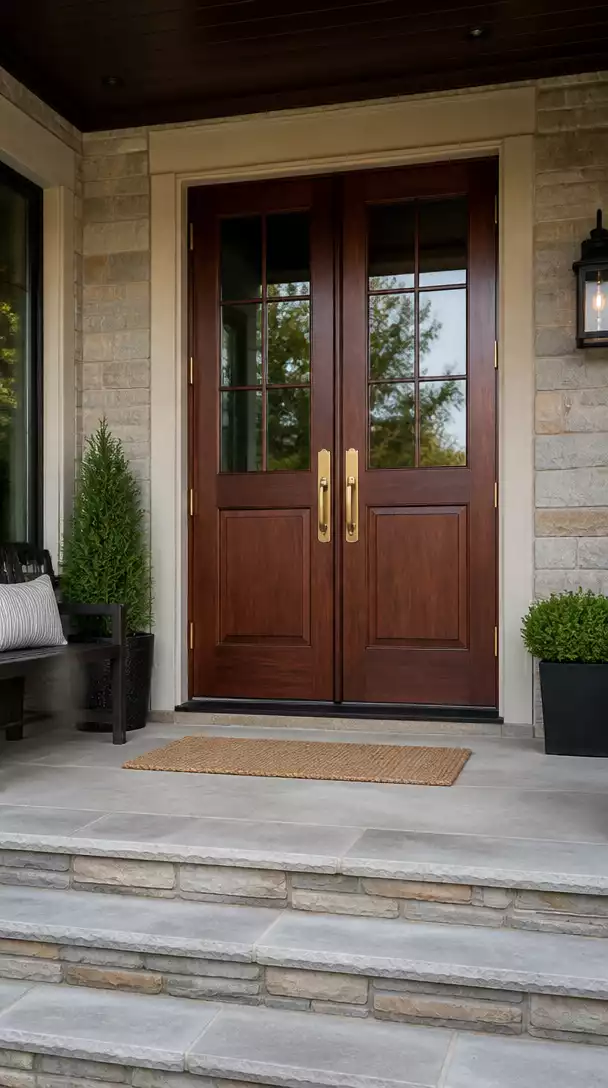
A sagging door that refuses to latch is a frustrating structural failure. Investing in wooden double front doors requires looking beyond aesthetics to prioritize dimensional stability and core engineering. This 12-point audit ensures your entry survives decades of exposure, starting with the right wood species.
1. Wood Species: The Durability Hierarchy
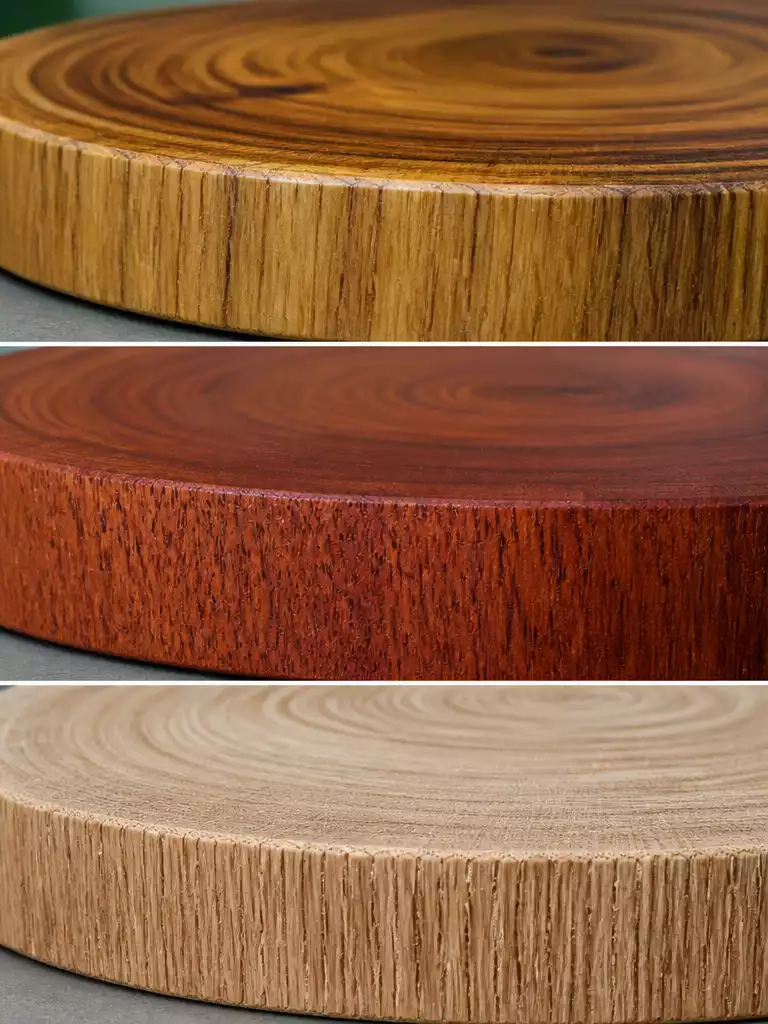
Selecting high-density hardwoods ensures your grand entrance resists rot and remains structurally sound for generations.
As an Amazon Associate I earn from qualifying purchases. Affiliate links may earn me a commission at no extra cost to you.
It is a common misconception that any wood labeled as a “hardwood” is fit for a double-door span. In reality, the cellular makeup of the wood determines whether your $5,000 investment will withstand 30 years of storms or begin to warp before the first anniversary.
When dealing with the massive surface area of double doors, you are fighting a constant battle against dimensional instability. Mahogany stands as the gold standard for this specific application because its interlocking grain pattern naturally resists the twisting and “cupping” that causes double doors to gap at the meeting stile.
| Wood Species | Primary Strength | Maintenance Level |
|---|---|---|
| Mahogany | Best Stability (Interlocking Grain) | Moderate |
| Teak / Iroko | Best Moisture Resistance (High Oil) | Low |
| White Oak | Best Impact Resistance (High Janka) | High |
Beyond stability, you must consider Janka Hardness, which measures a wood’s resistance to denting and wear. While softwoods like Pine or Fir might look charming, they will show every “kick” from a toddler or bump from a grocery bag within six months of daily use.
For high-moisture environments, species like Teak or Iroko are superior because they are naturally hydrophobic. Their high internal oil content acts as a built-in sealant, preventing the fiber collapse that leads to structural rot in humid climates.
⚠️ Avoid Knotty Alder in Wet Zones
Knotty Alder is popular for its rustic look, but it has a dangerous tendency to “pocket” water within its grain. In high-moisture areas, these pockets become breeding grounds for fungal rot that can destroy a door frame from the inside out.
White Oak is another formidable contender due to its high tannin content, which provides natural rot resistance. However, it is more prone to movement than Mahogany, meaning it requires a more rigorous finishing schedule to keep moisture out of the pores.
Ultimately, the “active leaf” of your double door—the one you open 20 times a day—requires a species that balances weight with structural rigidity. Settling for a low-density wood for an 8-foot span is a recipe for a sagging door that eventually refuses to latch correctly.
.
📋 What to Check First When Choosing Wood Species:
- Local Climate Match: Confirm the species thrives in your humidity and temperature range to minimize warping and rot.
- Door Size Suitability: Ensure the wood’s density and grain structure suit the height and width of your double doors for stability.
- Finish Compatibility: Check if your chosen species accepts marine-grade finishes well to protect against UV and moisture long-term.
2. Solid vs. Engineered Core: Dimensional Stability
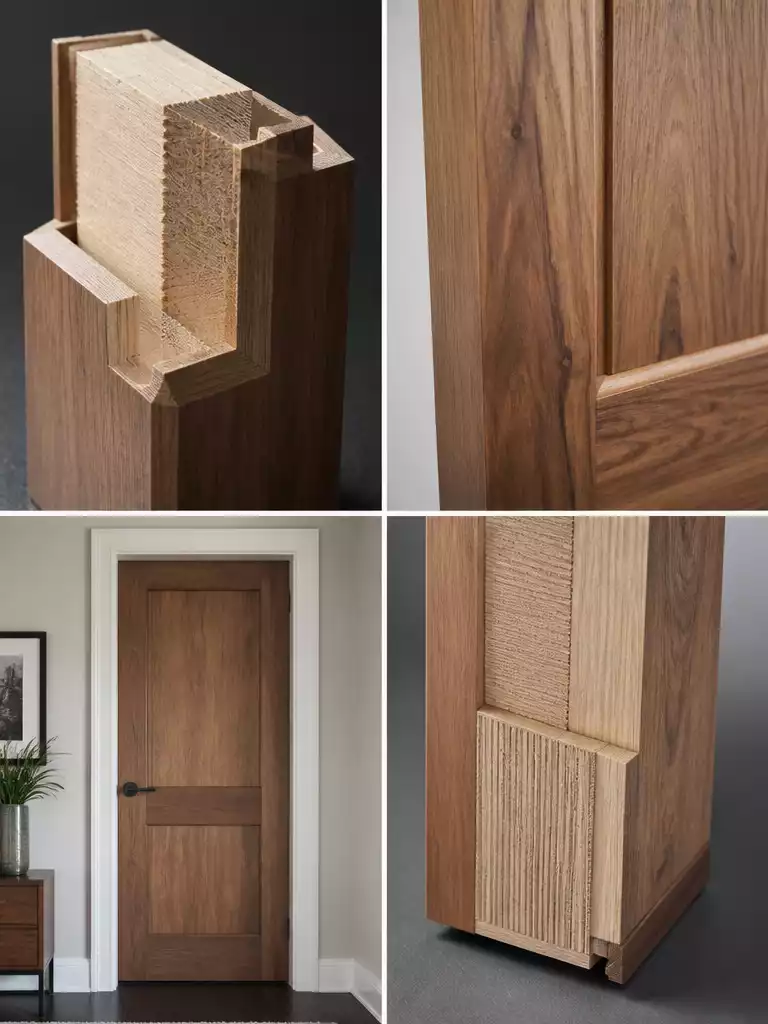
Choose the right internal engineering to ensure your heavy double doors remain perfectly aligned for decades.
The “solid wood” label often carries a sense of prestige, but when it comes to massive double doors, that weight can be a liability. Solid wood is a living material that breathes, meaning it expands and contracts with every shift in humidity.
In a double-door configuration, even a tiny amount of movement is magnified. If one door bows just a fraction of an inch, your deadbolt won’t align, and your climate-controlled air will whistle right through the gap.
The Engineered Advantage: LVL Cores
Modern high-performance doors often use Laminated Veneer Lumber (LVL) cores. This involves bonding multiple layers of wood with alternating grain directions, which creates a mechanical counter-balance.
- Warp Resistance: Because the grain layers fight against each other, the door cannot “curl” or twist.
- Refinishing Threshold: To ensure longevity, look for a thick-sawn veneer of at least 1/4 inch; this allows you to sand and refinish the door multiple times over 30+ years without hitting the glue line.
- Weight Distribution: Engineered cores provide the stability of a skyscraper while maintaining the look of traditional timber.
Solid stave construction is still available and offers that satisfying, prestigious “thunk” when you close the door. However, this choice requires a strictly controlled environment to prevent the wood from bowing away from the weatherstripping over time.
Expert Insight: If your double doors face West and receive direct afternoon sun, an engineered core is mandatory. The “heat-sync” effect on dark-stained solid wood can cause the stiles to curl outward, compromising your home’s seal.
| Feature | Solid Wood | Engineered Core |
|---|---|---|
| Stability | Prone to seasonal warping | Highly dimensionally stable |
| Sun Exposure | High risk of bowing | Recommended for direct sun |
| Longevity | 50-100 years (with care) | 30-50 years (thick veneer) |
Ultimately, the choice between solid and engineered comes down to your local climate and the level of protection your entryway provides. Regardless of what is inside the door, the way the corners are held together determines if the structure sags over time.
.
📋 What to Check First Before Choosing Your Core:
- Sun Orientation: Confirm the doors’ exposure to afternoon sun to determine if an engineered core is necessary.
- Veneer Thickness: Verify the exterior veneer is at least 1/4 inch thick to allow future sanding and refinishing.
- Local Humidity Control: Assess indoor climate stability, as solid stave doors need tightly regulated humidity to avoid warping.
3. Joinery and Construction: The Mortise-and-Tenon Standard
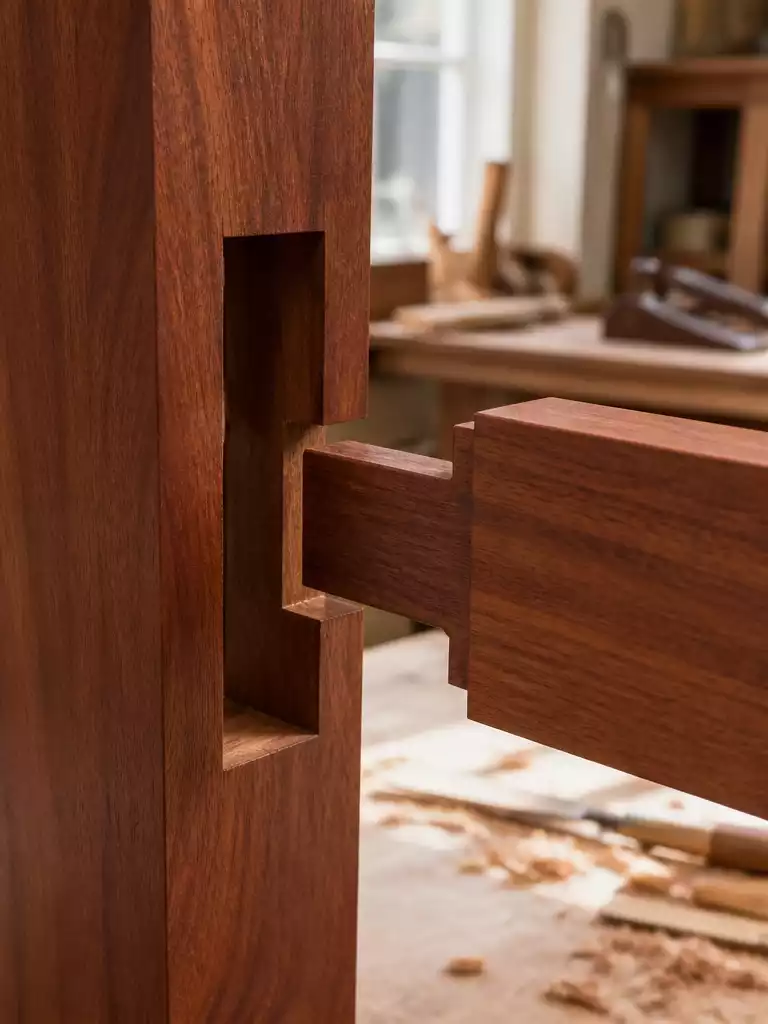
Precision-engineered joints ensure your grand entrance remains perfectly aligned and effortless for a lifetime.
The “hinge drop” is the silent killer of double doors, eventually causing the active leaf to scrape the floor or refuse to lock. This structural failure usually traces back to corners that rely on glue and prayers rather than mechanical strength.
For a door set that spans six feet or more, the industry gold standard is Deep Mortise and Tenon joinery. This method physically interlocks the horizontal rail into a deep pocket in the vertical stile, creating a structural bond that no amount of seasonal wood movement can shake loose.
Why “Dowelled” Joints Often Fail
Many mass-produced doors use simple wooden dowels to connect the frame, which are prone to specific long-term issues:
- Stair-stepping: Under the massive weight of 8-foot doors, dowels can snap or compress, causing the joints to shift like a set of stairs.
- Glue Dependency: Dowels rely almost entirely on adhesive; if the glue fails due to humidity, the entire door loses its squareness.
- Surface Area: Dowels provide minimal contact points compared to the broad, flat surface of a full tenon.
Beyond the primary joint, you should look for Cope and Stick detailing on the door’s inner profiles. These precision-milled grooves aren’t just for decoration; they provide significantly more surface area for modern Type III waterproof adhesives to create a permanent, weather-resistant seal.
High-quality construction also requires the right chemistry to survive the elements. Ensure your manufacturer uses Type III waterproof glue, which is specifically formulated to withstand the rigorous expansion and contraction cycles of exterior wood without becoming brittle or delaminating.
.
📋 What to Check First Before Confirming Joinery Quality:
- Corner Alignment: Inspect all frame corners for tight contact with no visible gaps or light leaks at the joints.
- Glue Type Verification: Confirm the use of Type III waterproof adhesive specified by your manufacturer for exterior durability.
- Joint Reinforcement: Ask if the tenons are draw-bored or pinned to mechanically lock the joint beyond just glue strength.
4. Climate Suitability: Matching Species to Zip Code
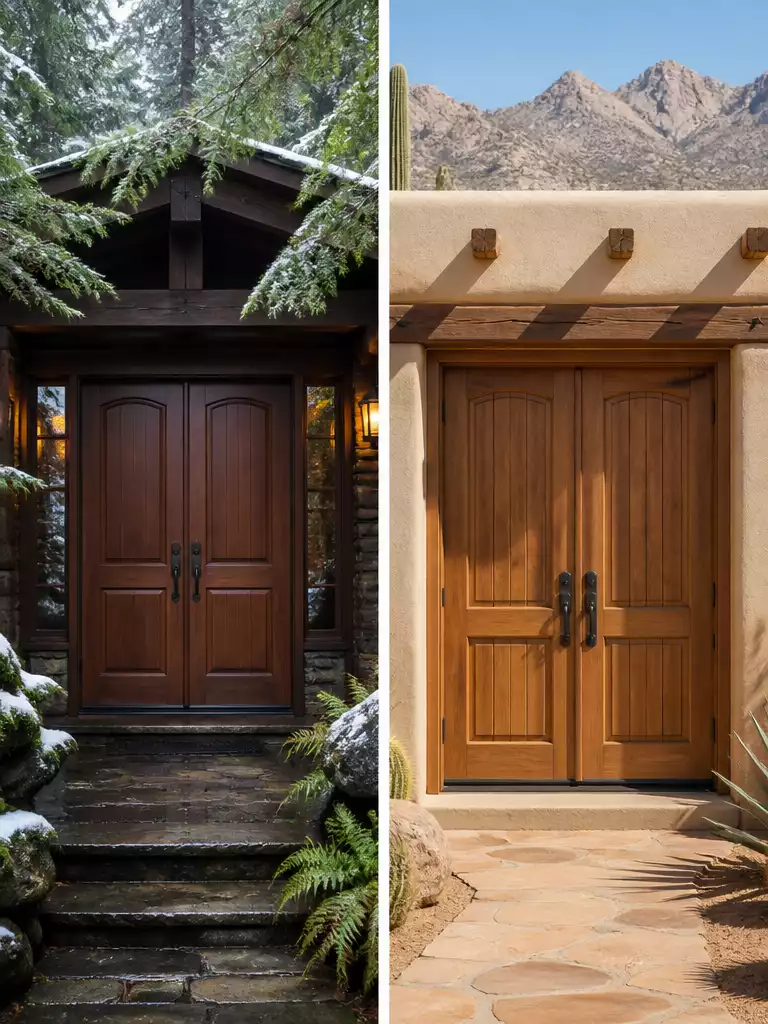
Aligning your wood choice with local humidity ensures your entry remains airtight and effortless through every season.
Is your air salty, bone-dry, or swamp-heavy? Most homeowners choose a door based on a swatch in a showroom, forgetting that wood acts like a cellular sponge that reacts to the specific chemistry of your zip code.
In coastal environments, the air is a corrosive cocktail of salt and moisture that can cause standard wood fibers to collapse and rot within a few seasons. For these salt-air zones, Teak or Accoya (acetylated wood) are the only practical choices because their natural oils and chemical stability prevent the salt from penetrating the grain.
The “Expansion Gap” Strategy
A double door built for the Pacific Northwest requires different “float” tolerances in its panels than one built for the Arizona desert. In high-humidity zones, panels need extra room to expand within the stiles to prevent the door from binding or cracking the frame.
High-desert aridity presents the opposite challenge: 10% humidity can suck the moisture out of wood so fast it “checks,” creating small surface cracks along the grain. In these regions, species like Mesquite or specific engineered cores are essential to maintain structural integrity when the air is bone-dry.
Common Mistake: The Acclimation Fail
Buying a door manufactured in a humid climate like Indonesia and installing it in a dry climate like Denver without a 4-week acclimation period in a temperature-controlled garage will almost certainly lead to warping.
The geography of your home also dictates how much “movement” your hardware has to compensate for. A door that stays perfectly square in a temperate climate may shift just enough in a seasonal swing to require adjustable hinges or deeper weatherstripping pockets.
.
📋 What to Check First When Matching Doors to Climate:
- Local Humidity Levels: Confirm whether your area swings between dry and humid seasons to plan panel expansion gaps accordingly.
- Manufacturing Origin: Verify the door’s climate of origin and allow proper acclimation before installation to prevent warping.
- Exposure Direction: Check if your door faces intense sun or salt air, as this impacts species choice and finish requirements.
Diving into the technical side can feel a bit overwhelming, but every detail you consider builds a stronger foundation. Each choice you make about materials and construction adds up, guiding your double doors toward lasting success. This isn’t about perfection right away, but about steady, thoughtful progress that pays off over time.
⚡ Keep This in Mind:
- Climate considerations shape your door’s durability—see insights on matching species to your zip code.
- Structural choices like core construction affect long-term stability—explore more about solid versus engineered cores.
- Focus on durability over aesthetics to ensure your doors perform well for decades, not just seasons.
5. Finish and Sealant: Marine-Grade Protection
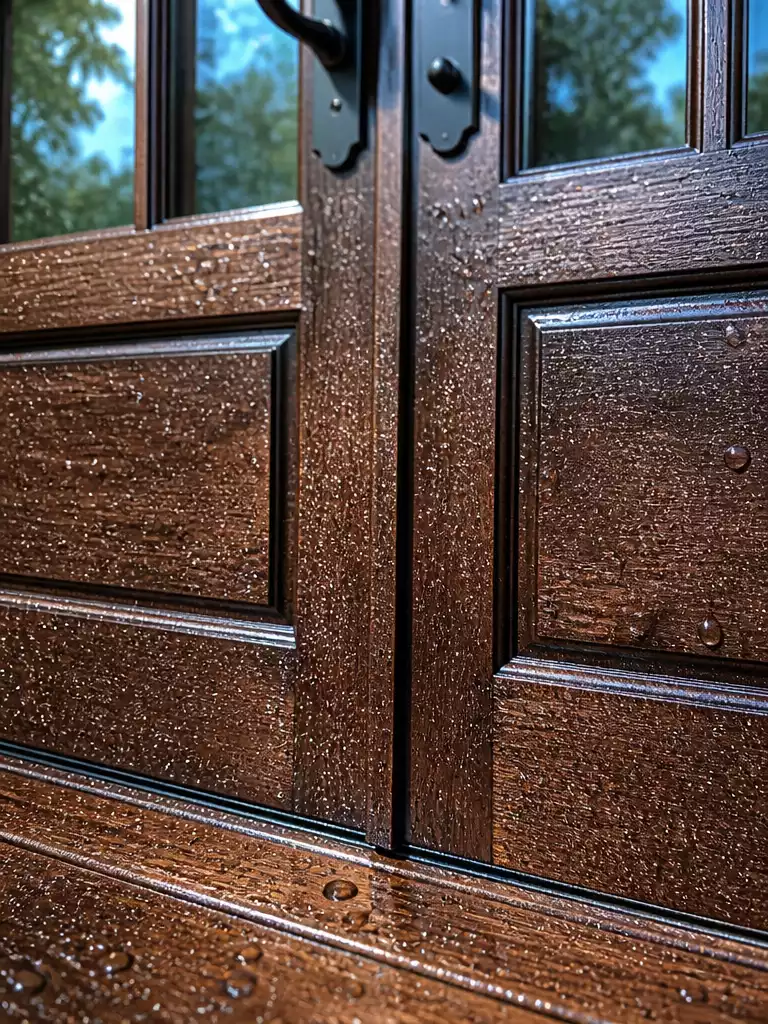
A high-performance barrier ensures your investment remains shielded from relentless UV rays and moisture intrusion.
The “maintenance trap” often catches homeowners by surprise when a beautiful new finish begins to flake away within two years. Traditional polyurethanes create a rigid plastic shell that looks great initially but eventually cracks as the wood naturally expands and contracts.
Once those hairline cracks appear, water seeps behind the film, trapping moisture against the wood and causing the finish to peel in large, unsightly sheets. To avoid a full strip-and-sand project, you need a coating that moves with the wood rather than fighting against it.
The Gold Standard: Marine Spar Varnish
True marine-grade spar varnishes are engineered for the harshest environments on earth. Unlike standard interior clears, these formulas contain a higher ratio of oil to resin, keeping the cured film flexible enough to withstand seasonal wood movement.
They are also loaded with UV blockers that act like high-SPF sunscreen for your door. This prevents the sun from “bleaching” the wood fibers, which is the primary cause of finish failure on south-facing entryways.
Modern technology has introduced high-end European water-borne finishes that offer a “micro-porous” advantage. These advanced coatings allow the wood to “breathe” by letting internal moisture vapor escape while remaining completely waterproof from the outside.
The 6-Sided Seal: Your door is only as durable as its most vulnerable point: the bottom edge. Ensure your finisher seals all six sides of the door leaf—especially the invisible bottom grain where road salt and rain-splash thrive.
| Finish Type | Failure Mode | Maintenance Level |
|---|---|---|
| Standard Polyurethane | Cracking & Peeling | High (Requires Stripping) |
| Marine Spar Varnish | Gradual Fading | Medium (Sanding/Recoat) |
| Micro-porous Oil | Thinning/Erosion | Low (Wipe-on Refresh) |
Expert Insight: Dark stains absorb significantly more heat than light tones. This heat-sync effect forces the wood to expand and contract more violently, which can break the finish bond up to 40% faster than a natural or light-colored stain.
Choosing the right sealant is a balance between the look you want and the work you’re willing to do later. Film-forming oils that fade over time are far easier to maintain than hard topcoats that require chemical stripping once they begin to fail.
.
💡 Practical Tips for a Long-Lasting Finish:
- Edge First: Always apply the finish starting with all edges, especially the bottom, before coating flat surfaces.
- Multiple Coats: Build up at least three flexible coats of marine spar varnish for optimal protection and longevity.
- Regular Inspection: Check your door annually for signs of wear or cracking, focusing on corners and bottom edges to catch issues early.
6. Structural Geometry: Panel Style and Proportions
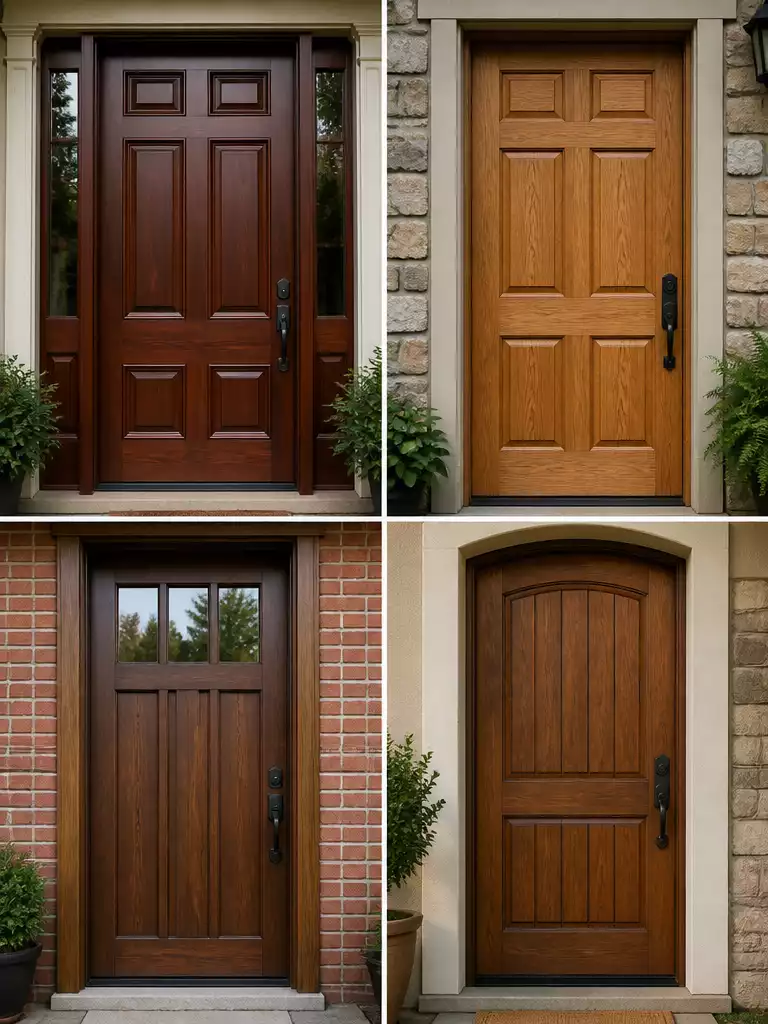
Smart geometric design allows your door to breathe and move without compromising its structural seal.
It is easy to view door panels as a purely decorative choice, but in the engineering of a double door, they function as floating rafts. Because wood naturally expands and contracts with the seasons, a solid, fixed slab would eventually buckle or crack under its own internal pressure.
High-quality construction utilizes “Space Balls”—small rubber expanders tucked inside the stiles—that allow the center panels to grow in the humid summer months without blowing the door’s joints apart. This internal “give” is what prevents the dreaded seasonal sticking that plagues poorly designed entries.
The Proportional Stress Audit
The way you divide the surface area of your double doors directly impacts their lifespan. Larger surface areas create more leverage for warping and cupping.
- Panel Count: Dividing a door into 3 or 4 smaller raised panels is structurally superior to one massive single panel, as it distributes wood movement across multiple points.
- Stile Width: For double doors, the vertical stiles (the outer frame) must be at least 5-6 inches wide to support the torque of the active leaf slamming against the passive one.
- Profile Depth: A “raised” profile provides extra thickness and stiffness at the center of the panel, acting as a natural reinforcement against twisting.
Flat panels lack the “raised” architectural shoulder that allows wood fiber to flex naturally. In high-UV environments like the South or West, the lack of this physical relief often leads to surface splits and hairline grain separation.
When selecting your geometry, remember that proportions aren’t just about the “look” from the curb; they are about weight distribution. A wider stile provides the necessary “meat” for deep hardware mortises, ensuring your locks and hinges have enough structural wood to bite into for the long haul.
.
📋 What to Check First:
- Panel Movement Clearance: Confirm your door design includes enough room for panels to expand without stressing framing joints.
- Stile Thickness: Verify vertical stiles meet the 5-6 inch minimum for hardware strength and to resist warping forces.
- Panel Division: Assess if multiple smaller panels fit your entry style and climate instead of a single large slab for better durability.
7. Glass Options: Thermal Seal and Weight Impact
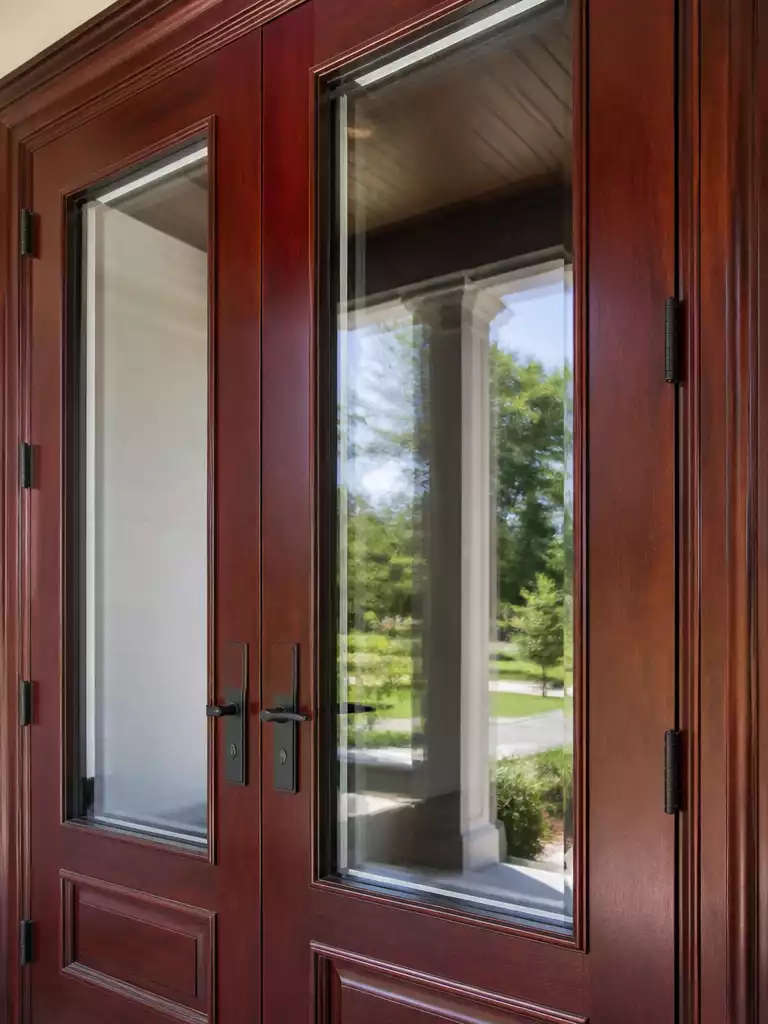
High-performance glazing ensures your grand entryway remains crystal clear and thermally efficient for decades.
When you choose large glass inserts for double doors, you aren’t just picking a “look”—you are adding significant weight and complexity to the structural frame. The primary risk here is the double-pane failure, that frustrating moment when the internal seal breaks and your beautiful view turns into a foggy, clouded aquarium.
To prevent this, Insulated Glass Units (IGU) must be specified with “Warm Edge Spacers.” These flexible components allow the glass to move slightly as the wood frame expands and contracts with the seasons, preventing the stress cracks common in cheaper, rigid aluminum spacers.
The Weight Factor: Hinge Requirements
Adding 1-inch thick triple-pane glass can increase the weight of your doors by 50 to 80 lbs. This extra load makes standard residential pins obsolete; you must use ball-bearing hinges to prevent the “active” leaf from dragging across your hardwood floors after just one season of use.
Security is the other half of the durability equation. While tempered glass is standard for safety, laminated glass is the superior choice for long-term home integrity because it remains bonded to an interlayer even if it’s struck.
This ensures that even if a crack occurs, the home’s thermal envelope stays intact and the door remains functional until a replacement can be professionally installed. For the best longevity, look for specific sealing technology in your quote.
Pro Tip: The Fog-Free Guarantee
Always request “Dual-Seal” IGU construction, which utilizes both Polyisobutylene and Silicone. This combination is the industry gold standard for achieving a 20-year fog-free guarantee, protecting your investment from premature seal failure.
| Glass Type | Durability Benefit | Hinge Impact |
|---|---|---|
| Double-Pane IGU | Standard thermal barrier | Moderate (Standard hinges) |
| Triple-Pane IGU | Maximum insulation; quietest | High (Ball-bearing required) |
| Laminated Safety | Impact resistant; UV protection | High (Heavier glass density) |
.
📋 What to Check First with Glass in Double Doors:
- Frame Clearance: Confirm the door frame can handle thicker glass without compromising weatherstripping or sealing.
- Hinge Load Capacity: Verify hinges are rated for extra glass weight to avoid sagging or binding over time.
- Seal Durability: Inspect supplier specs for dual-seal IGUs to ensure long-term fog resistance in your climate.
8. Hardware Compatibility: Preventing the “Double Door Sag”
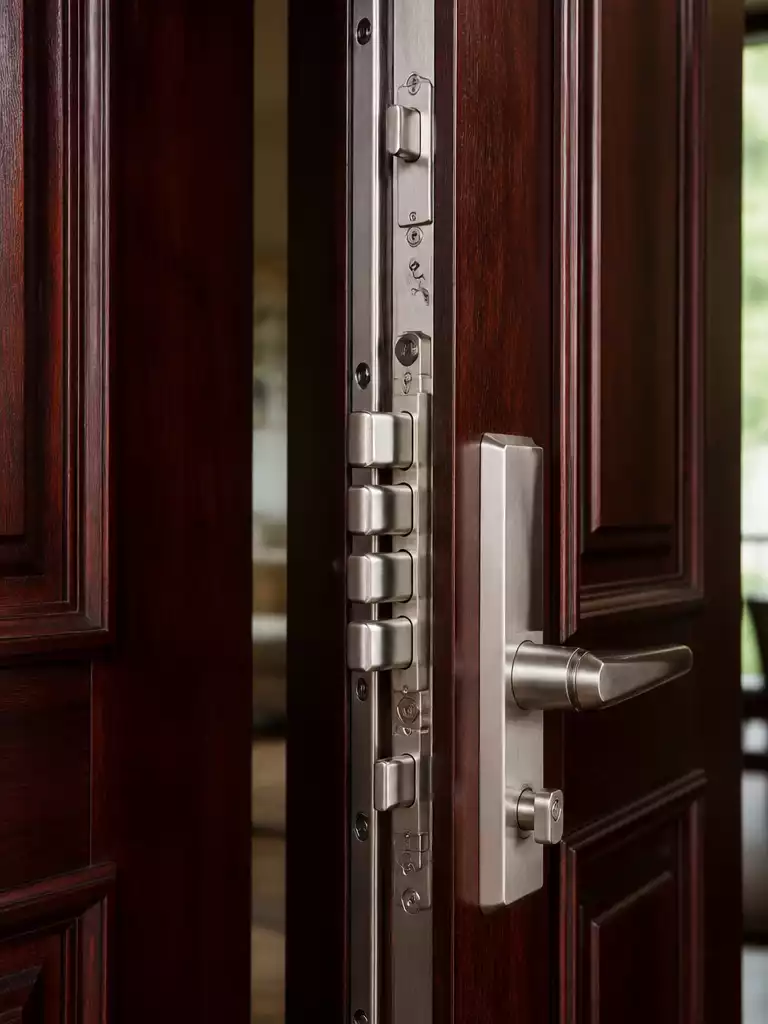
Heavy-duty hardware ensures your grand entry remains perfectly aligned and effortless to operate for decades.
The most common failure in double doors isn’t the wood rotting; it’s the “passive door” losing its battle with gravity. Because one door is often pinned in place while the other is used daily, the structural torque eventually causes the pair to misalign, leaving you with a gap that lets in both drafts and noise.
To prevent this, you cannot rely on standard residential-grade hinges or simple deadbolts. Heavy wood double doors require hardware engineered to distribute massive weight across the entire vertical length of the stile.
The Double Door Hardware Audit
- Multi-Point Locking Systems: A 3-point lock is mandatory for 8-foot doors to “pull” the wood into the weatherstripping at the top, middle, and bottom, preventing seasonal warping.
- Hinge Duty: Specify 4″ x 4″ solid brass or stainless steel hinges with 4 hinges per door leaf to manage the weight without “stair-stepping.”
- Astragal Integrity: Ensure the T-astragal (the vertical strip where doors meet) features an integrated bolt system for a permanent, airtight weather seal.
- Ball Bearing Hinges: These are non-negotiable for heavy spans to ensure the door doesn’t “bind” or squeak as the house settles.
When the two doors meet, the T-astragal acts as the final line of defense against the elements. If this component isn’t properly spec’d with a heavy-duty bolt, the passive door will eventually “ghost open” or fail to provide the compression needed for your weatherstripping to work.
Choosing high-performance hardware isn’t just about security; it’s about maintaining the dimensional squareness of the entire entry system. Without these mechanical reinforcements, even the most expensive mahogany doors will eventually scrape the threshold or fail to latch correctly.
.
📋 What to Check First:
- Door Weight Compatibility: Confirm your hinges and locks are rated for the combined weight of both door leaves plus any glass or hardware added.
- Flush Bolt Installation: Verify recessing space in the door edge for flush bolts to avoid protrusions that interfere with closing.
- Alignment with Frame: Inspect hinge mortises and strike plates for precise fit, ensuring doors close squarely without forcing or sagging.
9. Sizing and Openings: The “Squareness” Audit
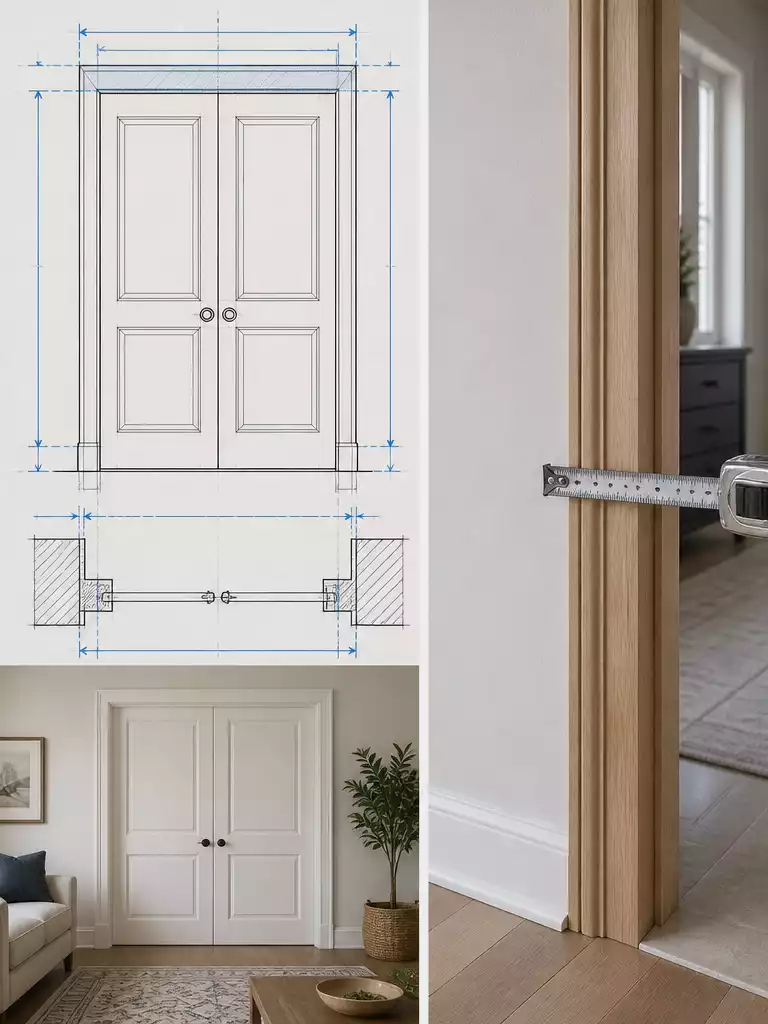
Precision measurements ensure your grand entrance remains airtight and operates smoothly for decades to come.
Even the most expensive mahogany doors will fail if the “hole in the house”—the Rough Opening (RO)—isn’t structurally sound. When you double the width of an entry, you double the potential for structural settling to interfere with the door’s operation.
Standard double door dimensions typically follow the “6/0 x 8/0” rule, which consists of two 36-inch doors side-by-side. However, a 2-inch “shim space” is a non-negotiable technical requirement to allow for the natural settling of the home without crushing the door frame.
The Critical Squareness Checklist
- Diagonal Verification: Measure the RO from top-left to bottom-right and top-right to bottom-left. If these two numbers differ by more than 1/4 inch, the doors will bind and the finish will rub off the edges within months.
- Header Integrity: Because double doors span over 6 feet, a standard single header is insufficient. Ensure your contractor has installed a double or triple LVL header to support the overhead weight.
- Sub-sill Flashing: A dedicated flashing system must be installed under the threshold. This prevents the bottom of your wood frame from sitting in standing water during heavy rain.
The “Header Sag” is a common silent killer for double doors. If the header above the opening isn’t beefy enough, the weight of the house will slowly press down on the center of the frame, causing the doors to rub at the top or fail to latch entirely.
Before ordering, confirm that your threshold is perfectly level. In double door systems, a floor that slopes even slightly across that 6-foot span will cause one door to hang lower than the other, breaking the weather seal at the meeting stile.
Once you have confirmed that your opening is square and the header is reinforced, you have created the necessary foundation for a successful installation. This structural precision is what allows the hardware and seals to perform their jobs effectively.
.
📋 Before You Try This: Key Opening Checks
- Frame Plumbness: Verify the jambs are perfectly vertical—any tilt causes binding and uneven weather sealing.
- Rough Opening Depth: Confirm the wall thickness matches your door frame depth to prevent gaps or trimming issues.
- Threshold Drainage: Check that water drainage slopes away from the threshold to avoid moisture buildup against the door bottom.
10. Installation Quality: The “Six-Side” Rule
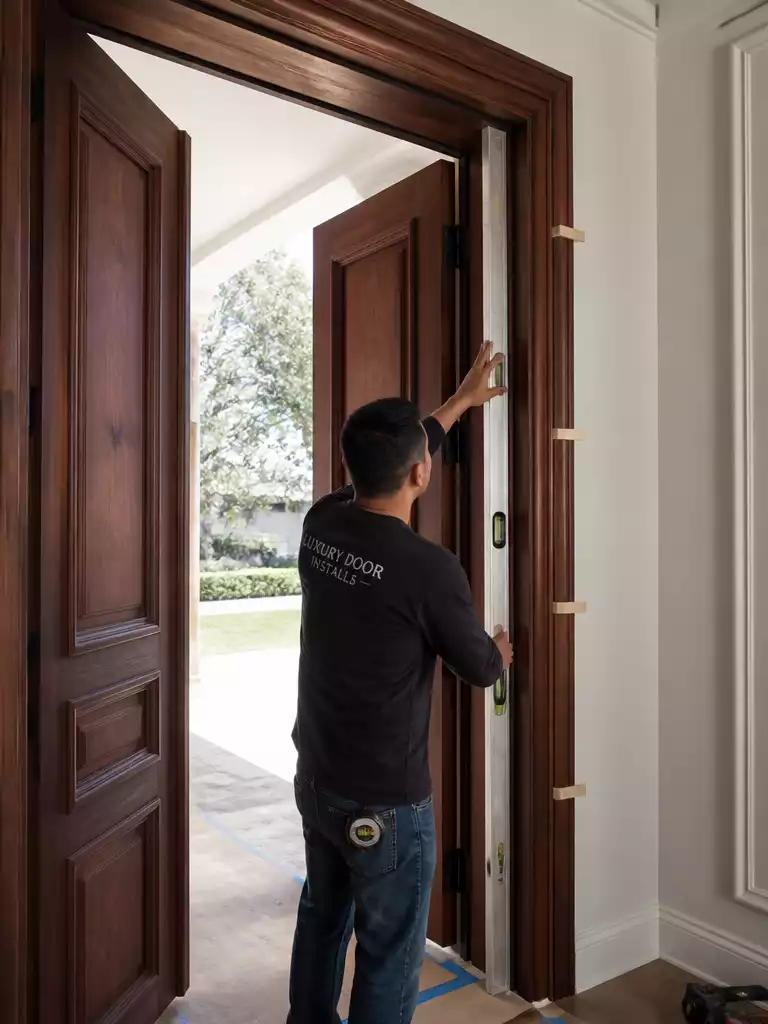
Precision installation ensures your investment remains airtight and operates effortlessly for decades to come.
You can buy the most expensive mahogany slab on the market, but it is effectively worthless if the installation is handled by a general handyman. A $10,000 door installed by a $100 handyman is a $0 investment because double doors are significantly more temperamental than single entries.
The “Plumb, Level, and Square” trifecta is the absolute baseline for a successful build. Even a 1/8th inch tilt in the hinge-side jamb will cause these massive doors to “ghost open” or bind against the floor, eventually stripping the hardware screws.
The “Six-Side” Sealing Requirement
Most homeowners don’t realize that a door has six sides: the front, the back, and the four edges. If your installer fails to seal the invisible bottom edge, moisture will wick up through the end-grain, causing the wood to rot from the inside out within five years.
- Back-caulking the Sill: Sealing the underside of the threshold prevents water from creeping under the frame and rotting your subfloor.
- Top and Bottom Sealing: Before the door is hung, the top and bottom edges must receive the same number of finish coats as the faces to prevent seasonal swelling.
To verify the seal, perform the “Dollar Bill Test” once the weatherstripping is in place. Close the doors on a dollar bill at various points along the meeting stile and the perimeter.
If you can pull the bill out without resistance, your climate control is leaking and your door is vulnerable. The weatherstripping should provide even compression across the entire span to keep the elements exactly where they belong—outside.
Installation Quality Checklist
- Verify the rough opening is square by measuring the diagonals; they should be within 1/4 inch of each other.
- Confirm the use of 3-inch or longer screws through the hinges into the wall studs to prevent sag.
- Ensure a sub-sill flashing system is installed to direct water away from the entryway.
- Check that the “active” door latches securely without needing to be pushed or pulled with force.
.
📋 What to Check First Before Installation:
- Opening Integrity: Confirm the rough opening is perfectly square and solidly framed to prevent future shifting or binding.
- Weather Barrier Prep: Verify the sill pan and flashing are installed correctly to redirect water away from the door frame.
- Material Compatibility: Ensure the door’s wood species and finish are matched to your local climate to avoid installation-related warping or swelling.
11. Maintenance Schedule: The “Ounce of Prevention” Log
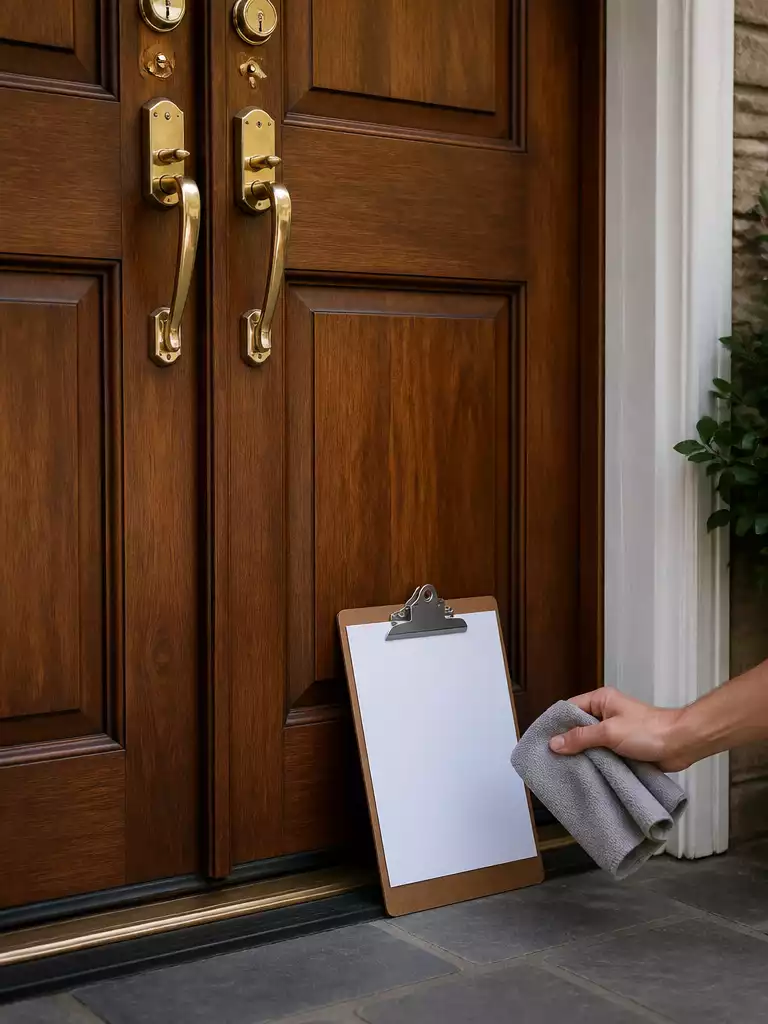
Preserving the structural integrity of your investment through proactive, simple seasonal care routines.
Think of maintainance for your double doors like an oil change for a luxury vehicle. If you skip the small adjustments, the “engine”—which in this case is the cellular structure of the wood—will eventually seize and fail.
Most homeowners wait until they see peeling paint or a door that won’t latch to act, but by then, moisture has already moved into the grain. Staying ahead of UV breakdown is the only way to ensure those 8-foot stiles don’t begin the slow process of bowing.
The Condition Audit: What to Look For
Perform a visual walk-through every six months, specifically after major seasonal shifts. You are looking for the “early warning” signals that the protective shield is thinning.
- Graying Grain: This is a sign that UV rays have reached the wood fibers; the finish is no longer screening out the sun.
- Flaking or Checking: Small surface cracks (checking) mean the wood is drying out and losing its natural elasticity.
- Finish Cloudiness: If the clear coat looks milky, moisture is trapped beneath the surface and needs immediate attention.
Annual cleaning is your first line of defense against “grime-bonding,” where dirt and pollen physically bake into the topcoat. Use a mild soap and water solution to wipe down the exterior, which prevents abrasive particles from scratching the finish during windstorms.
The real secret to longevity is the 3-year re-coat. By lightly sanding the surface and applying a single fresh topcoat every few years, you avoid the massive expense of a “strip and sand” project that requires taking the doors off their hinges.
Pro Tip: The $20 Save
Check your door “sweep”—the rubber strip at the bottom—every 24 months. These dry out and crack, allowing water to wick into the unprotected end-grain at the bottom of the door; replacing a $20 sweep can save a $5,000 door from bottom-up rot.
| Interval | Action Required | Why It Matters |
|---|---|---|
| 6 Months | Visual audit & hardware lubrication | Prevents hinge friction & identifies UV damage early |
| 12 Months | Mild soap wash & wax (if using oil) | Removes corrosive pollutants and restores luster |
| 3-5 Years | Maintenance topcoat application | Reinforces the UV shield before the base wood is exposed |
Remember that maintenance isn’t just about aesthetics; it’s about keeping the wood fibers stable. A well-maintained finish keeps the moisture content of the wood consistent, which is the only way to prevent the seasonal warping that plagues double-door sets.
.
📋 Installation Quality: What to Check First
- Plumb & Level Check: Use a reliable level to verify the hinge jamb is perfectly vertical before mounting the door.
- Shim Material: Confirm installer uses non-compressible plastic shims instead of wood to prevent gradual sagging.
- Weatherstripping Fit: Test the door closed with a thin dollar bill to ensure consistent compression around all edges for airtight sealing.
Cost vs. Longevity: The Total ROI Calculation
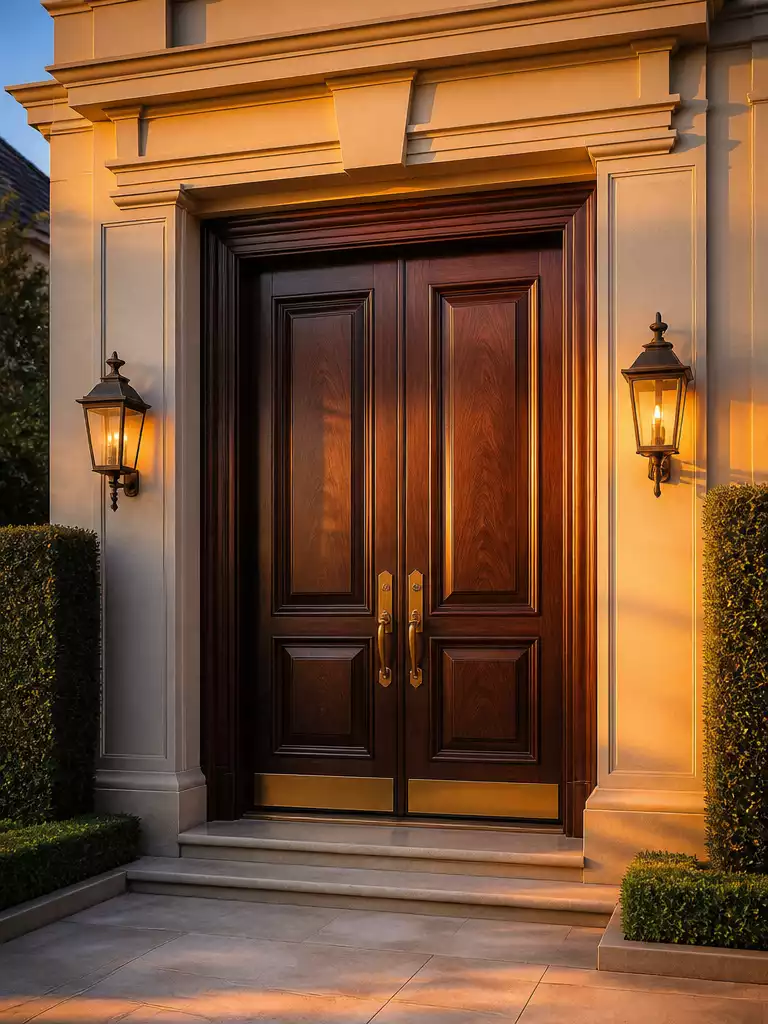
Choosing high-grade materials transforms an upfront expense into a permanent architectural asset for your home.
When you are staring at a quote for custom mahogany double doors, it is easy to feel some sticker shock. However, durability is a math problem where the cheapest entry price often leads to the highest total cost of ownership.
A “Buy Once, Cry Once” philosophy is particularly relevant for double doors because the labor to replace them—including reframing, interior trim work, and siding repair—often exceeds the cost of the door itself. Investing in structural integrity now prevents a forced replacement in just a few years.
| Factor | Budget Pine/Fir Set | Premium Mahogany Set |
|---|---|---|
| Initial Cost | $2,000 – $3,000 | $7,000 – $10,000+ |
| Expected Lifespan | ~7 Years | 50 – 100 Years |
| 20-Year Total Cost | $6,000+ (3 replacements) | $7,000 (0 replacements) |
| ROI at Resale | Low (visible wear) | 70% – 90% |
Beyond the physical wood, there is a hidden Energy Efficiency ROI to consider. High-quality double doors with precision seals reduce HVAC “cycling” by maintaining a true airtight envelope, potentially saving you $100 to $300 annually in extreme climates.
Resale value also favors the long-term play. Real estate data consistently shows that a grand, well-maintained wood entry is one of the few renovations where you can recoup nearly 90% of the cost when you sell your home.
Read the fine print before signing. Most wood door warranties are voided if you don’t have a specific porch overhang (usually a 1:1 ratio) or if you paint the door a dark color that absorbs excessive heat.
Ultimately, the most durable choice is the one that fits your home’s specific environmental exposure and the manufacturer’s warranty requirements. When you balance the lifespan of 50+ years against the recurring headache of cheap replacements, the premium option is clearly the more frugal path.
.
📋 Before You Schedule Installation:
- Confirm Level Floors: Uneven flooring will complicate door alignment and may require subfloor adjustments before installation.
- Check Existing Frame: Inspect the rough opening for rot or warping that must be repaired to ensure a secure, plumb fit.
- Plan Weatherproofing: Verify that flashing and sill pan details are ready to integrate seamlessly with your door to prevent moisture infiltration.
You now have a comprehensive set of factors to consider when choosing wooden double front doors that stand the test of time. There’s no need to perfect every detail at once; even focused attention to a couple of key areas can make a lasting difference.
With each deliberate step, you’re investing in a durable entryway that supports your home’s comfort and value for decades. Taking time to understand the technical essentials gives you confidence to protect your investment wisely.