
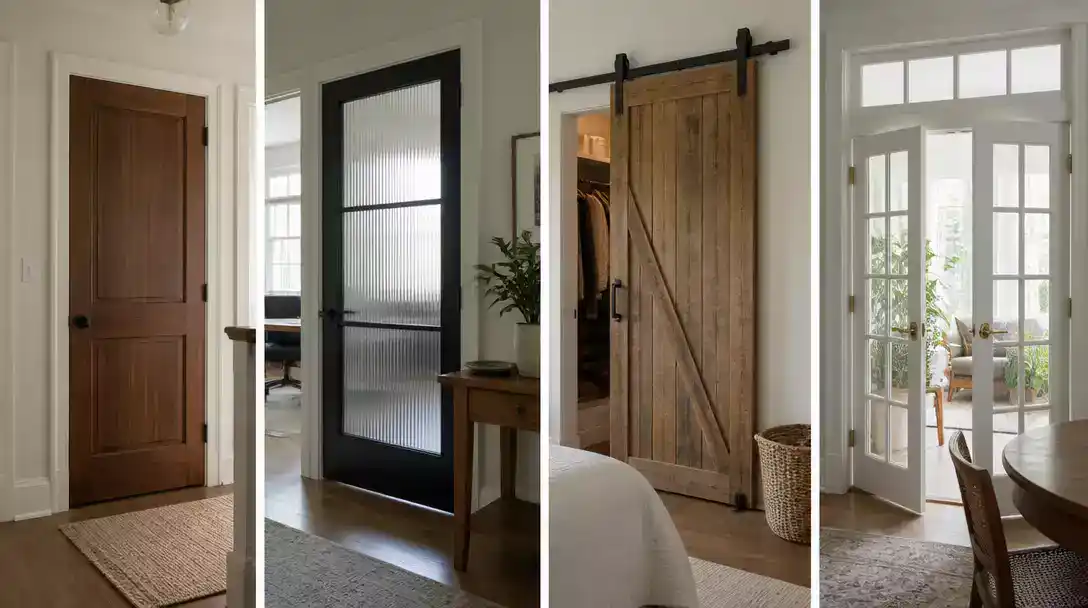
A door swap can make a room feel twice its size, block the din of a laundry cycle, or let light pour into a hallway—but picking the wrong one leaves you with a daily irritation. Whether you’re planning a full reno or one budget-friendly pivot, this guide compares 10 door types by privacy, space, durability, and real cost.
Here are 10 door choices that upgrade every room—starting with the classic that gets better with age.
Solid Wood Doors
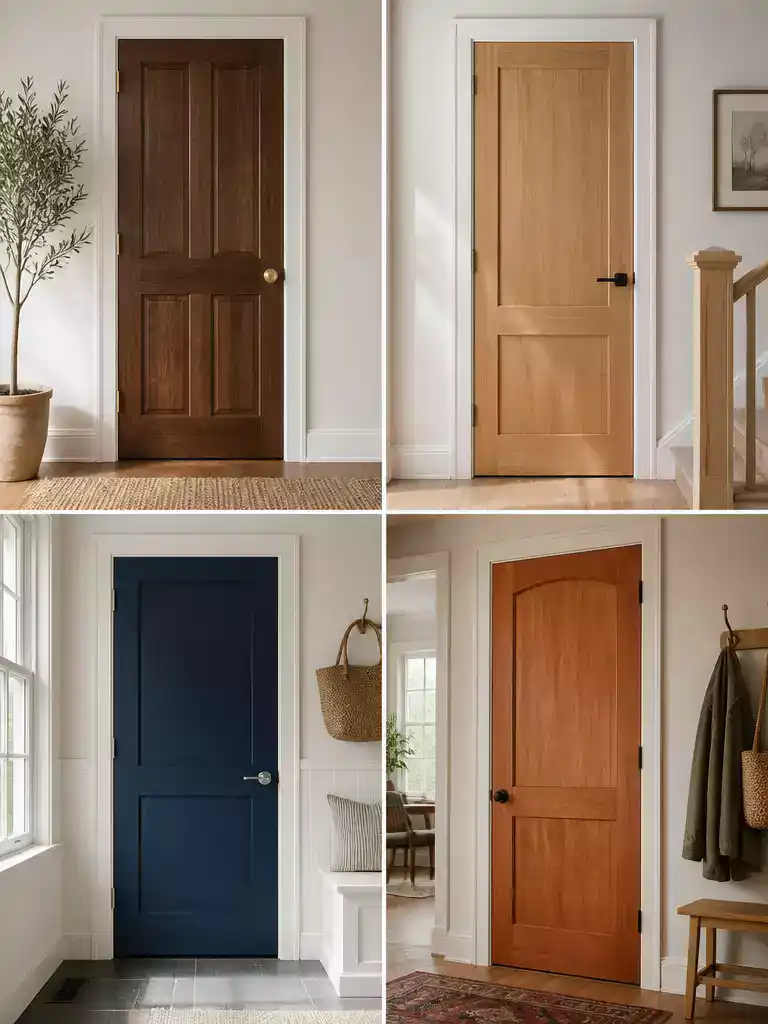
Invest in a door that gets richer with age, not one you’ll replace in five years.
As an Amazon Associate I earn from qualifying purchases. Affiliate links may earn me a commission at no extra cost to you.
A door you can sand down and refinish in 2035 when trends shift—solid wood is the only option on this list with a decades-long second act.
Walnut deepens to a chocolate brown over time; oak stays pale and resists dents. That natural patina can’t be faked with veneer.
It’s one of the only doors you can stain to match your existing millwork exactly. The grain pattern also shifts the formality of the room: sweeping cathedral grain reads traditional, while straight vertical grain leans modern.
Here’s why this door earns its weight—literally:
- Heirloom flexibility: Sand it, restrain it, or paint it—a solid slab can change identity with the trends.
- Heavy silence: At 80–100 lbs, a solid-core wood door swallows the thud of a laundry cycle or the chatter of a playroom far better than a hollow core.
- Wood that moves: Solid wood expands and contracts with the seasons. In a steamy bathroom or mudroom, quartersawn oak cuts that movement nearly in half.
Moisture reality check: If every edge isn’t sealed—especially the top and bottom—humidity wicks up from the floor like a straw. In an unvented bathroom, a solid door can swell and stick within a single season.
Cost reality: Upfront, a solid wood slab costs several times more than a hollow-core door. Spread that over 30+ years of one-and-done use, and the per‑year cost drops below replacing a cheap door two or three times.
Pro tip: Seal all six faces before hanging—moisture can travel up from the bottom edge. And never hang a door this heavy on two standard hinges; use three ball‑bearing hinges to keep it from sagging over time.
But what that solid heft doesn’t offer is a steel backbone for security. That brings us to the door that dares someone to try.
.
{!output-tips-writer-1}
Steel Entry Doors
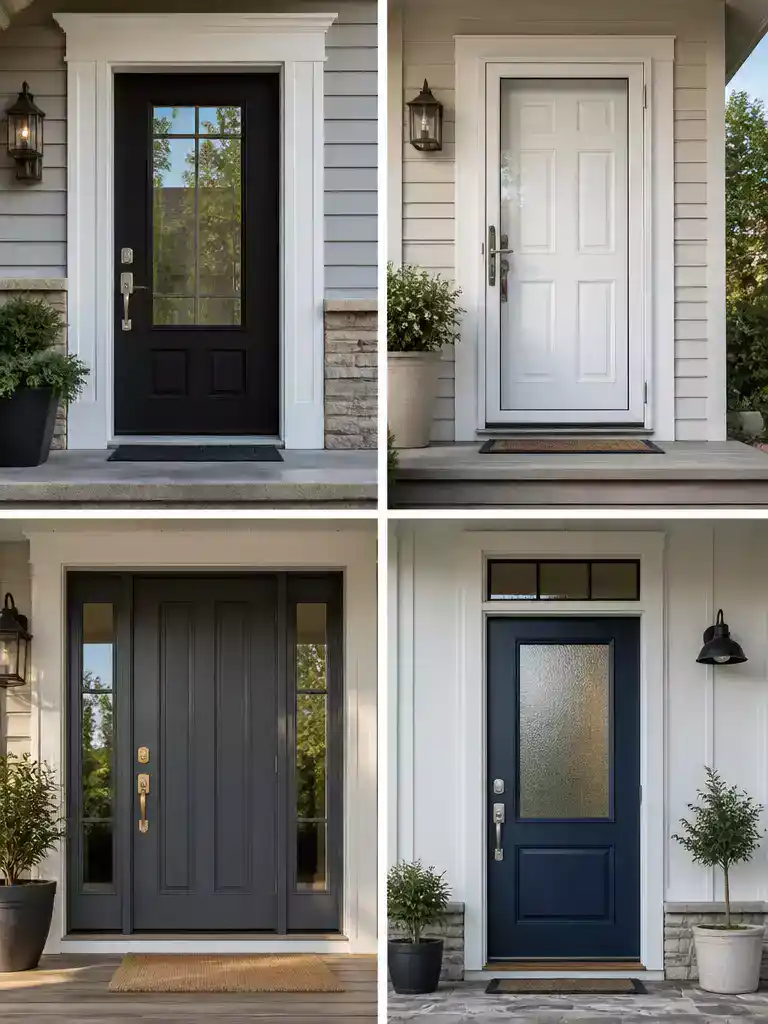
A front door that brings serious security without draining your renovation budget.
For a front door that says “not today” to a booted kick, steel is the bodyguard material—but it comes with a dent-and-rust Achilles’ heel. A 24-gauge steel skin wrapped around a polyurethane foam core creates an R-value between 5 and 12, giving you a tight thermal envelope for north-facing entries that freeze over in January.
That foam core is the secret. It insulates without adding the weight of solid wood, so the whole slab often clocks in under 50 lbs—light enough for a solo DIY install. And on a front entry that faces biting wind, that insulation means the inside face of the door won’t feel like an ice block when you touch it barefoot at midnight.
🔑 The thermal break you can’t skip: Inside the frame, a vinyl strip stops cold from conducting through the metal edge to the interior. Skip this detail, and frost forms on the indoor door edge in sub-zero climates. Solid wood doors don’t need a thermal break at all—the material itself is the insulator—but steel demands this engineered separation to perform.
Now for the trade-off. A misaimed ladder, a hail stone, or an enthusiastic kid with a hockey stick can dimple that steel skin. Once the paint chips, the exposed metal rusts—and unlike wood, you can’t sand out a dent and stain over it. You’re patching and repainting, or living with the character mark.
That makes steel a calculated choice: unbeatable cheap security, but the finish won’t stay flawless for a decade. This is the door you pick when a locked front entry matters more than a furniture-grade surface—and when you’re willing to add a storm door for an extra layer of dent protection.
💰 Budget reality check
A basic primed steel slab can cost as little as $150, making it the most affordable exterior door that still meets energy code. Compare that to solid wood at $500+ and fiberglass at $300–$600, and steel wins the upfront numbers every time. The catch? You may replace it sooner than a fiberglass door would need refinishing.
✅ Pro tip — get the paint right: When painting a steel door yourself, use a direct-to-metal (DTM) acrylic paint—regular latex peels within a season. If you’re ordering pre-finished, look for a factory-applied baked-on coating; it outlasts any field-applied finish and comes with a warranty that brushwork never will.
If you love the look of wood but flinch at steel’s dent-prone finish, the next option mimics oak so well your neighbors will tap it twice to be sure.
.
{!output-tips-writer-2}
Fiberglass Doors
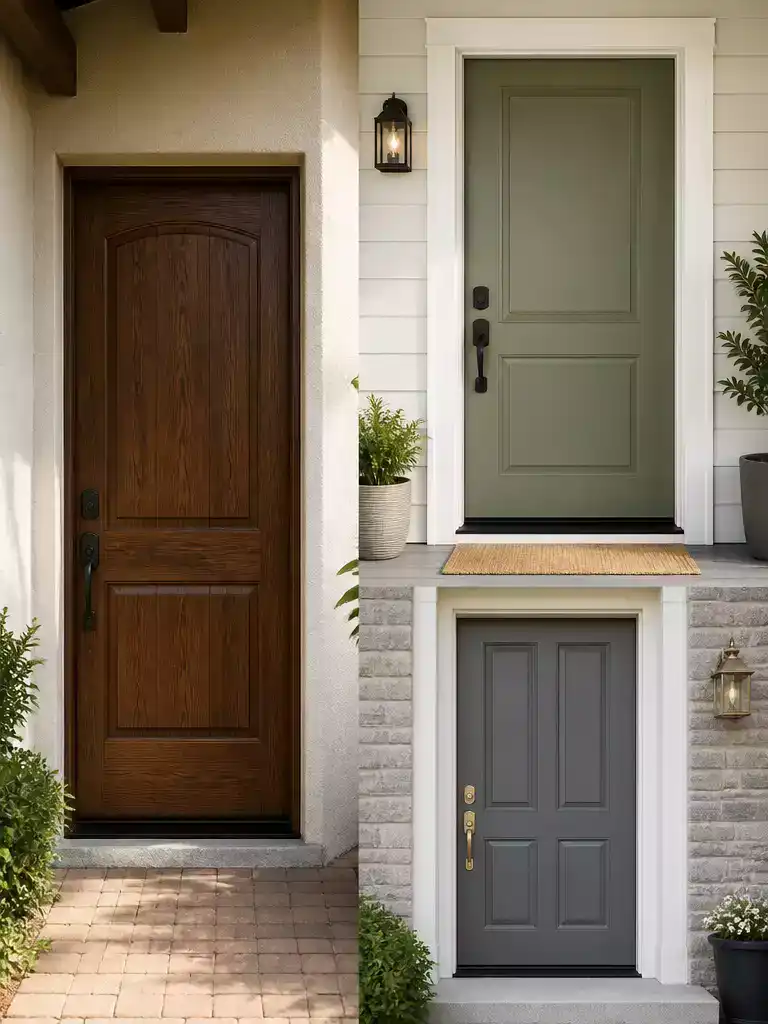
This door wears oak’s look so well, even a knock won’t give it away.
The door that guests will swear is solid oak until they knock—and it shrugs off a baseball bat and a season of sun.
A deep wood-grain emboss that your fingertips can feel, combined with a UV-resistant gel coat, means this door won’t chalk, fade, or warp on a west-facing entry that cooks in afternoon glare.
No other material fakes wood this convincingly while needing nothing but a soapy sponge to stay clean.
Compression-molded fiberglass skin over a foam core gives it dent resistance steel can’t match. A kid’s bike can hit it and leave no mark, and it won’t rust, rot, or split.
Price-wise, it sits above steel but below solid wood. The 30-year low-maintenance lifespan recoups the difference, since you won’t be sanding, staining, or replacing it.
Now we step inside, where doors can do more than close off a room—they can borrow daylight from the next space and make a windowless powder room feel airy.
.
{!output-tips-writer-3}
Glass Interior Doors
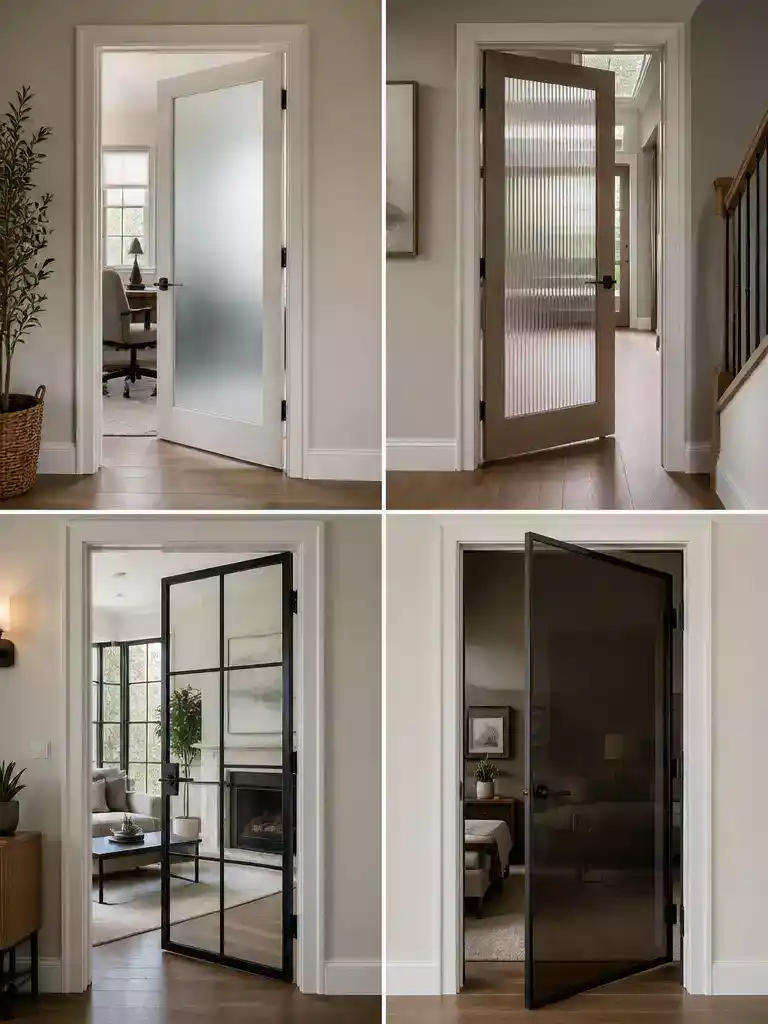
Borrow light from the next room while keeping your mess out of sight.
When your hallway is a cave and the only light source is a living room window 15 feet away, a glass door acts like a light pipe. It borrows daylight without sacrificing the ability to shut out sound.
A home office off a dark corridor can steal daylight through a full‑lite frosted panel. The floor plan feels wider, yet messy papers stay hidden.
The level of privacy depends entirely on the glass texture—choose wrong, and a bathroom door becomes a regret.
Safety code: All glass panels must be tempered or laminated—no exceptions. But glass offers almost zero sound isolation; a door between a TV room and nursery won’t block late‑night audio.
Glass panels come in full‑lite (door mostly glass), half‑lite (glass in the upper half), or three‑quarter lite for balanced light and privacy.
- Thin steel framing gives an industrial loft edge, with visible welding details and raw metal.
- Frameless reads as 90s minimalist; clean edges make the glass float, but fingerprints are merciless.
- Black metal grid turns a clear glass door into a modern farmhouse statement, with symmetrical rectangles.
- Hardware is seen from both sides—choose levers or pulls that hold up from every angle.
Pro tip: Test before you etch—install clear glass and apply a removable frosted film for two weeks. If the balance feels right, then commit to permanent etched glass; you can’t undo a sandblast.
Glass doors come in 1‑3/8” or 1‑3/4” slabs, and the weight demands solid blocking behind the hinge jamb to prevent sagging.
Pair a glass door with a transom above it, and a cramped entry suddenly borrows ceiling light. A small threshold becomes a grand focal point.
If your space crunch is about floor area rather than light, the next door frees up every inch a swing would have stolen.
.
{!output-tips-writer-4}
Before any door lands in a cart, half the battle is already won if the opening measurements and handing are dead-on—style debates won’t salvage a slab that doesn’t fit the rough opening. A single solid call on what fits your house and how it swings can anchor the whole entryway, even if the other decisions feel unsettled.
🎯 The Calls Worth Getting Right:
- Measure stud-to-stud, not the old door—a ¼” gap kills the look no finish can fix.
- Plumb the jamb before ordering; a pre-hung unit forgives an out-of-square frame that a slab won’t. Worth comparing front door styles once you know the rough opening.
- Confirm handing in the actual doorway—a reversed swing isn’t returnable after paint. One correct order form beats ten perfect style picks.
Sliding Barn Doors
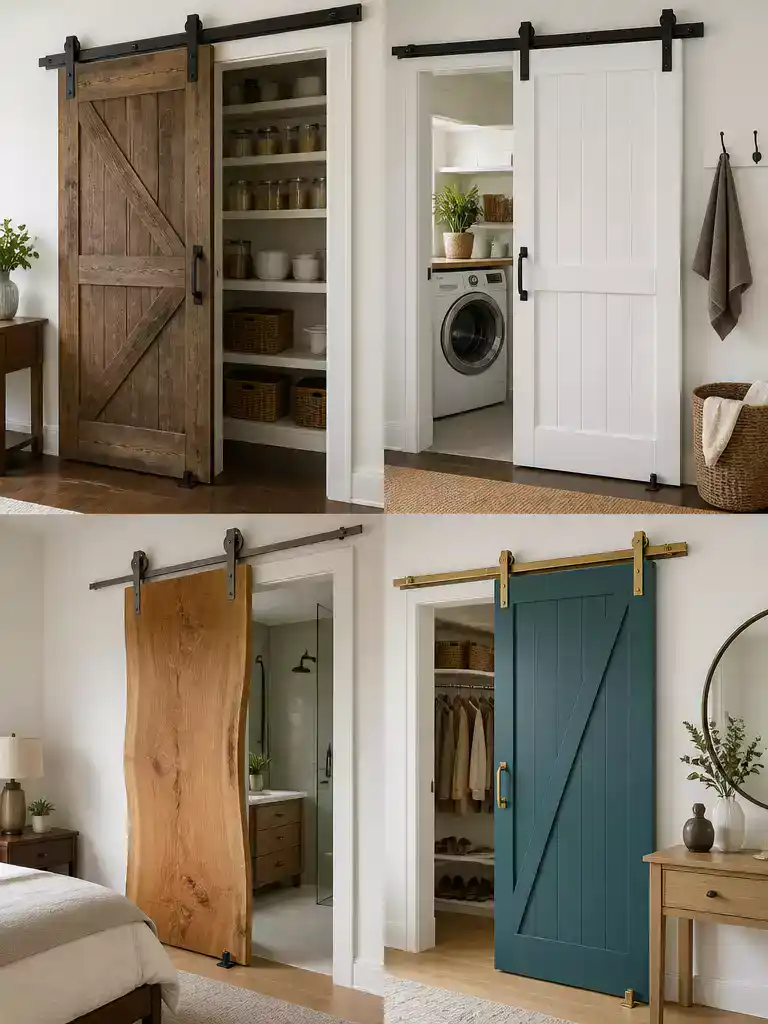
Reclaim every square foot of floor space and turn a hardware rail into the room’s focal point.
A door that glides on the wall instead of swinging into it—the barn door solves the tiny-bedroom puzzle where a swinging door ate up the only spot for a dresser.
It reclaims the 9+ square feet of dead floor a swing would command, and the hardware—chunky steel wheels on a black iron rail—becomes the room’s accent piece.
No pocket in the wall required, so you can retrofit it in a single afternoon.
- Space-saving workhorse. Perfect for laundry rooms, pantries, walk-in closets, or as a movable room divider between a master bedroom and ensuite.
- Track as style element. Choose matte black, brass, or galvanized steel finishes deliberately—the rail and strap hangers stay fully visible.
- Retrofit-friendly. Mount a header board into studs above the opening, hang the rail, and slide the door on—no drywall surgery needed.
But the privacy gap is real. Because the door hangs ½” off the wall, sound and light leak around all four edges.
It won’t block the sound of a shower or contain bathroom odors, making it a poor pick for a guest bath.
For a pantry, closet, or a couple’s bed-to-bath transition, that sliver of openness is often fine—and the space savings are worth it.
You need a blank wall length equal to the door’s width to slide it fully open.
If your layout puts a light switch or thermostat in that path, you’re moving it first. For wider openings, bypass barn doors stack two slabs that slide past each other.
A solid wood slab plus hardware can top 120 lbs, so the rail must hit studs—or use a mounting board—or it will pull out of drywall anchors.
Never hang a barn door on a hollow wall without reinforcing behind the track.
Pro Tips for a Smoother Ride
Always install a floor guide or the door will swing into the wall with every footstep.
Upgrade to a soft-close track—it prevents kids’ fingers from getting slammed and stops the door from drifting open on its own.
Sliding barn doors are never rated for exterior or garage-to-house fire separation.
Keep them inside the living envelope—and use them where square footage matters more than perfect silence.
.
{!output-tips-writer-5}
Pocket Doors
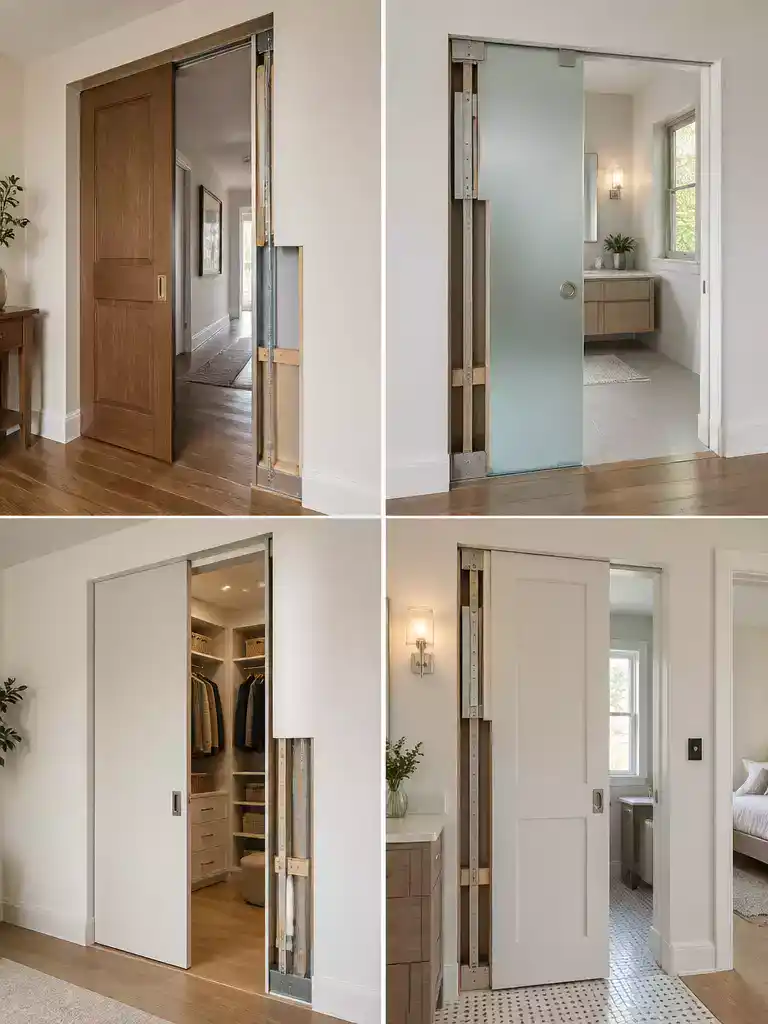
Reclaim every square foot—a pocket door slides away so your floor plan finally breathes.
A door that melts into the wall cavity—the pocket door is the Houdini of architecture, turning a constricted hallway doorway into an open arch whenever you want.
It erases the door entirely from the floor plan when open, giving back the 10 to 12 square feet nothing else can.
In a narrow Jack-and-Jill bathroom or a walk-through closet, the difference between a pocket door and a swing is the difference between usable floor and a cramped afterthought.
And unlike a barn door, which hangs off the wall and leaks sound around all four edges, a pocket door can seal tightly with a decent sweep at the bottom and a solid-core slab for mass.
That makes it a legitimate privacy door for a guest bath or home office where a barn door would leave everyone uncomfortable.
The retrofit reality: Installing a pocket door into an existing wall means opening the drywall to insert the pocket frame kit.
New construction is painless—but in a retrofit, moving plumbing or electrical inside that wall can easily blow the budget past what you planned.
Track quality rules everything here.
A cheap stamped-metal track will stick and derail within a year, leaving you yanking a door that won’t budge while guests wait outside the bathroom.
You generally need a 2×6 wall or a dedicated slim pocket frame to house a standard 1-3/8-inch door, so older homes with 2×4 interior walls may need the narrower frame kit.
- Door slab options are wide open: flush, paneled, Shaker, even glass—any style can mount to a pocket track, so you’re not stuck with a blank builder-grade slab.
- Essential hardware: an edge pull recessed into the door face combined with a privacy mortise lock—standard knobs or levers will stop the door before it fully disappears.
- Leveling is non-negotiable: the door simply won’t latch closed unless the track runs perfectly level, so shimming the frame during installation is where the real precision lives.
- Weight matters: if you’re hanging a solid wood door, order the heavy-duty track rated for 125-plus pounds—the standard version will bow and ruin the slide within months.
Pro tip: plan an access panel behind the trim or in the adjacent wall so you can replace the track later without demolishing tile.
And always spec soft-open/soft-close hardware—it prevents kids’ fingers from getting snatched and stops the door from slamming into the pocket like a freight train.
From an invisible door to the grandest possible double-door statement, we step into the classic that frames a room like a picture window.
⭐ Top Products for Pocket Doors
Soft Close Pocket Door Hanger Kit
Black Sliding Closet Door Handles
Blackout Curtains for Pocket Doors
{!output-tips-writer-6}
French Doors
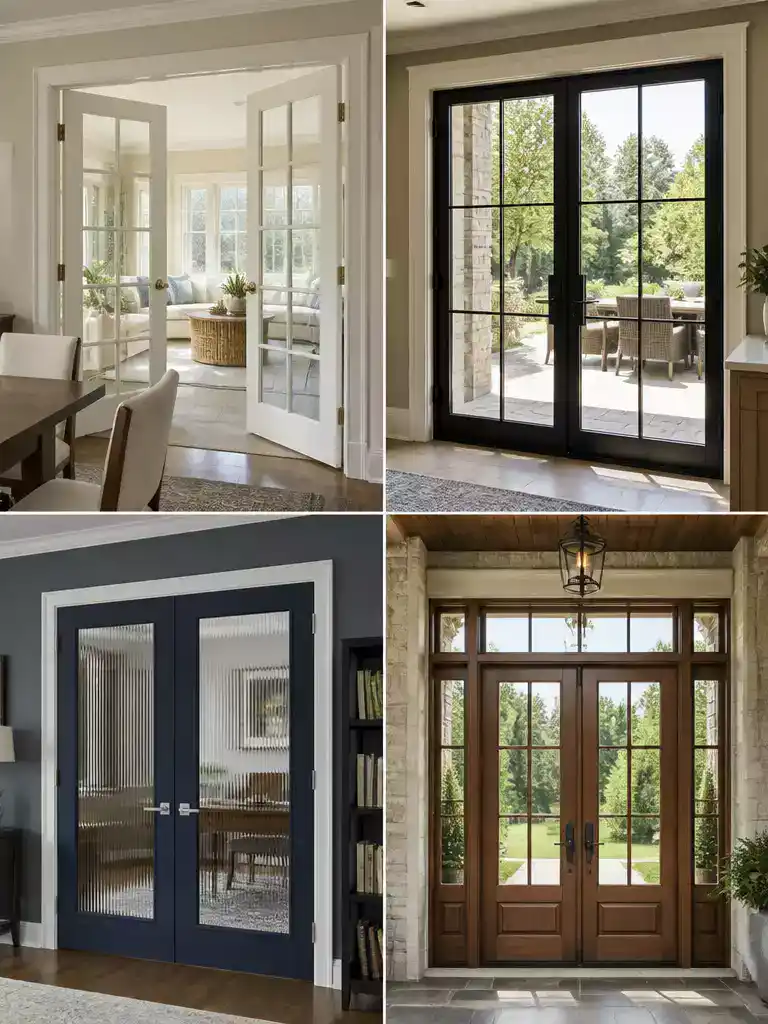
Two doors swing wide to erase the wall between rooms—then close tight when you need to shut out sound and scent.
When you want an open connection between kitchen and dining but still need to slam the door on a smoky seared steak, French doors give you the full-width opening of a cased archway with the option to seal it all off.
Two doors that swing to create an uninterrupted five-foot passage—no center post blocking the view.
That full-width portal, combined with glass that keeps sight lines alive, is why French doors make a sunroom-to-living-room transition feel expansive instead of like two separate boxes.
Who it’s for: Anyone craving a dramatic opening between shared living spaces—dining room to living room, primary bedroom to ensuite, or kitchen to patio.
Who should skip: Compact rooms where double-swing arcs would dictate all your furniture placement, and anyone who needs true sound isolation between spaces.
Both leaves swing, so you need the clear floor area for two arcs—in a compact dining room, French doors will eat into furniture placement fast.
Measure your swing zones before ordering, not after the hinges are mortised.
Glass and privacy: The glass you choose dictates whether French doors work or become a daily regret.
-
▪
Clear glass — Full sight-line connection; great for a living room to sunroom link, terrible on a bathroom or home office. -
▪
Ribbed or reeded glass — Blurs outlines enough for a primary bath or hallway office while still passing daylight. -
▪
Frosted glass — Total obscurity for a guest bath or nursery entrance; zero transparency, maximum privacy. -
▪
Tinted glass — Adds a moody filter and cuts glare; works well in west-facing rooms that catch harsh afternoon sun.
The hardware story: The inactive leaf uses a flush bolt system at top and bottom—slide the bolts into the frame, and it stays put.
The active leaf gets the main handle, while dummy knobs on the inactive side add symmetry so the pair looks balanced from both sides.
A high-quality astragal—the vertical seal where the two doors meet—prevents that annoying door rattle when someone walks past.
Pro Tip
For interior pairs, skip the heavy exterior multipoint lock—simple ball catch flush bolts are enough and cost a fraction. For exterior French doors to a patio, invest in a multipoint system that throws pins at top, bottom, and center; it also pulls the door tighter to the weatherstrip for a better seal.
Common mistake:
Installing a clear-glass French door on a bathroom and then scrambling to add frosted film after the first guest visit. Decide privacy level during the order, not after the hardware is on.
Styling notes: The number of glass lites defines the look—a 1-lite door reads modern and clean, a 10-lite grid leans traditional and formal, and full-lite with no muntins feels almost invisible.
Adding a transom above French doors amplifies the grand-entry feel and borrows even more light, turning a standard 80-inch opening into something that feels custom-milled.
French doors work inside or out, but the framing, threshold, and weatherproofing differ dramatically—exterior pairs need a sloped sill and full weatherstripping to keep rain from creeping under the astragal.
If glass panes and double-leaf formality feel overdone for a crisp modern interior, the next door strips back to a single, uninterrupted plane of color.
.
{!output-tips-writer-7}
Flush Panel Doors
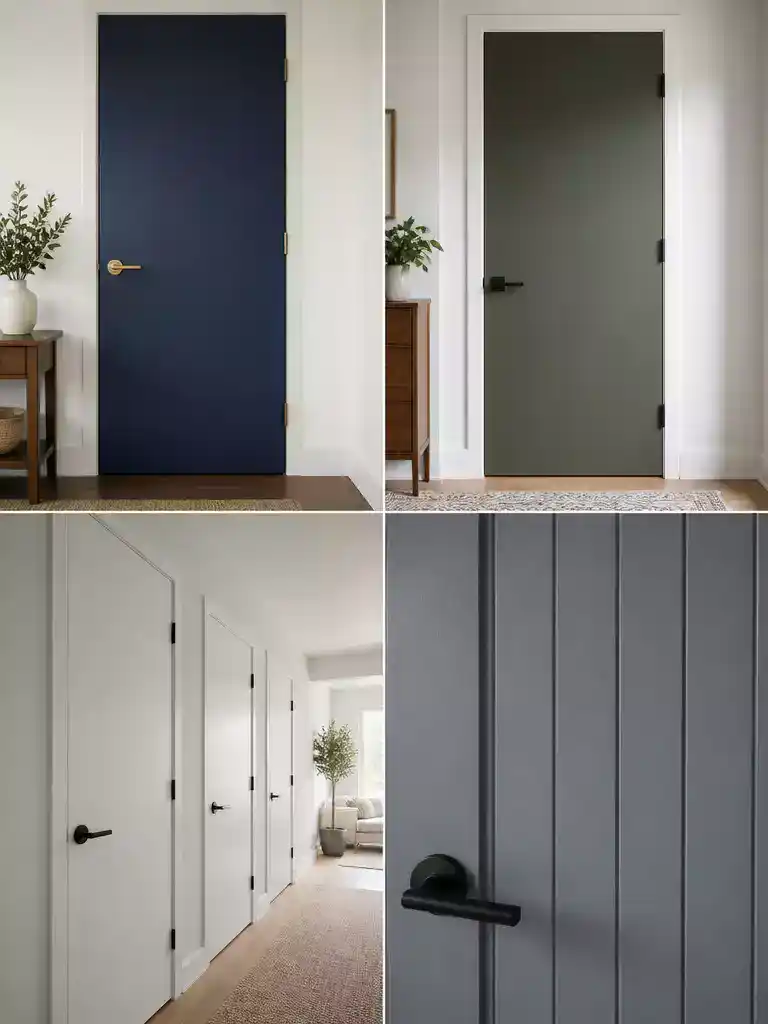
A single uninterrupted plane, painted deep navy or matte olive, turns a simple slab into a design moment.
A door so plain it becomes a deliberate design move—the flush door is all about the color you paint it and the vertical V-grooves that catch the light.
It’s a blank canvas for bold, unbroken color. Painted in deep navy or matte olive against a white wall, a flush door anchors a minimalist room the way a paneled door can’t, and its smooth face makes hardware pop.
Flush doors come pre-primed and ready to paint in one afternoon, and the core you choose changes everything from weight to sound control.
Groove options are subtle but shift the whole look. A totally smooth slab reads ultra-modern; a pair of vertical V-grooves adds linear texture without becoming a traditional panel.
Skip high-gloss paint on hollow-core doors—it telegraphs every wave in the fiberboard. Stick to satin or eggshell sheen, which forgives surface imperfections.
Where it hits hardest: a long hallway of matching flush doors in one color creates a clean, rhythmic line, and these are the most affordable door option—ideal for multi-room batch upgrades.
Steer clear of steamy bathrooms with hollow-core; moisture can swell the fiberboard edges. For a minimalist edge, install concealed hinges (Soss or European) so the hardware almost disappears.
Pro tip: Swap to a solid-core flush door and paint it with a satin or eggshell finish—gloss amps every flaw, while satin hides them. Craving the flush look with more luxury? Look for a flush wood-veneer door with a horizontal match-grain pattern.
From stark flat planes to a door split right down the middle—literally—we arrive at the farmhouse classic that serves fresh air and keeps the dog out.
.
{!output-tips-writer-8}
Dutch Doors
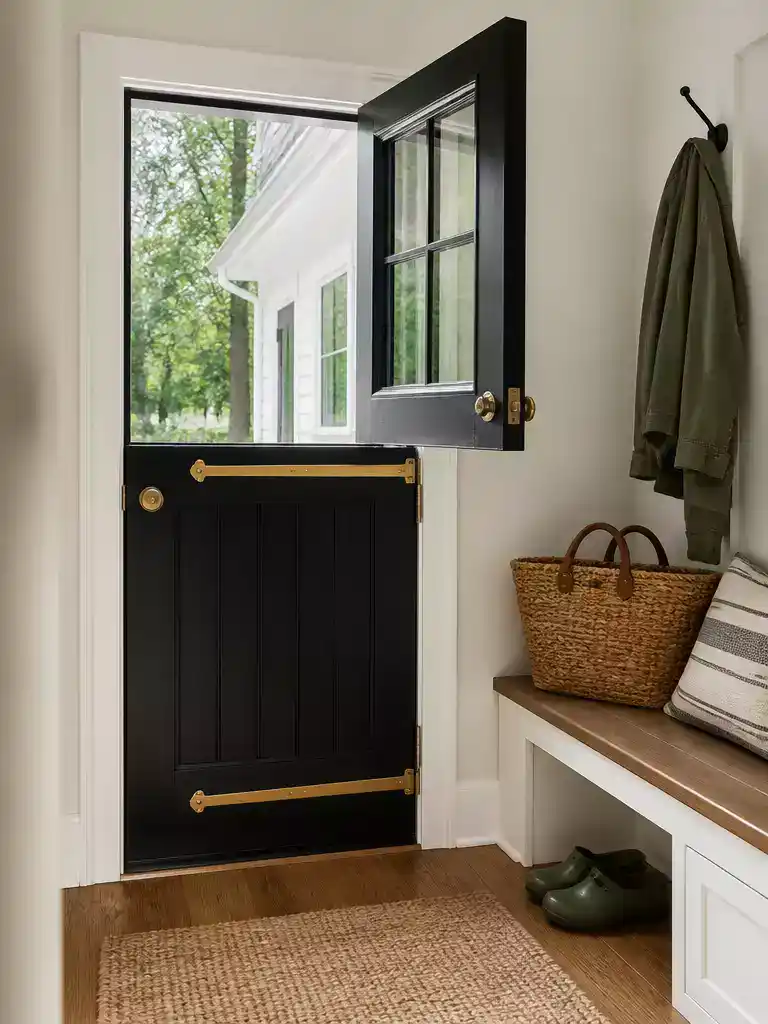
Top open for breeze, bottom closed for safety—one door doing two jobs at once.
The door that lets a cross-breeze in while the bottom half stands sentry against a muddy-pawed retriever—the Dutch door splits at the waist for two functions in one.
Independent operation of the top and bottom halves is what makes this door worth saving.
On a spring day, swing open the top for light and air while the bottom keeps a crawling baby or a curious terrier safely inside—no baby gate required.
That flexibility makes it ideal as a side kitchen door to the garden or a mudroom-to-yard passage where you want ventilation without giving the dog free rein.
But this split design comes with hardware most standard doors skip entirely.
Here’s what the setup demands:
- A Dutch door hinge—a long strap that connects both halves across the split line, not a standard butt hinge.
- A mortise bolt or slide bolt that locks the two halves together so the whole thing operates as one door when you want it to.
- Interlocking weatherstrip along the split line if the door faces the outdoors—skip it for interior use to keep the look clean.
- Precise jamb alignment—if the frame isn’t perfectly plumb, the halves won’t latch, and you’ll feel the misalignment every time you close it.
Most Dutch doors use a 50/50 split, but a 60/40 ratio with the lower section taller puts the ledge at a comfortable elbow-rest height.
That ledge, however, collects dust, pollen, and rain splash on exterior installations—something to factor in if you’re picturing a low-maintenance setup.
As for security, this is rarely a primary front door.
The bottom half can be forced more easily than a full slab, so it’s better suited to a side entry or a mudroom door that leads to a fenced yard.
You can order Dutch doors in solid wood for interior charm or fiberglass for exterior durability, but expect to go custom—big-box stores rarely stock them.
Pro tip: For exterior Dutch doors, install a separate deadbolt that engages both halves and add a retractable insect screen on the upper half—otherwise you’re trading breeze for mosquitoes.
For interior use, skip the weatherstrip and deadbolt entirely; a simple slide bolt at the split line keeps the look clean and the halves secure.
And while Dutch doors read farmhouse-charm to most people, painted matte black with minimal hardware they shift into sharp contemporary territory.
The split demands commitment—both in ordering lead time and installation precision—but the payoff is a door that does what no other on this list can.
Finally, we come to the one door you don’t pick for style—but that might be the most important choice in your home for reasons that have nothing to do with color.
⭐ Recommended for Dutch Doors
Adjustable Door Draft Blocker 36 Inch
Adhesive Under Door Sweep 2 Pack Black
Large Door Draft Stopper 36 Inch Black
{!output-tips-writer-9}
Fire Rated Doors
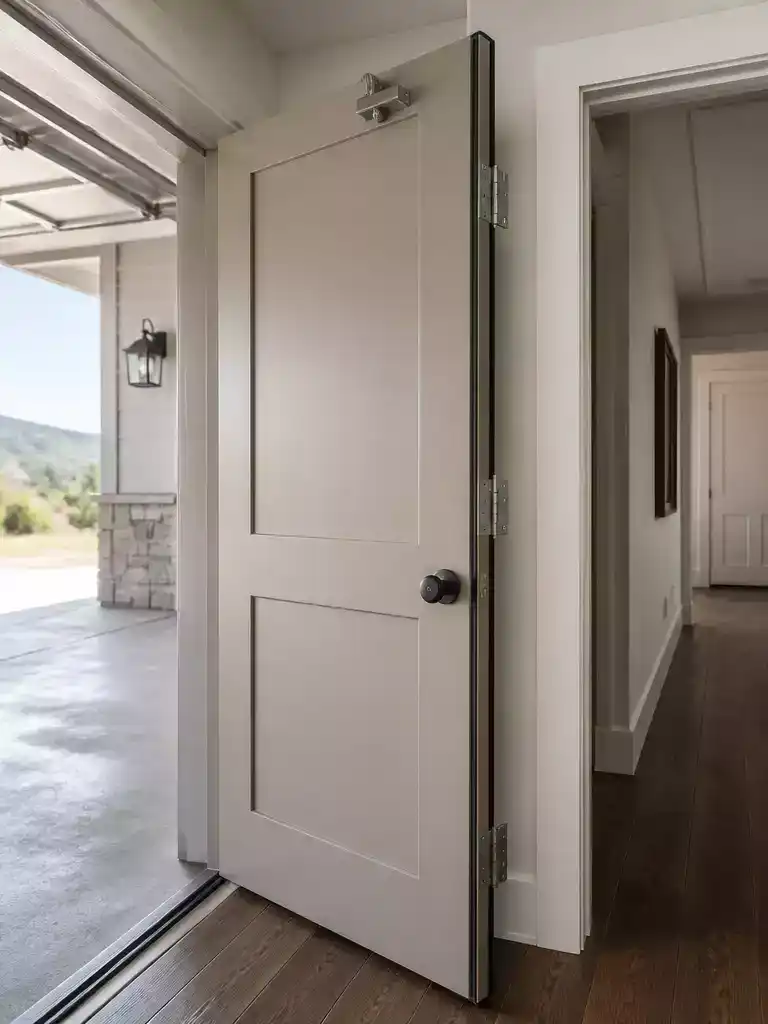
The safety door you forget exists—until those 20 minutes matter more than any design choice.
The door between your garage and kitchen isn’t there for convenience—it’s required by code to hold back flames for at least 20 minutes. And yes, it can now look like a normal Shaker door.
A mineral-based core and intumescent strips that swell with heat seal the gap and buy you escape time. Modern fire-rated doors now come with paint-grade MDF skins, real wood veneers, and even fire-rated glass lites, so you don’t have to stare at an ugly industrial slab.
The label—a metal tag on the hinge edge—must stay visible for inspection. Paint over it, and you’ll fail code. That tag is the only proof the door meets its rating.
⚠️ Three installation moves that void the rating instantly:
- ➖ Trimming more than ⅛” off the top or bottom—any deeper cut breaches the mineral core and kills the fire resistance.
- ➖ Skipping the self-closing hinges—a door that doesn’t latch shut won’t stop smoke, which is the real killer in house fires.
- ➖ Hanging it on a flimsy frame—these doors weigh 80+ lbs and need solid blocking behind every hinge screw.
Self-closing hinges are mandatory. They’re adjustable for tension, so you can dial in a firm latch without the door slamming hard enough to rattle the wall.
Cost runs higher than a standard solid-core door—expect to pay 30-50% more. But the penalty for not having one where code requires it is a failed inspection and a genuinely dangerous condition that no finish upgrade can fix.
Pro tip: If your garage-to-house step-up is taller than standard, order the correct size instead of cutting the door down—a trimmed fire door is no longer rated and will fail inspection. For a premium look, seek out fire-rated doors with a walnut veneer and concealed self-closing pivot hinges. They’re indistinguishable from high-end interior doors and no one will guess it’s a safety device until they spot the label.
Intumescent seals are often built right into the frame or door edge—when heat hits them, they expand to fill the gap and choke off smoke passage. Check that they’re present and intact on any fire-rated door you buy.
Fire-rated doesn’t mean soundproof, though the dense mineral core does dampen more noise than a hollow door. If you’re putting one between a garage and a home office, the added mass is a welcome side benefit.
.
{!output-tips-writer-10}
With ten door types laid out from solid wood to fire-rated, you’ve got a clear lens for privacy, light, and budget. The point isn’t to juggle every option—it’s to zero in on the one or two that solve a room’s biggest friction. Get those right, and the rest feels settled.
The doors that earn their keep in your home are rarely the whole list. Start with the swap that nags at you most daily, and the entry shifts from ordinary to intentional. Explore these room-by-room upgrades to see where a single swap changes everything.