
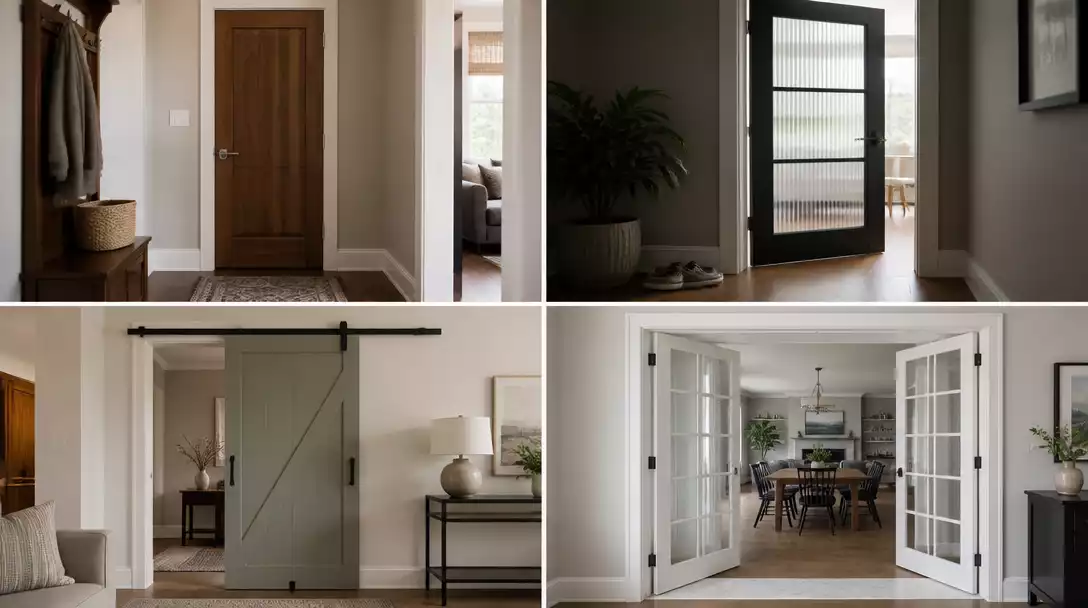
A door is never just a door — the wrong one fights the room’s purpose every day, while the right one solves a problem you stop noticing. This guide unpacks 10 door choices by what actually matters — privacy, durability, light, square footage — so you can pick exactly what each room needs. Starting with the solid wood door that brings real warmth you can refinish for decades.
Solid Wood Doors
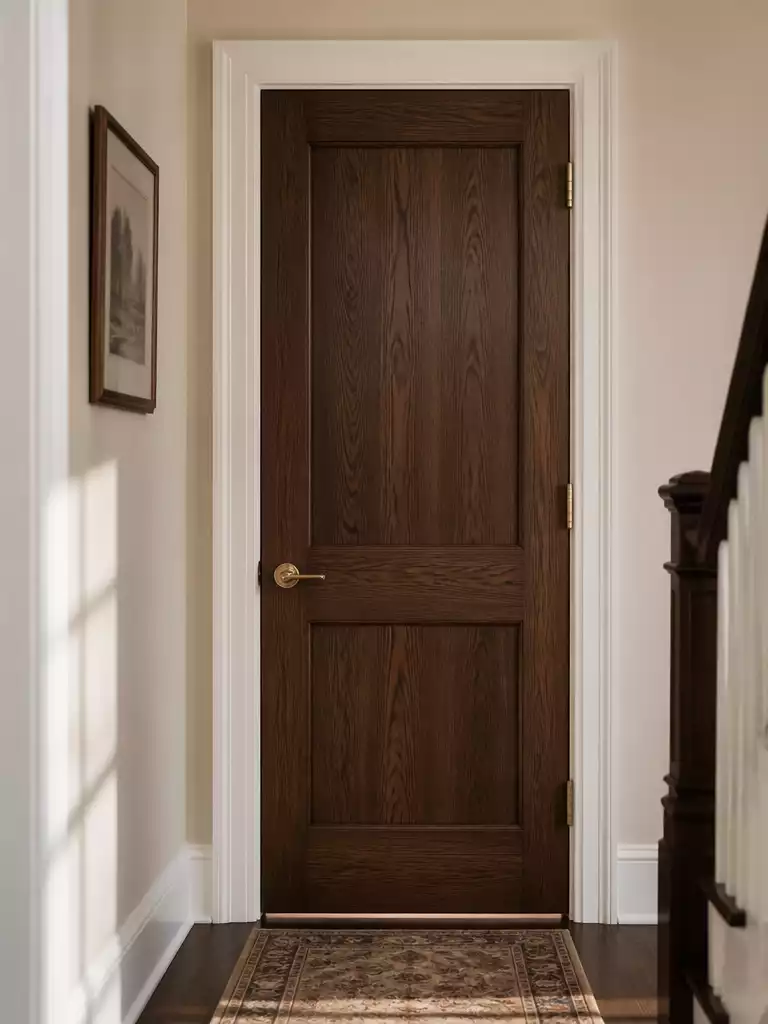
A door with real grain under your hand, built to age deeper and richer with every decade.
As an Amazon Associate I earn from qualifying purchases. Affiliate links may earn me a commission at no extra cost to you.
Run your hand across a solid wood door and your fingertips catch every ridge and valley the saw blade left in the grain — a texture no molded panel or laminate skin even attempts.
That subtle, irregular topography is what makes a solid wood door feel permanently settled into a house rather than simply installed. A hollow-core door gets punctured and you throw it away. A fiberglass skin scuffs into plastic sheen and you live with it. Solid wood, though, is the only interior door you can sand, re-stain, or paint an entirely different color thirty years later without losing its bones.
Take a walnut door: it arrives on day one with a honey-brown glow that reads warm and new. Ten years and one fresh coat of oil later, that same door has deepened to a dark espresso that no factory finish can replicate on a composite core.
That refinishable surface is the entire argument for solid wood. Everything else is a trade-off you need to measure against the room it’s going into.
Cost is the quiet gatekeeper here. An unfinished solid wood slab starts around $250, but a pre-hung hardwood unit with an adjustable threshold can push past $800.
That price tag makes this the door for the long-haul room — the one you plan to live with for twenty years, not the quick flip where someone else will appreciate the patina you paid for.
Pro Tip: Seal It Right the First Time
An oil-based polyurethane soaks down into the wood fibers rather than sitting on top like water-based formulas. That means surface scratches stay invisible longer because there is no plastic skin to scuff white. Also, pre-hung solid wood doors often come with adjustable thresholds — pay for them. They kill drafts and let you tweak the seal as the door settles over the first two years without pulling the entire frame apart.
Three more details that matter once the door is in your hands:
- Plan for three hinges, not two. A solid wood door weighs significantly more than hollow-core — the extra hinge prevents sag that shows up as a dragging corner within the first year.
- Sound dampening is a real upgrade. Solid wood carries an STC rating of 30+ compared to a hollow-core door’s 20. In a bedroom off a living area, that difference is the line between hearing every word of the TV and hearing a muffled murmur.
- Veneer cut changes the look. Plain-sliced veneer gives you long, cathedral grain arches across the face. Rotary-cut veneer produces tighter, repeating grain with less figure. If you want uniform grain across every door in a hallway, specify plain-sliced and buy all slabs from the same flitch.
Here is the image worth pinning: a walnut door at year one — honey-brown, fresh, almost golden in afternoon light — set beside the same door at year ten, now a deep, lived-in espresso that looks like it absorbed a decade of conversation.
No factory finish, no composite core, no shortcut replicates that transformation. That slow color shift is the thing you cannot buy off a shelf — only time and real wood deliver it.
Up next: warmth and patina have no place facing a hailstorm. Steel entry doors take a beating without developing character — and that is exactly the point.
⭐ Top Products for Solid Wood Doors
Vinyl Slide-On Door Bottom for Wood Doors
Door Pivot Hinges for Wood Doors
Pivot Hinge for Heavy Wood Doors
{!output-tips-writer-1}
Steel Entry Doors
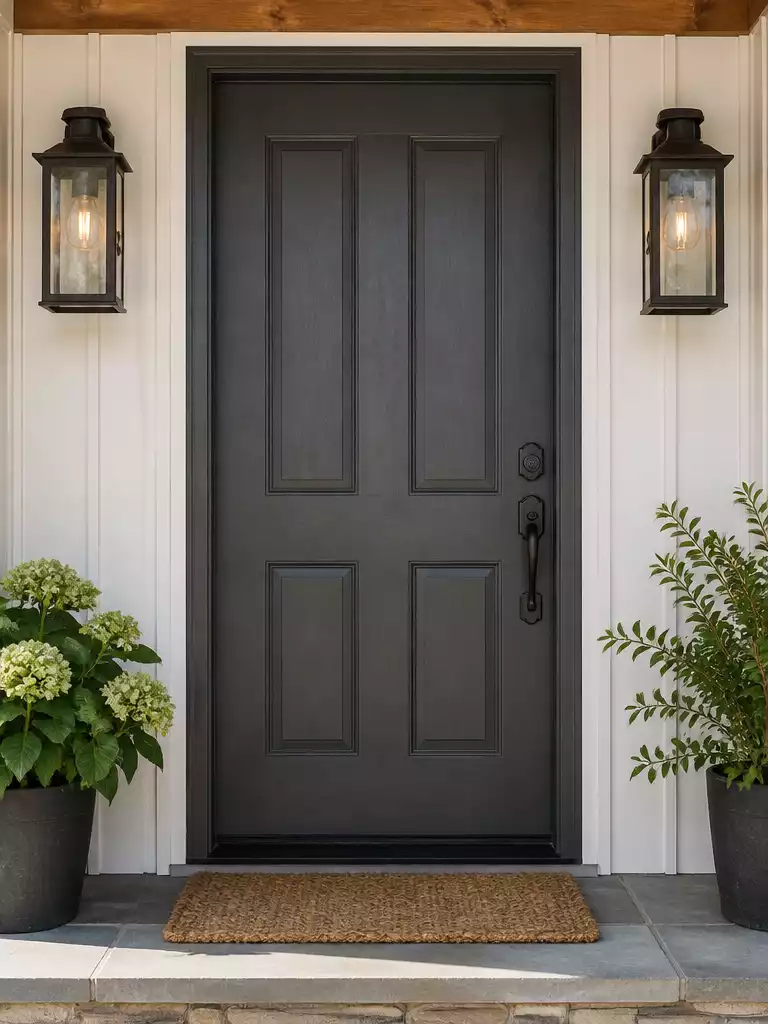
A door that shrugs off delivery truck dings and hail without flinching.
The overnight delivery truck backs into the front door and barely leaves a scuff — steel’s entire personality is that it takes impact without giving way. A 20‑gauge skin holds its shape against a teenager’s bike handle, while a 24‑gauge panel shows a dent on the first clumsy nudge.
Street‑facing in a four‑season climate is where steel outshines every other material. It ignores the rain‑to‑sun temperature jump that twists a wood door, and the foam core kills exterior noise more effectively than solid wood.
Rust Watch: A scratch that reaches bare metal blooms orange within a season — especially near salt spray. Hunt for a factory rust‑inhibitor dip, and keep a zinc‑chromate primer ready for any touch‑up you sand or scuff.
Pro Tip: Field‑drilling for a peephole or lockset breaks the factory paint seal. Coat the raw metal edge with automotive touch‑up paint before mounting hardware, and you’ll never see rust creeping out of the borehole.
Magnetic weatherstripping seals tighter than any compression gasket, keeping the foam core’s R‑value right at the threshold. And since steel accepts a high‑gloss enamel, you can get a wet‑look navy or charcoal finish that stays crisp for years — a level of gloss wood simply can’t hold.
One caution: dark paint on a south‑facing wall absorbs enough heat to warp the steel skin under direct sun. If you want deep black or charcoal, specify a heat‑reflective coating.
Security for the Dollar: An 18‑gauge steel door costs half what a high‑end wood entry costs. A crowbar gives up after twenty seconds of noisy, frustrating work — time enough for an alarm to trip and a neighbor to look.
Steel brings brawn, not grain. When you need the look of wood without surrendering to weather swings, fiberglass picks up right where steel leaves off — a door that fools the eye while surviving worse conditions than steel ever could.
⭐ Top Products for Solid Wood Doors
Vinyl Slide-On Door Bottom for Wood Doors
Door Pivot Hinges for Wood Doors
Pivot Hinge for Heavy Wood Doors
{!output-tips-writer-2}
Fiberglass Doors
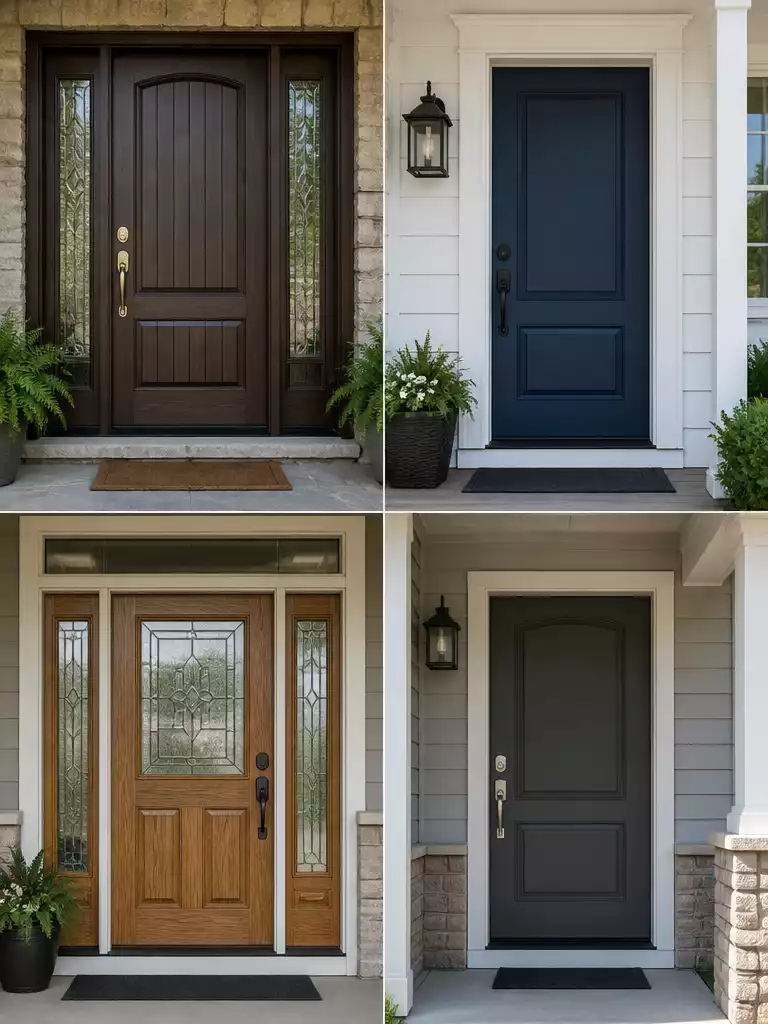
Wood-grain so convincing your neighbors will knock just to touch it.
You want the carved mahogany front door. But you live where the afternoon sun hits 105°F and the humidity swings 40 points between July and January. That’s the exact tension fiberglass doors were engineered to dissolve — they give you the grain without the grief.
The visual deception starts in the factory. Fiberglass skins are cast directly from real wood planks, so the grain is three-dimensional, not a printed decal slapped on a flat sheet. A gel stain settles into the grain valleys and wipes clean from the peaks, exactly like staining actual oak.
From six feet away, nobody can tell it isn’t wood. But unlike wood, this door won’t swell, cup, or split when the seasons turn hostile. That’s not a small perk — it’s the entire reason fiberglass exists as a category.
Climate endurance is where fiberglass genuinely separates from the pack. Stick one on a west-facing wall in Phoenix and it stays dimensionally stable while wood joints tear themselves apart in the dry heat. Park one steps from the Atlantic in a salt-spray zone — no rust blooms, no pitting on the skin.
The polyurethane foam core earns an R-value of 7 to 8, edging out steel and trouncing solid wood, with zero thermal bridging through the skin. That’s real energy math, not brochure fluff. Cost lands between $300 and $1,200 for the slab — pricier than steel, cheaper than a premium hardwood unit, and the expense is in the molding and staining process, not raw material markup.
Pro tip: Two-tone gel stain depth. Apply a base coat of golden oak, then a second pass of dark walnut worked only into the grain crevices using a rag pulled tight. The result is a two-tone depth that stock stain jobs completely miss — and it’s the kind of detail that makes a fiberglass door read as custom millwork.
One caveat worth knowing: fiberglass can be refinished, but only with specific urethane coatings — you can’t sand it down like wood. And a flying stone bounces off a fiberglass skin where it would leave a steel door with a permanent dimple.
This is the door your neighbor stops to tap with a knuckle, convinced it’s real wood. That tactile deception — the solid feel, the visible grain, the total lack of plastic sheen — is exactly what makes fiberglass the savviest compromise in entry doors today.
Quick specs to remember
- Dent resistance is high — impacts bounce instead of dimpling
- Door styles include arched tops and sidelight surrounds for one-piece factory orders
- Factory-applied finishes last longer than field-applied; order pre-finished when possible
- Refinishing requires urethane coatings, not sanding — plan long-term color changes accordingly
⭐ Top Products for Solid Wood Doors
Vinyl Slide-On Door Bottom for Wood Doors
Door Pivot Hinges for Wood Doors
Pivot Hinge for Heavy Wood Doors
{!output-tips-writer-3}
Glass Interior Doors
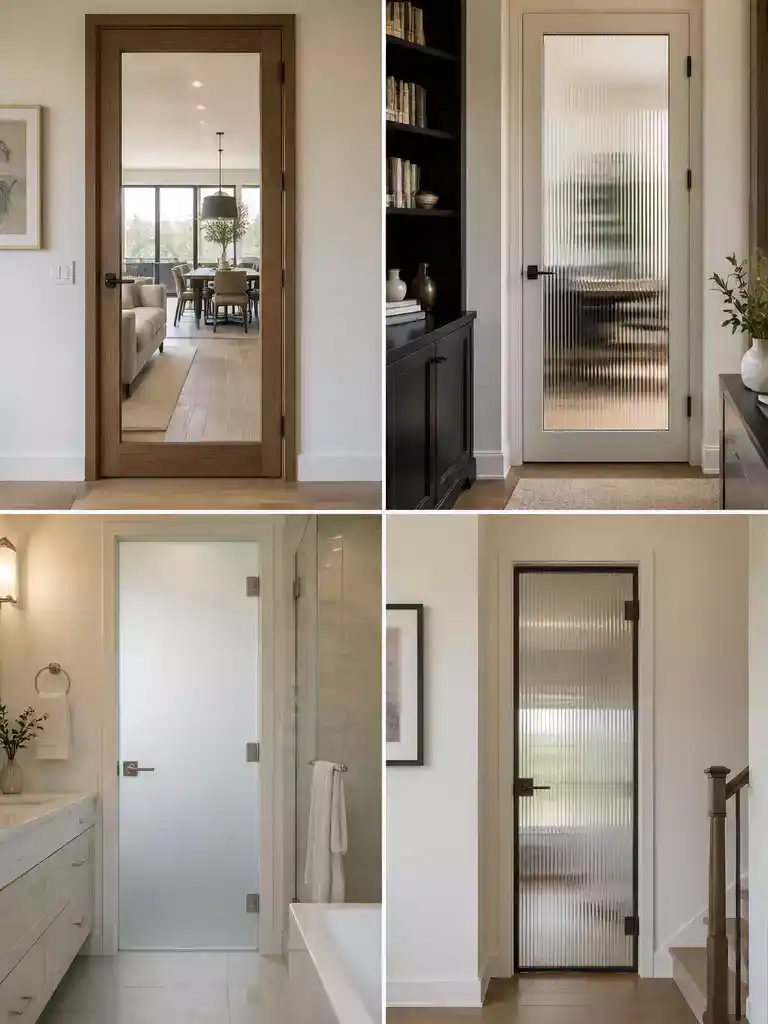
Turn a dim hallway into a sunlit corridor without adding a single fixture.
The dark hallway that never sees natural light from any window. Then a solid door gets replaced with a glass-panel one, and suddenly the entire corridor is lit—no electrician required. A glass interior door is the only option on this list whose primary job is to transfer daylight between rooms while still marking a boundary.
Different glass textures solve different privacy needs. The table below matches each type to its best room, so you can borrow light without giving up the right level of seclusion.
Sound isolation is the honest trade-off. A glass door with a 3/8-inch pane has an STC rating around 27—fine for visual privacy, but a loud conversation will bleed through. If noise is the real concern, step up to laminated glass; it raises the cost but dampens vibration noticeably.
Price sits between $200 and $700 depending on the glass type and frame material. Aluminum frames lean modern and cost less. Wood-wrapped frames read traditional and push the budget higher. The frame width also shifts the whole feel: thin steel-look profiles suit a clean contemporary room, while chunky wood surrounds anchor a classic space.
Pro tip to kill the rattle: Glass interior doors need silicone-based setting blocks at the bottom of the panel. These keep the glass from vibrating against the frame when the door closes—a detail that eliminates the cheap rattle some homeowners complain about on the first day.
Most glass interior doors require a bottom rail to meet building codes for safety glass. And the weight difference matters: a full-glass slab often calls for heavy-duty ball-bearing hinges instead of standard ones, especially on a door that gets daily use.
Pairing a glass door with a transom window above pushes the light-borrowing effect even further. When the door is closed, daylight still passes through the transom into the next room—a trick that makes a windowless interior feel connected to the rest of the house.
Pin This Detail
Reeded glass is the single best texture for a home office door. It blurs shapes without blocking daylight, so a person walking past appears only as a moving shadow, not a visible figure. That one texture choice gives you privacy and light in a single slab—no curtains, no film, no compromise.
Glass gives you light, but what a tight room often needs is every square foot of floor space back. That’s where a door that slides instead of swings comes in.
.
{!output-tips-writer-4}
Scrolling through door types, it’s easy to feel like every room demands a completely different decision. But a door succeeds when it fits the actual conditions it faces daily—and those conditions repeat more than you think.
💡 What Actually Matters Most:
- The door’s swing arc claims floor space—measure your doorway’s clearance before picking any slab.
- A hygrometer reading over 60%? Pick a door built for moisture exposure instead of solid wood.
- Hardware backset must match the pre-drilled bore—getting it wrong means reordering.
Sliding Barn Doors
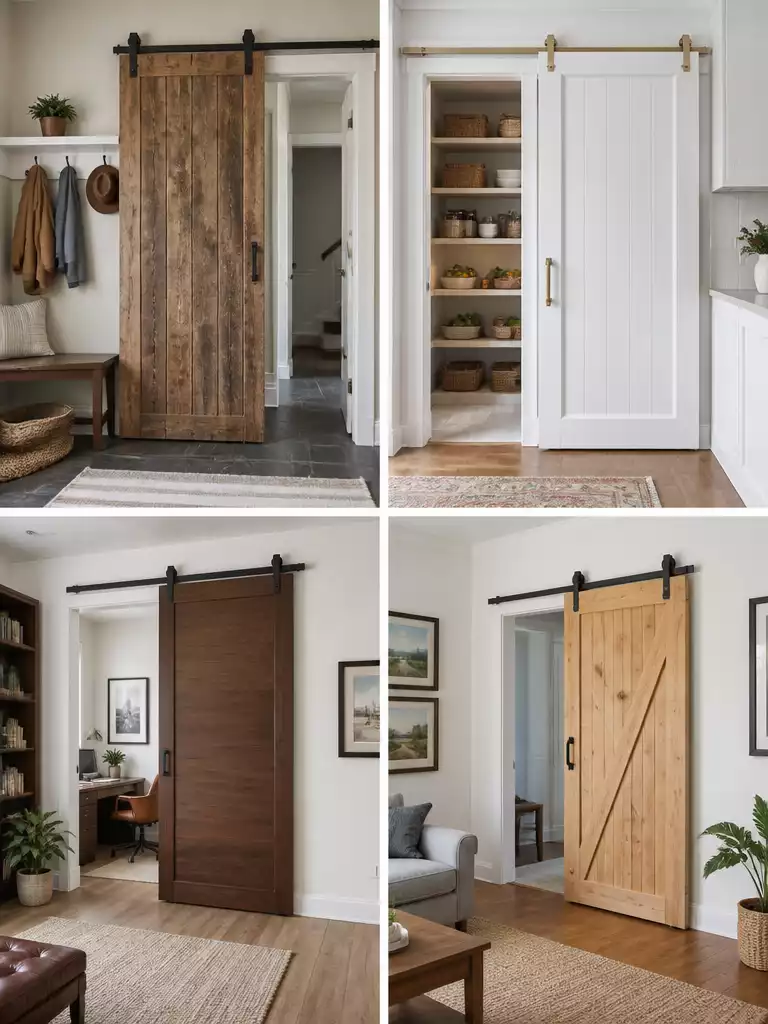
Reclaim every square foot of floor space with a door that glides instead of swings.
That bedroom closet with bifold doors that have been off-track since 2014 — flimsy, always pinching fingers, never closing flush — finally gets replaced by a single slab hanging from a black steel rail.
One fingertip push, and it glides silently across the opening. No arc, no dead zone, no 30-inch semicircle of unusable floor.
The space equation is the only reason to choose a barn door: it frees up the 8 to 10 square feet of floor real estate a swinging door devours.
In a tight pantry or a powder room, that means the difference between a clear walkway and a sideways shuffle every single time.
But the trade-off hits hard on sound and privacy. A barn door hangs a half to three-quarters of an inch off the wall — that gap lets conversation, TV noise, and every drawer opening pour right around the edges.
The latch is cosmetic, not a lock. This is perfect for a mudroom entry or a living-room closet, but a disaster for a bedroom or bathroom where privacy isn’t negotiable.
Hardware is the real cost driver here, not the slab. A soft-close sliding track system runs from $150 to $400, while the door itself can be a salvaged warehouse find for fifty bucks.
The hardware’s finish — matte black, brushed steel, or unlacquered brass — sets the tone for the whole room before the door even moves.
And here’s the design trick most people miss: an oversized, 8-foot black iron rail with exposed stand-off brackets turns a simple door into the room’s anchor piece. Choosing a train-rail-sized track for a modest door reads intentional, not undersized.
Pro Tip: Mount Into Studs, Never Drywall Anchors
A 30-pound slab accelerating on rollers creates a pull-out force that will tear drywall anchors out within months. The fix: screw a 1×4 mounting board into the studs, paint it the wall color so it disappears, then bolt the track directly to that board. The header board distributes the load across multiple studs and gives the track a rock-solid base that won’t budge.
BEFORE YOU HANG IT — THREE NON-NEGOTIABLES
- Install the bottom guide. Without a floor guide or wall-mounted stay roller, the door swings into the drywall every time it passes by — and eventually gouges a groove you can’t hide.
- Oversize the slab by 2-3 inches per side. If your rough opening is 32 inches wide, the door slab should be at least 36 inches to fully block sightlines when closed. Anything narrower leaves a peep-show gap at the edge.
- Match the slab weight to the hardware. Hollow-core slabs slide fine on standard rollers, but a solid wood door needs heavy-duty hangers rated for the load — otherwise the bearings grind down within a year and the glide turns into a shove.
Barn doors save floor space brilliantly, but their hardware always stays visible — the track, the hangers, the stand-offs, all on display.
If the goal is to make a door vanish entirely when it’s open, the solution slides into the wall cavity, not in front of it.
⭐ Top Products for Solid Wood Doors
Vinyl Slide-On Door Bottom for Wood Doors
Door Pivot Hinges for Wood Doors
Pivot Hinge for Heavy Wood Doors
{!output-tips-writer-5}
Pocket Doors
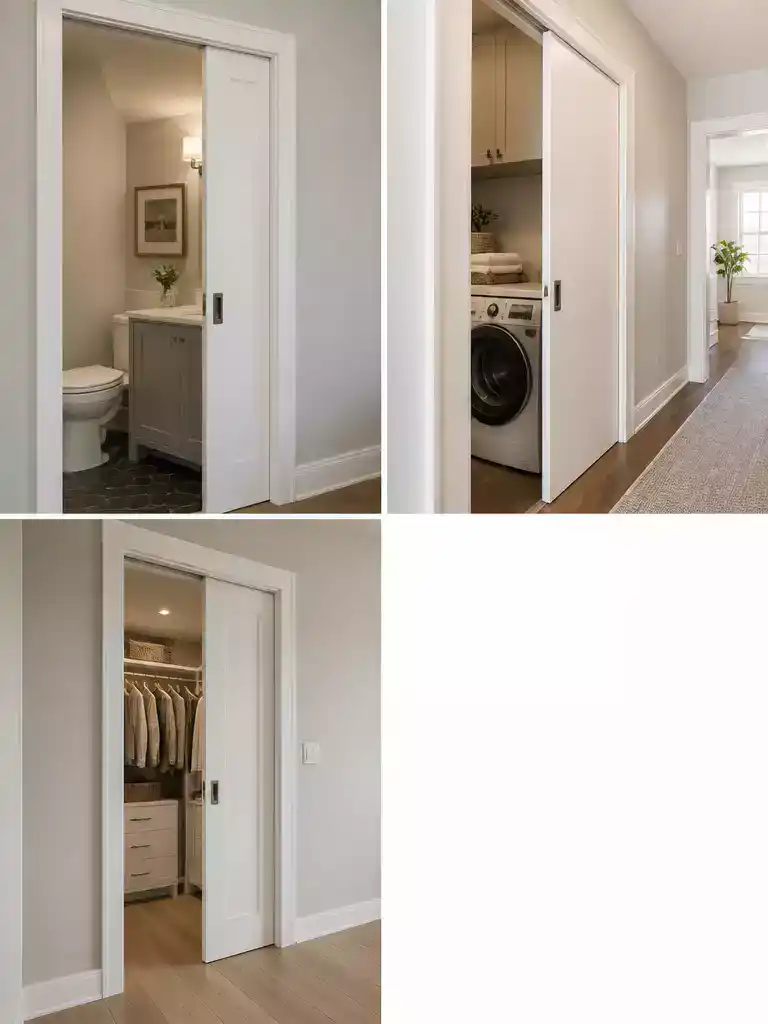
Reclaim every square foot by making the door disappear into the wall entirely.
A half-bath that measures five feet wide has exactly one problem: a 28-inch door swinging inward eats more than half the floor before you’ve even stepped inside.
Replace that door with a pocket door, and the slab slides completely into the wall cavity, leaving the full five feet of open floor untouched.
The pocket door’s entire reason for existing is total disappearance when open.
Unlike a barn door that always displays its slab and hardware against the wall, a pocket door hides inside a split-stud pocket frame, giving back 100% of the swing clearance.
That makes it non-negotiable in laundry nooks, walk-in closets, and tight corridors where any door arc would block traffic.
But that trick comes with a structural catch that catches plenty of DIYers off guard.
The wall containing the pocket cannot house electrical outlets, plumbing pipes, or load-bearing elements running through the cavity.
Here’s what the wall actually needs:
- The pocket frame eats 3–4 inches of wall thickness, so it requires a 2×6 wall or a special slim frame in a 2×4 wall.
- For a load-bearing wall, a beefy header must be installed over the pocket — which means opening the ceiling.
- The track should be accessible from above via the attic for maintenance without demolition later.
Cost is in the labor, not the slab.
The pocket frame kit itself runs $80 to $150, but cutting into a wall, reframing, and patching drywall pushes the total installed cost to $700 to $1,200 for a single door.
The payoff is every square foot reclaimed, and in a 70-square-foot laundry room, that’s nearly 10% of the room given back.
Pro Tip: A soft-close, synchronized slider system like Johnson Hardware’s I-Beam track uses ball-bearing hangers that don’t jump the track, plus an inside-the-pocket bumper that stops the door without slamming. Always specify a solid-core door — hollow-core pocket doors sound tinny and cheap rattling inside the cavity.
The Square-Footage Math Worth Saving: A 30-inch swinging door eats about 6 square feet of floor. A pocket door reclaims that entirely. In a 70-square-foot laundry room, that single change gives back nearly 10% of the room.
Privacy hardware gets limited fast with pocket doors.
You cannot install a deadbolt, so for any room needing real security, use a surface bolt or a privacy latch instead.
And the door slab itself must be 1 inch narrower than the rough opening for the pocket to close flush — a detail that’s easy to miss when ordering.
Pocket doors work brilliantly in half-baths, laundry rooms, and closets where you need the floor space more than a lock.
Skip them for bedrooms and shared bathrooms where sound isolation and deadbolt privacy actually matter — the hollow wall cavity transmits noise more than you’d expect.
While pocket doors vanish for efficiency, some openings demand celebration — a wide, double-door pass-through that makes moving between rooms feel intentional.
.
{!output-tips-writer-6}
French Doors
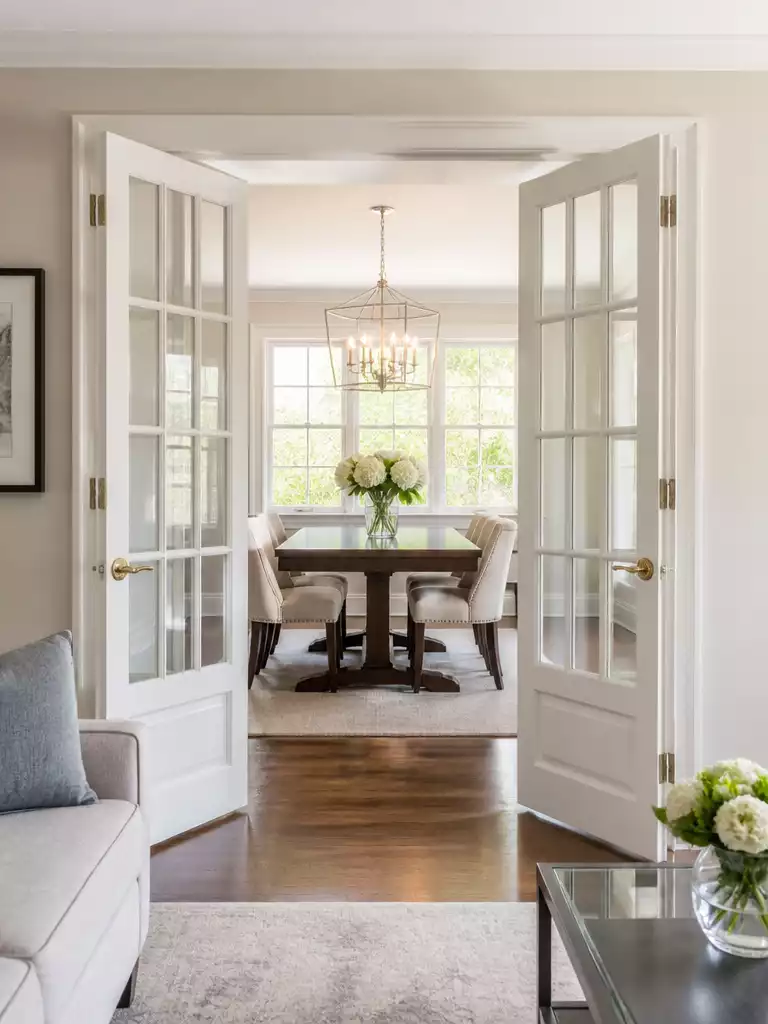
A wide-open passage between rooms that makes entertaining feel effortless and natural.
You swing both leaves wide for a dinner party, and suddenly the threshold between dining room and living room disappears.
15 guests drift through a 5-foot-wide opening instead of funneling through a single door — the space instantly feels connected, not chopped up by walls.
That grand, ceremonial opening is French doors’ entire reason for being.
Two matching doors are hinged on opposite jambs, meeting at the center without a fixed mullion when open, so you get an uninterrupted view and walkway.
Because each leaf carries glass — often divided lites or a single large pane — light pours through even when the doors are closed.
You get the privacy of a solid wall when you need it, and borrowed light the rest of the day — nothing else on this list does both quite the same way.
- • Where they work best: Formal dining rooms, home libraries, sitting rooms off a master suite, and any pair of spaces you want to close off occasionally but open up completely for gatherings.
- • Privacy control: Use aftermarket frosted film, built-in mini-blinds sandwiched between the glass, or floor-to-ceiling drapery to blur sightlines when you don’t want a see-through wall.
- • Space requirement: Each leaf swings, so a 5-foot opening needs 2.5 feet of clear floor on either side — furniture has to live outside that radius, or you’ll be shuffling chairs every time you close the doors.
The floor-space trade-off is non-negotiable.
In a smaller room, that swing can eat the only usable corner, so measure carefully and consider an asymmetrical pair — a wider active leaf and a narrower fixed leaf — to shrink the clearance on one side without sacrificing the grand look.
Pro install precision: The two leaves must be shimmed until the center gap is exactly 1/8 inch top to bottom — any narrower and they’ll bind, any wider and you’ll get light seep.
Use ball-tip catches and flush bolts on the inactive leaf to keep it solidly in place when closed, and pair heavy glass-filled doors with ball-bearing hinges so they never sag.
THE DIMENSION THAT SELLS IT
A 60-inch French door set creates a 58-inch clear pass-through when both sides are thrown open — wide enough to carry a farmhouse table straight through during a move or renovation. That functional grandeur is what makes these doors feel like an architectural event, not just a doorway.
If you’re installing these on an exterior wall, out-swing French doors save interior floor space but need a heavy-duty closer to handle wind gusts.
Inside, a low-profile marble or wood threshold keeps the floor transition nearly seamless while still defining the opening. Skip these entirely if you can’t dedicate the swing clearance — they’ll frustrate you daily.
⭐ Top Products for Solid Wood Doors
Vinyl Slide-On Door Bottom for Wood Doors
Door Pivot Hinges for Wood Doors
Pivot Hinge for Heavy Wood Doors
{!output-tips-writer-7}
Flush Panel Doors
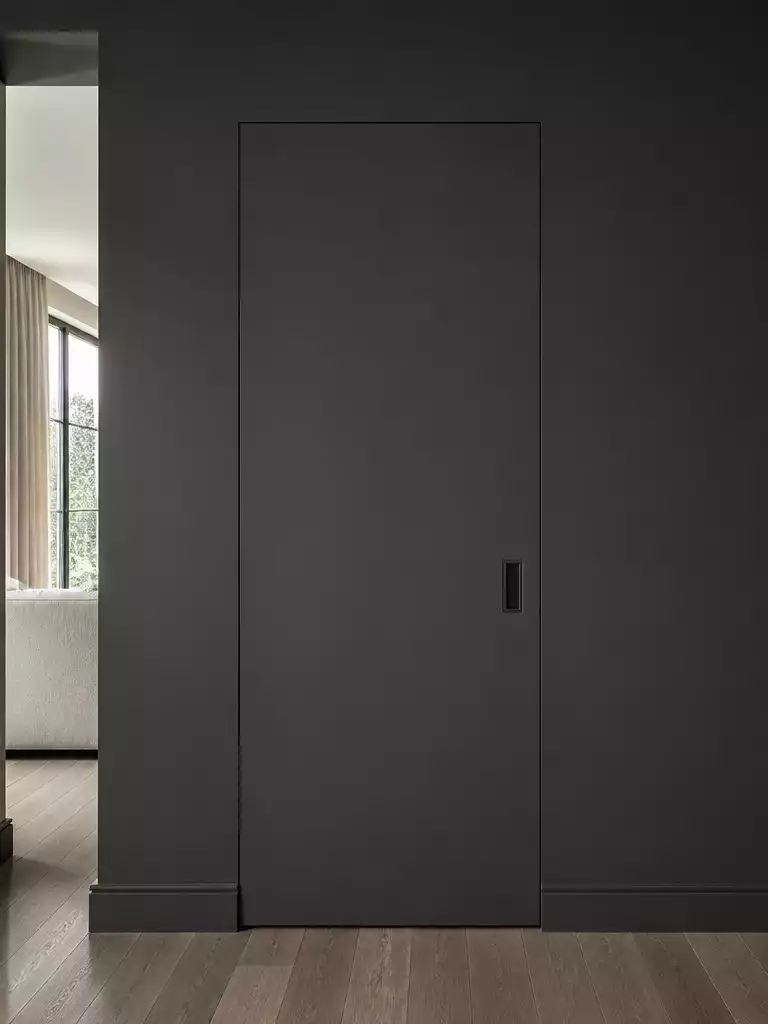
A door that disappears into the wall, letting the room’s architecture take center stage.
Paint a flush door and its surrounding wall the same deep charcoal, and the door practically vanishes.
No raised panels, no beveled edges, no moldings — just a smooth, uninterrupted slab that refuses to compete for attention.
That’s the entire point of a flush panel door. It’s the quietest visual statement in the house, and for anyone chasing a clean, modern interior, it’s the only door that makes sense.
Where a paneled door announces itself with shadows and lines, a flush door steps back and lets the room’s lighting, furniture, or art do the talking.
Minimalist architects reach for this door specifically because it reads as architecture, not decoration.
Hardware makes or breaks the vanishing act. Concealed SOSS hinges, a magnetic latch, and a flush pull in matte black let the door sit completely flat with no projecting knobs or levers.
The result is a door that reads as a seam in the wall — not a doorway until you push on it.
Mortise and flush pulls are non-negotiable here; a standard lever or knob instantly ruins the flush-plane illusion.
Pro Tip: Solid Core, Three Hinges, and MR Substrate
A solid-core flush door — particleboard inside — weighs significantly more than hollow but gives you real sound insulation and a substantial feel when it closes.
That weight demands three hinges, not two, or the door will sag within a year.
For bathrooms, laundry rooms, or any damp zone, specify MR (moisture-resistant) MDF substrate — standard MDF swells and crumbles at the edges when humidity creeps in.
If you want the full disappearing-door recipe that designers pin over and over, here it is: Benjamin Moore’s “Graphite” in matte on both the door and the wall, paired with SOSS invisible hinges and a flush pull in matching matte black.
From across the room, only a hairline shadow gives away that the door exists.
Flush doors also happen to be the easiest type to wrap in wallpaper for a fully camouflaged accent — the flat surface takes adhesive without fighting panel grooves.
Standard flush slabs come 1-3/8 inches thick, but upgrading to 1-3/4 inches noticeably improves sound performance, especially in a bedroom or home office.
And unlike hollow-core doors, a solid-core flush door can be cut down in width if the core runs all the way through — a rare flexibility that saves you from custom-order delays.
⭐ Top Products for Solid Wood Doors
Vinyl Slide-On Door Bottom for Wood Doors
Door Pivot Hinges for Wood Doors
Pivot Hinge for Heavy Wood Doors
{!output-tips-writer-8}
Dutch Doors
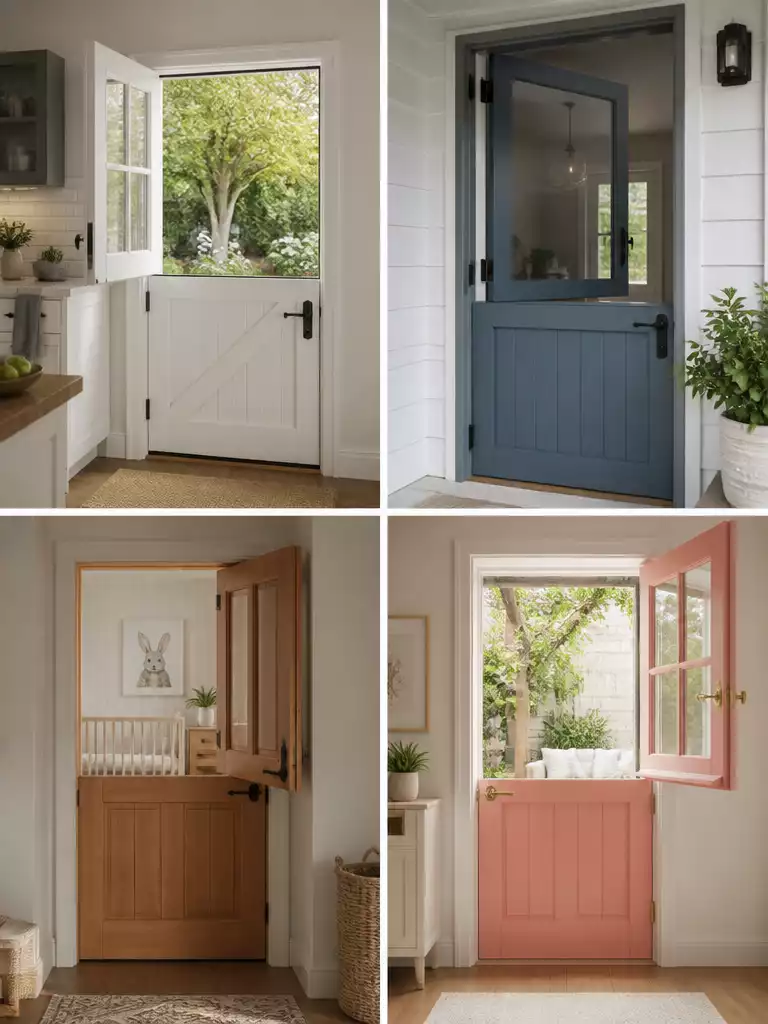
Let in the breeze while keeping the dog in — the door that splits a room in half and solves everything.
It’s Sunday morning, the kitchen door’s bottom half stays latched so the dog can’t escape, while the top half swings wide open to let in the smell of fresh-cut grass and a cross-breeze. The house breathes, and the baby gate disappears.
The horizontal split is the whole point. The door is sawn in two, with a shelf-like meeting rail where the halves either latch together or release independently, turning one door into a half-wall window, a vented barrier, and a standard closure all at once.
That solves a strangely specific problem: connecting indoors to outdoors without surrendering pet or child containment. A Dutch door works exactly where you want air and sound to pass through, but need to block small creatures — kitchen to back patio, mudroom to yard, a nursery that needs cross-ventilation, or a laundry room that gets stuffy.
The Instagram-ready version: a Dutch door painted Farrow & Ball “Setting Plaster” pink, top half open to a garden view with a child leaning on the bottom rail — pure nostalgia with a practical side.
The upper half can hold glass panes for borrowed light or stay solid for full privacy. Expect to pay for the clever engineering: custom Dutch doors run $800 to $1,500 because of the precise split alignment, a heavy-duty quad-hinge system that bears both leaves, and the specialized latch that locks the halves together.
A few pre-hung exterior fiberglass Dutch doors from companies like Therma-Tru drop that to $500–$700, which is a steal for the breeze-and-barrier combo. Either way, don’t skip the coordinated threshold and bottom sweep — without them, the gap under a Dutch door becomes a draft tunnel.
Pro tip on the center seam: An exterior Dutch door absolutely needs a rabbit joint — a tongue that overlaps into a groove — packed with a silicone bulb weatherstrip. Otherwise, wind-driven rain blows straight through the middle. Inside, a felt pad on the meeting rail kills the rattle when the halves vibrate.
- Quad hinges: Four hinges on one side are non-negotiable — the weight of both leaves will sag a three-hinge setup within a year.
- Retractable screen: Adding a top-half screen keeps bugs out when the upper door is open, no permanent frame needed.
- Sealed threshold: A coordinated threshold and door bottom sweep work together to stop air leakage under the split when the door is fully closed.
For all the personality and breeze of a Dutch door, there’s one door you don’t choose for personality at all — it’s chosen for you by building code, and getting it right is non-negotiable.
⭐ Top Products for Solid Wood Doors
Vinyl Slide-On Door Bottom for Wood Doors
Door Pivot Hinges for Wood Doors
Pivot Hinge for Heavy Wood Doors
{!output-tips-writer-9}
Fire Rated Doors
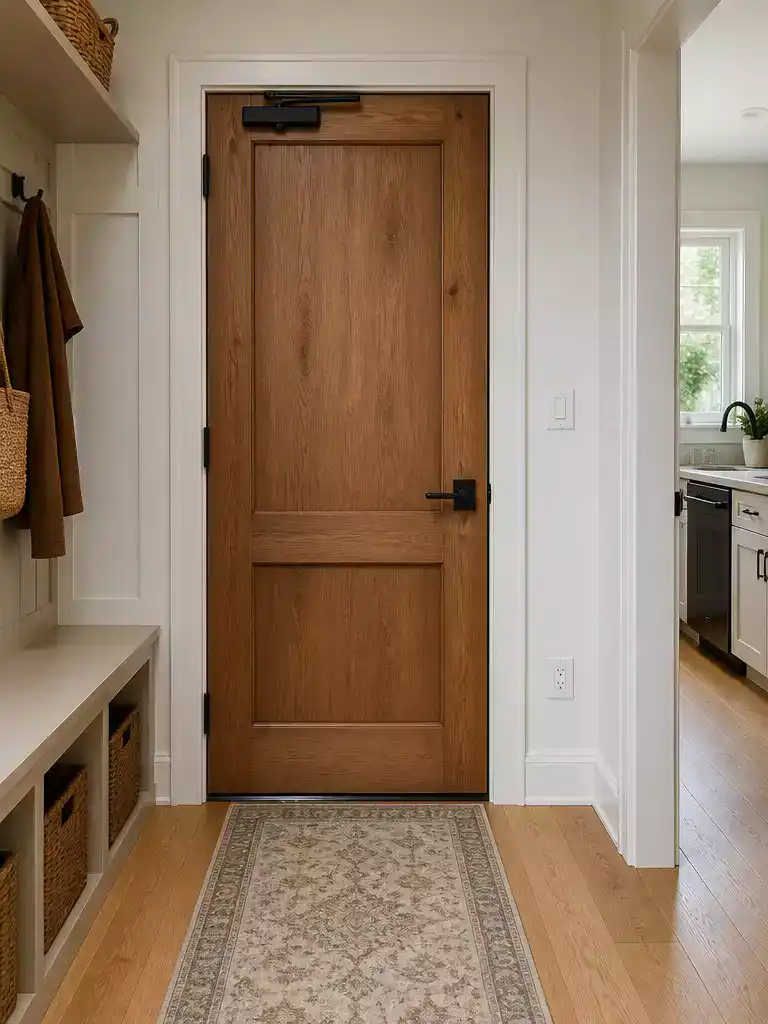
The wood door that quietly protects — a fire-rated look no guest will suspect.
You spot it only when the door is open: a small stamp on the top edge that reads “20-MINUTE FIRE RATED” next to a testing agency mark.
That stamp is the entire reason this door exists, not a style choice.
A fire-rated door’s sole job is to compartmentalize a blaze for a code-dictated period — typically 20 minutes for an attached garage-to-house connection, 45 to 60 minutes between multi-unit dwellings.
Inside, a mineral-based core (gypsum or vermiculite) releases water vapor under heat, slowing temperature rise long enough for you to get out.
Per the International Residential Code, it must be self-closing and self-latching — no exceptions.
The slab alone runs $200–$500, but the full installed cost including a fall‑away closer and smoke seals often tops $600.
Skip this door between the garage and living space, and you are not just breaking code — you could void your homeowners insurance after a fire.
Here’s the part most people don’t realize: today’s wood‑veneered fire doors look identical to a standard solid wood door, with the only giveaway being a thin intumescent seal strip tucked into the frame.
That strip stays hidden until heat makes it expand, sealing the gap against smoke and flame.
A 20‑minute rated wood door can match the rest of your interior doors perfectly — nobody notices the safety until it matters.
Pro tip: tame the closer, don’t disable it. Many homeowners unhook the closer because it slams.
Adjust the sweep speed on the cylinder and the latch speed on the separate valve until the door swings shut in about five seconds and latches without a bang.
A gentle, quiet close is completely achievable — and it keeps the door code‑compliant.
Three Non-Negotiables
- Label stays put. The fire‑rating label must remain on the door’s top edge. Removing it voids the rating instantly — no matter what the door is made of.
- Minimum 1‑3/4 inches thick. Fire‑rated doors are noticeably heavier than standard 1‑3/8‑inch interior slabs; plan for three hinges and a solid frame.
- The frame must be rated too. A rated door in an unrated frame is not code‑compliant. Use a steel frame or a wood frame with intumescent seals.
That subtle black intumescent seal around the door frame is the hidden safety line most people never see — and precisely the detail worth saving for your next project.
.
{!output-tips-writer-10}
You’ve now walked through ten distinct door solutions, from solid wood’s warmth to fire-rated necessity. But a house doesn’t need every option — a couple of right calls carry the whole entry. Start with the one or two doors that match the rooms you use most, and the rest can follow when you’re ready.
For front entries especially, the right piece sets the tone — our breakdown of doors that improve style, security, and function helps you land on the one that fits. Pick the door that solves today’s biggest friction, and the rest is just refining.